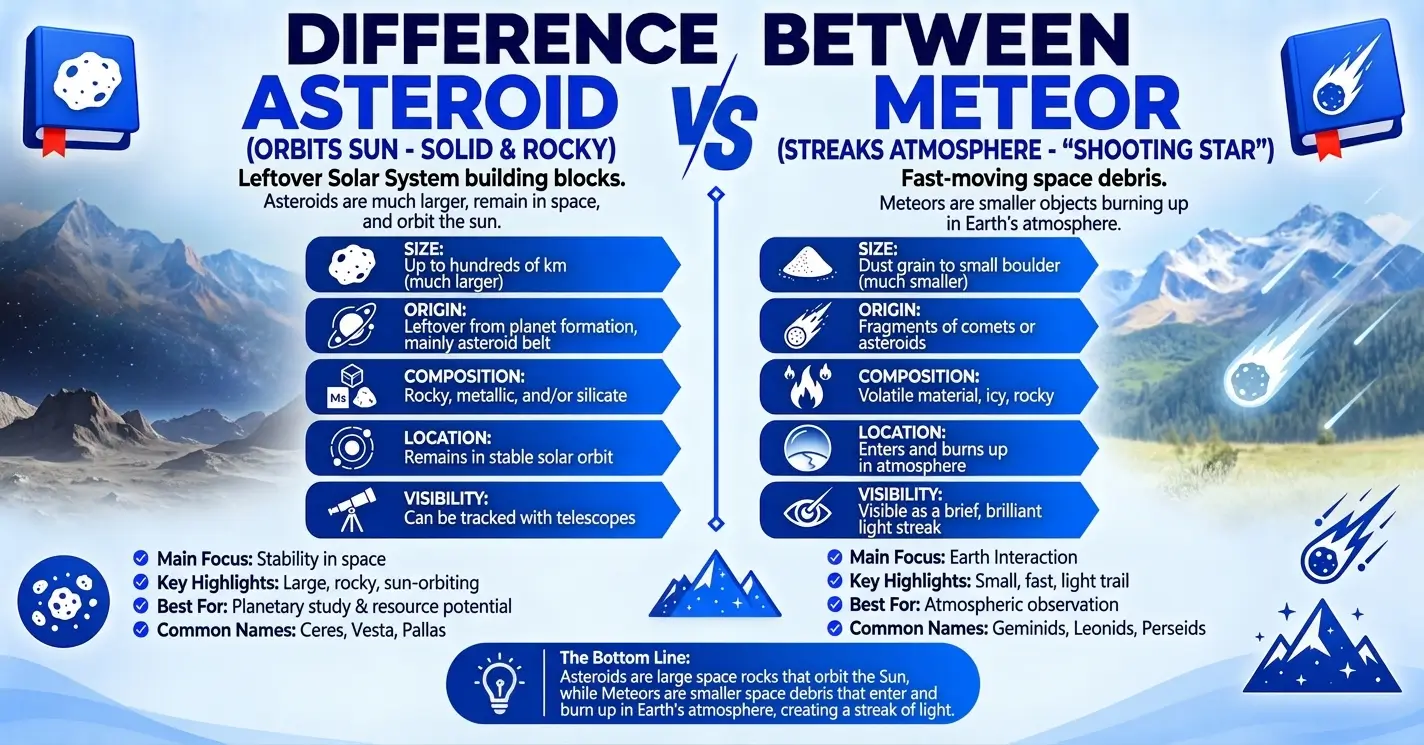

Asteroids and meteors are both associated with objects from space, but the two terms do not describe the same thing. An asteroid is a physical body in space that orbits the Sun, while a meteor is the visible light and related atmospheric phenomenon produced when material from space enters an atmosphere at high speed.
The confusion becomes easier to resolve when you add a third term: meteoroid. A meteoroid is the smaller natural space object that can produce a meteor when it enters Earth’s atmosphere. If some of that material survives and reaches the ground, it is called a meteorite.
Quick Answer
An asteroid is a rocky or metallic object that orbits the Sun, while a meteor is the streak of light and associated atmospheric effects produced when a solid object from space enters an atmosphere.
The key difference is therefore not simply size. Asteroid describes a space object; meteor describes an atmospheric phenomenon. A meteoroid is normally the solid object producing the meteor.
Asteroid vs Meteor at a Glance
| Feature | Asteroid | Meteor |
|---|---|---|
| What it is | A physical space object | A light and atmospheric phenomenon |
| Where it is normally discussed | In space | In an atmosphere |
| Main relationship | Orbits the Sun | Produced during atmospheric entry |
| Material | Generally rocky, metallic or carbon-rich | Produced by an entering solid object |
| Can you see it? | Usually observed with astronomical instruments; some can be seen indirectly | Often visible as a streak or flash of light |
| Common expression | Space rock | “Shooting star” |
| Related term | Meteoroids can come from asteroids | Meteoroids produce meteors |
| If material reaches the ground | — | Surviving material is a meteorite |
NASA describes asteroids as relatively small, inactive bodies orbiting the Sun, while a meteor is the light phenomenon produced when a meteoroid enters an atmosphere.
What Is an Asteroid?
An asteroid is a relatively small rocky body that orbits the Sun. Asteroids can contain rock, metal, dust or combinations of these materials, and they range from relatively small bodies to objects hundreds of kilometers across.
Many asteroids are located in the main asteroid belt between Mars and Jupiter, although asteroids also occur elsewhere, including in orbits that bring some of them into Earth’s neighborhood.
For example:
Scientists are tracking an asteroid that will pass relatively close to Earth.
Here, asteroid refers to the physical object itself.
Asteroids are remnants of material left over from the formation of the solar system, so studying them can provide information about the early solar system.
Important point about size
It is tempting to define the difference as:
asteroid = large
meteor = small
That is not technically accurate.
A meteor is not primarily a size category. The International Astronomical Union defines a meteor as the light and associated physical phenomena resulting from the high-speed entry of a solid object from space into a gaseous atmosphere.
Size can help distinguish asteroids from smaller objects such as meteoroids, but it does not define what a meteor is.
What Is a Meteor?
A meteor is the visible atmospheric phenomenon produced when a solid object from space enters an atmosphere at high speed.
The streak of light commonly called a shooting star is a meteor. It is not an actual star, and technically the word meteor refers to the luminous phenomenon rather than simply the solid piece of rock traveling through space.
For example:
We saw a bright meteor streak across the night sky.
The thing you see is the meteor—the light and associated atmospheric effects.
The solid object responsible for the phenomenon is generally a meteoroid while it is traveling through interplanetary space or through the atmosphere.
What Is the Main Difference Between an Asteroid and a Meteor?
The simplest distinction is:
An asteroid is an object. A meteor is an atmospheric phenomenon.
An asteroid exists as a physical body orbiting the Sun. A meteor occurs when solid material from space interacts with an atmosphere at high speed and produces light and other physical effects.
This distinction is important because saying that “a meteor is a small asteroid” is misleading. The object responsible for an ordinary meteor is more precisely called a meteoroid.
There is another important nuance: the IAU notes that a meteor phenomenon can be produced not only by a meteoroid but also by an asteroid, comet, or other solid object with the appropriate combination of mass, speed and atmospheric conditions.
So the relationship is better represented as:
Asteroid → may produce smaller fragments → meteoroids → atmospheric entry → meteor
But an asteroid can also enter an atmosphere directly and produce a meteor phenomenon.
Where Does a Meteoroid Fit In?
The word meteoroid is the missing link between asteroid and meteor.
A meteoroid is a small natural solid object moving through or coming from interplanetary space. Meteoroids can originate from asteroids, comets and other natural bodies. The IAU currently describes meteoroids as roughly 30 micrometers to 1 meter in size, while also emphasizing that the size boundary is an agreed convention rather than a sharp physical boundary.
NASA likewise describes meteoroids as small particles or space rocks and notes that many originate from comets or asteroids.
This gives you a useful terminology chain:
Asteroid: a larger space body orbiting the Sun.
Meteoroid: a smaller natural object traveling through space.
Meteor: the light and associated phenomenon created during atmospheric entry.
Meteorite: material that survives the atmospheric passage and reaches the ground.
What Happens When a Space Rock Enters Earth’s Atmosphere?
The terminology changes according to what is happening.
- A solid object is traveling through space.
- If it fits the relevant category, it may be called a meteoroid.
- It enters Earth’s atmosphere at high speed.
- The atmospheric interaction produces heat, light, ionization and other effects.
- The visible phenomenon is called a meteor.
- If solid material survives the meteor phase and reaches the surface, it is called a meteorite.
This is why “meteor,” “meteoroid” and “meteorite” should not be treated as interchangeable terms.
When to Use “Asteroid”
Use asteroid when you are referring to a physical rocky or metallic body orbiting the Sun.
Examples:
- Astronomers discovered a new asteroid.
- The spacecraft is studying an asteroid.
- Many asteroids orbit in the main asteroid belt.
- Scientists are monitoring a near-Earth asteroid.
In each example, the word refers to the space object itself.
When to Use “Meteor”
Use meteor when you are referring to the luminous atmospheric phenomenon produced during high-speed entry.
Examples:
- I saw a meteor last night.
- The meteor disappeared within a few seconds.
- Several meteors were visible during the meteor shower.
- The bright meteor was visible across a large part of the sky.
If you mean the solid object still traveling through space, meteoroid is generally the more precise term.
Asteroid, Meteoroid, Meteor and Meteorite in Sentences
Asteroid
The asteroid is orbiting the Sun.
The sentence describes a physical object in space.
Meteoroid
A meteoroid entered Earth’s atmosphere at high speed.
The sentence identifies the solid object responsible for the atmospheric event.
Meteor
The meteor produced a bright streak across the sky.
The sentence describes the light and atmospheric phenomenon.
Meteorite
Scientists recovered a meteorite from the ground.
The sentence describes material that survived the atmospheric passage and reached the surface.
This four-term distinction is more useful than simply memorizing “asteroid vs meteor.”
Common Mistakes With Asteroid and Meteor
Mistake 1: Calling the rock itself a meteor
Incorrect:
A meteor is a rock flying through space.
Better:
A meteoroid is the solid object traveling through space; a meteor is the light and associated atmospheric phenomenon produced when it enters an atmosphere.
The IAU specifically distinguishes the meteor phenomenon from the solid object producing it.
Mistake 2: Saying every meteor comes from an asteroid
Incorrect:
Every meteor is caused by a piece of an asteroid.
Better:
Meteors can be produced by meteoroids originating from asteroids or comets, and larger solid bodies can also produce meteor phenomena.
NASA and the IAU both recognize multiple possible sources.
Mistake 3: Calling a rock on the ground a meteor
Incorrect:
Scientists found a meteor on the ground.
Better:
Scientists found a meteorite on the ground.
A meteorite is material that survives the atmospheric passage and reaches the surface.
Mistake 4: Saying meteors are stars
Incorrect:
A shooting star is a small star falling toward Earth.
Correct:
A shooting star is the popular name for a meteor.
No actual star is involved.
Commonly Confused Terms
| Term | Meaning |
|---|---|
| Asteroid | A relatively small body orbiting the Sun |
| Meteoroid | A small natural solid object moving through interplanetary space |
| Meteor | Light and associated atmospheric phenomena from high-speed entry |
| Meteorite | Natural material that survives atmospheric passage and reaches a surface |
| Comet | A small solar-system body containing significant volatile material such as ice |
The most important distinction is between meteor and meteoroid: one describes the atmospheric phenomenon, while the other describes the solid object.
Can an Asteroid Become a Meteor?
This question needs a careful answer.
In everyday educational language, you may see statements saying that an asteroid “becomes” a meteor when it enters Earth’s atmosphere. This is a useful simplification, but it is not the most technically precise wording.
The IAU defines meteor as the light and associated physical phenomena created during atmospheric entry. The physical object remains a solid body moving through the atmosphere; depending on its characteristics and terminology being used, it may be an asteroid or meteoroid.
So a better rule is:
An asteroid can produce a meteor when it enters an atmosphere, but “meteor” technically names the atmospheric phenomenon, not simply the rock.
Common Collocations
Knowing common word combinations makes it easier to recognize how these terms are normally used.
With “asteroid”
Common combinations include asteroid belt, asteroid impact, asteroid surface, asteroid mission, near-Earth asteroid, asteroid collision, asteroid detection, and asteroid fragment.
With “meteor”
Common combinations include meteor shower, meteor streak, meteor trail, bright meteor, meteor observation, meteor event, and fireball.
With “meteoroid”
You will commonly see phrases such as meteoroid enters the atmosphere, meteoroid fragment, meteoroid stream, and meteoroid particle.
With “meteorite”
Common combinations include meteorite fragment, meteorite fall, meteorite impact, meteorite sample, and meteorite collection.
These phrases show how each term is commonly used in scientific and general English.
Are Asteroid and Meteor Interchangeable?
No.
They describe different concepts.
- Use asteroid for the physical space body.
- Use meteor for the atmospheric light phenomenon.
- Use meteoroid for the small natural object traveling through space or entering an atmosphere.
- Use meteorite for material that survives and reaches the ground.
Calling a meteor an asteroid, or calling an asteroid a meteor, can therefore change the meaning of the sentence.
How to Remember the Difference
Use this simple rule:
Asteroid = object in space.
Meteor = light in the atmosphere.
Then remember the middle and final stages:
Meteoroid = object before/during atmospheric entry.
Meteorite = material that makes it to the ground.
An even shorter memory chain is:
Space → Atmosphere → Ground
Meteoroid → Meteor → Meteorite
An asteroid is a related, generally larger solar-system body that can be a source of meteoroids or can itself produce a meteor phenomenon during atmospheric entry.
Which One Should I Use?
Choose asteroid when you are talking about a rocky or metallic body that orbits the Sun.
The term meteoroid refers to a smaller natural solid object traveling through space.
When you mean the bright phenomenon created as space material passes through an atmosphere, the correct term is meteor.
Finally, meteorite describes material that survives its passage through the atmosphere and reaches the ground.
Quick decision rule
Is it a physical object orbiting in space? → Asteroid or meteoroid, depending on the object and terminology.
Are you describing the streak of light in the sky? → Meteor
Did a piece survive and reach the ground? → Meteorite
Asteroid or Meteor? Practice Examples
Choose asteroid, meteoroid, meteor, or meteorite.
- Scientists are tracking a rocky body orbiting the Sun.
- A small natural particle is traveling through interplanetary space.
- A bright streak suddenly appeared across the night sky.
- Scientists recovered a fragment of extraterrestrial rock from the ground.
- Several bright streaks appeared during a meteor shower.
- A spacecraft is approaching a rocky body in the asteroid belt.
- A small fragment from a larger space body enters Earth’s atmosphere.
- The surviving rock was collected after the atmospheric event.
Answers
- Asteroid
- Meteoroid
- Meteor
- Meteorite
- Meteor
- Asteroid
- Meteoroid — before describing the atmospheric phenomenon
- Meteorite
Frequently Asked Questions
What is the difference between an asteroid and a meteor?
An asteroid is a physical rocky or metallic body orbiting the Sun. A meteor is the light and associated atmospheric phenomenon produced when solid material from space enters an atmosphere at high speed.
Is a meteor a rock?
Not technically. The rock or solid object producing the phenomenon is generally called a meteoroid. A meteor refers to the light and related atmospheric effects produced during entry.
Is a shooting star a meteor?
Yes. “Shooting star” is a popular name for a meteor, although a meteor has nothing to do with an actual star.
What is a meteoroid?
A meteoroid is a small natural solid object traveling through or coming from interplanetary space. Meteoroids can originate from asteroids, comets and other natural bodies.
What is a meteorite?
A meteorite is natural solid material that survives the meteor phase without being completely vaporized and reaches a surface. On Earth, this means material that makes it to the ground.
Can an asteroid cause a meteor?
Yes. The IAU notes that a meteor phenomenon can be produced by an asteroid, comet, meteoroid or another solid object when the entry conditions are appropriate.
Are asteroids bigger than meteoroids?
Generally, asteroids are larger than objects classified as meteoroids, but the boundary is not a perfectly sharp physical division. The IAU uses an approximate size range for meteoroids, and scientific definitions have evolved over time.
Does every meteor become a meteorite?
No. Much of the incoming material is destroyed or vaporized during atmospheric entry. A meteorite is the material that survives the meteor phase and reaches the ground.
Conclusion
The main difference between an asteroid and a meteor is that they describe different things. An asteroid is a physical space body that orbits the Sun, while a meteor is the light and associated atmospheric phenomenon produced when solid material from space enters an atmosphere.
For everyday accuracy, remember the terminology chain: meteoroid in space, meteor during atmospheric entry, and meteorite if material survives to the ground. An asteroid can be a source of meteoroids and can also produce a meteor phenomenon if it enters an atmosphere.
Practical rule: asteroid = space object; meteor = atmospheric light phenomenon.

Sajid Ali is an English language educator and content specialist with 7+ years of teaching experience. He holds master’s degrees in Information Technology and Education from the Virtual University of Pakistan and writes SEO-optimized, learner-friendly vocabulary content for diffari.com.