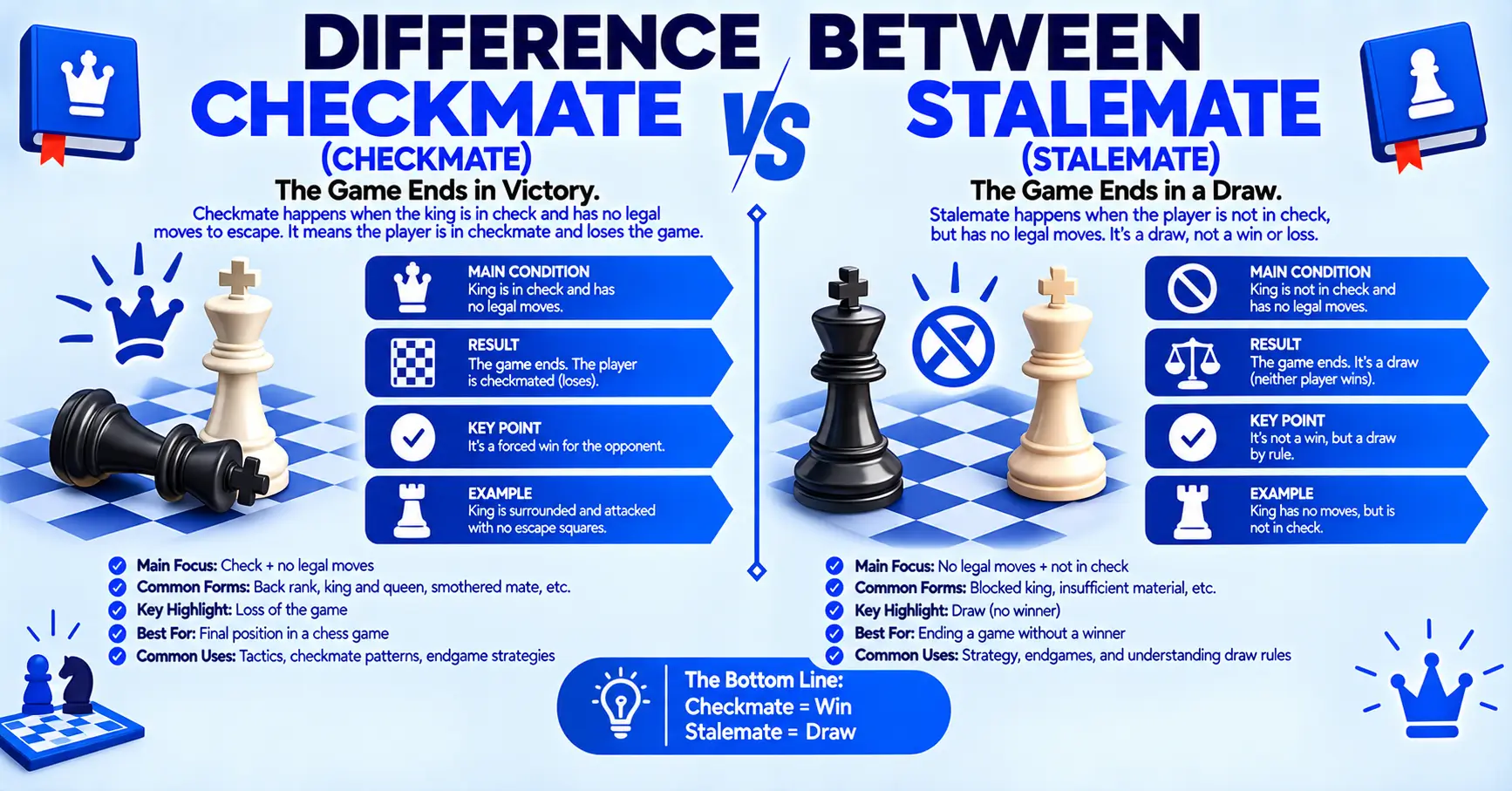
In chess, checkmate and stalemate both occur when the player to move has no legal move, but they have completely different results. Checkmate means the king is in check and cannot escape, so that player loses. Stalemate means the king is not in check and the player has no legal move, so the game is drawn. The easiest way to distinguish them is to check the king’s status first: is it under attack or not?
Quick Answer
Checkmate occurs when a player’s king is in check and there is no legal way to escape the attack. The player whose king is checkmated loses the game.
Stalemate occurs when the player to move has no legal move, but their king is not in check. The result is a draw.
The easiest rule to remember is:
In check + no legal move = checkmate.
Not in check + no legal move = stalemate.
That single distinction separates a win from a draw.
Checkmate vs Stalemate at a Glance
| Feature | Checkmate | Stalemate |
| King in check? | Yes | No |
| Player has a legal move? | No | No |
| Game result | Loss for the player in checkmate | Draw |
| Does the game end immediately? | Yes | Yes |
| Main issue | The king is under unavoidable attack | The player has no legal move despite not being in check |
| Typical beginner mistake | Missing an available defense | Accidentally removing every legal move without giving check |
Under the Laws of Chess, checkmate wins the game, while stalemate ends the game as a draw when the player to move has no legal move and their king is not in check.
What Is Checkmate?
Checkmate is a position in which a king is under attack and the player has no legal way to get out of check.
When a king is in check, the player must respond. Depending on the position, that response could involve:
- moving the king to a safe square
- capturing the attacking piece
- blocking the attack when blocking is possible
- using another legal move that removes the check
If none of these options works, the position is checkmate and the game ends.
Example of checkmate
Imagine Black’s king is on the edge of the board. White’s queen attacks the king, while White’s other pieces cover every square to which the king could escape.
If Black cannot:
- move the king,
- capture the attacking queen,
- block the attack, or
- make another legal move that eliminates the check,
Black is checkmated.
The important point is that Black’s king is actually under attack.
What Is Stalemate?
Stalemate occurs when the player whose turn it is has no legal move, but their king is not in check.
The game immediately ends as a draw. This is explicitly defined in the FIDE Laws of Chess.
A typical stalemate happens when one player has a large material advantage and traps the opposing king near the edge or corner of the board. The attacking player may control every available square around the king but fail to give check.
If the defending player has no legal move at all, the position is stalemate.
Example of stalemate
Suppose Black’s king is trapped in the corner.
White’s queen controls the king’s possible escape squares, but the queen does not attack the square occupied by Black’s king.
If:
- Black’s king cannot move legally,
- Black has no other piece with a legal move, and
- Black’s king is not in check,
the position is stalemate.
Black does not lose. The game is drawn.
What Is the Difference Between Checkmate and Stalemate?
The fundamental difference is whether the king is in check.
Both positions have one thing in common:
The player to move has no legal move.
But the king’s status changes the result:
Checkmate:
The king is in check → no legal move → loss
Stalemate:
The king is not in check → no legal move → draw
This is why a king being trapped is not automatically checkmate.
The decisive question is not:
“Can the king move?”
Instead, ask:
“Is the king currently in check, and does the player have any legal move?”
FIDE’s rules distinguish the two outcomes precisely this way.
Why “No Legal Moves” Is Not Enough
This is one of the most important concepts for beginners.
A player can have a king with no available square and still not be in stalemate.
Why?
Because stalemate requires the entire side to have no legal move.
For example, imagine the king cannot move, but that player’s pawn can legally advance.
The position is not stalemate because the player still has a legal move.
Similarly, if the king is not in check but a knight, bishop, rook, queen, or pawn has a legal move, the game continues. Chess.com also emphasizes that stalemate requires no legal move for the side to move, not merely an immobile king.
When Does Checkmate Happen?
Checkmate happens when all of these conditions are true:
- It is the player’s turn.
- Their king is in check.
- They have no legal move that removes the check.
- The resulting position therefore leaves the king under unavoidable attack.
The game ends immediately when a legal move produces checkmate.
Common ways to escape check
A player in check may sometimes escape by:
- moving the king
- capturing the checking piece
- blocking a sliding attack
- using another piece to eliminate the threat
If every possible defense fails, it is checkmate.
When Does Stalemate Happen?
Stalemate happens when:
- It is a player’s turn.
- Their king is not in check.
- The player has no legal move with any piece.
The result is a draw.
Stalemate is particularly common in simplified endgames where one side has a major material advantage and the defending king has been pushed toward the edge of the board.
This can create an unfortunate situation for the stronger player: a position that appears completely winning can suddenly become a draw.
Checkmate and Stalemate in Real Chess Positions
Consider these two simplified situations.
Position A: Checkmate
White’s queen attacks Black’s king.
Black’s king has no safe square.
Black cannot capture the queen.
Black has no other legal move that removes the check.
Result: Checkmate. White wins.
Position B: Stalemate
White’s pieces restrict every square around Black’s king.
Black’s king is not attacked.
Black cannot move the king.
Black’s other pieces also have no legal moves.
Result: Stalemate. The game is drawn.
The board may look almost identical in the two situations. The crucial difference is the presence or absence of check.
Common Mistakes With Checkmate and Stalemate
Mistake 1: “The king cannot move, so it is checkmate.”
Incorrect:
The king has no legal square, so it must be checkmate.
Correct:
Check whether the king is actually in check and whether the player has any other legal move.
Why:
A trapped king can be part of either a checkmate or a stalemate. The king’s check status determines which one applies.
Mistake 2: “The king has no moves, so it is stalemate.”
Incorrect:
The king cannot move, so the game is a stalemate.
Correct:
Stalemate requires the entire side to have no legal move.
Why:
A pawn, knight, bishop, rook, queen, or another piece may still have a legal move. If so, the position is not stalemate.
Mistake 3: “Stalemate means the stronger player wins.”
Incorrect:
I trapped the opponent’s king, so I won.
Correct:
If the king is not in check and the player has no legal move, the result is a draw.
Why:
Stalemate is officially a draw under the Laws of Chess.
Mistake 4: “Every draw is a stalemate.”
Incorrect:
The game was drawn, so it must have been stalemate.
Correct:
Stalemate is only one possible way a chess game can end in a draw.
Why:
Chess also has other draw mechanisms, including agreement, dead positions, and other rule-based situations.
Common Collocations With Checkmate and Stalemate
Checkmate collocations
- deliver checkmate
- achieve checkmate
- force checkmate
- avoid checkmate
- checkmate the king
- checkmate your opponent
- checkmate in one
- checkmate in two
- checkmate pattern
- checkmate position
Stalemate collocations
- reach stalemate
- cause stalemate
- force stalemate
- avoid stalemate
- accidental stalemate
- stalemate position
- stalemate draw
- stalemate trap
- create a stalemate
- escape through stalemate
These combinations reflect how the two terms are normally discussed in chess strategy and instruction.
Can Checkmate and Stalemate Be Used Interchangeably?
No.
Checkmate and stalemate describe different chess outcomes.
You cannot use stalemate to mean checkmate because stalemate specifically requires that the king not be in check.
Likewise, you cannot call a position checkmate when the player has no legal move but the king is not under attack.
The difference is small in wording but enormous in result:
- Checkmate = loss
- Stalemate = draw
How to Remember the Difference
Use this simple memory rule:
Check = checkmate if there are no legal moves.
Or even shorter:
Check + stuck = mate.
Safe + stuck = stalemate.
Think of the two positions this way:
Checkmate:
The king is attacked and trapped.
Stalemate:
The king is safe but trapped.
The word “check” is the key. If the king is being attacked and there is no legal escape, it is checkmate. If the king is not being attacked and the entire side has no legal move, it is stalemate.
Which One Should I Use? A Practical Decision Guide
When you are looking at a chess position, use this three-step test.
Step 1: Whose turn is it?
Identify the player who must make the next move.
Step 2: Is that player’s king in check?
Yes → It cannot be stalemate.
No → Continue to Step 3.
Step 3: Does that player have any legal move?
No legal move + king in check → Checkmate
No legal move + king not in check → Stalemate
At least one legal move → Neither checkmate nor stalemate
The fastest rule
King in check + no legal move → CHECKMATE
King not in check + no legal move → STALEMATE
Any legal move available → GAME CONTINUES
This is the most useful practical test to apply to an unfamiliar board.
Checkmate or Stalemate? Practice Examples
Try to identify the result before reading the answers.
1. The king is attacked and has no legal escape.
Answer: Checkmate.
2. The king is not attacked, but the king and every other piece have no legal move.
Answer: Stalemate.
3. The king cannot move, but a pawn can legally move.
Answer: Neither. The game continues.
4. The king is in check but can capture the attacking piece safely.
Answer: Neither. It is only check, not checkmate.
5. The king is not in check and has one legal move.
Answer: Neither. The game continues.
6. The king is in check and cannot move, capture the attacker, or block the attack.
Answer: Checkmate.
7. The king is trapped in the corner but is not attacked, and no other piece can move.
Answer: Stalemate.
8. A player has no legal king move, but their knight has a legal move.
Answer: Neither. It is not stalemate because the player still has a legal move.
Frequently Asked Questions
What is the main difference between checkmate and stalemate?
The key difference is whether the king is in check. In checkmate, the king is in check and the player has no legal move. In stalemate, the king is not in check and the player has no legal move.
Is stalemate a win or a draw?
Stalemate is a draw. Neither player wins. The Laws of Chess explicitly define stalemate as a drawn game.
Is checkmate a win?
Yes. The player who checkmates the opponent’s king wins the game. The game ends immediately when a legal move produces checkmate.
Can a king be trapped without being checkmated?
Yes. This is exactly how stalemate can occur. A king may have no legal square available while not being in check. If the entire side also has no legal move, the result is stalemate.
Does stalemate only consider the king’s moves?
No. All legal moves available to the player matter. If another piece can legally move, the position is not stalemate.
Can stalemate happen when the king is in check?
No. If the king is in check, the position cannot be stalemate. If the player has no legal way to escape the check, it is checkmate.
Why is stalemate a draw?
Under the Laws of Chess, a game is drawn when the player to move has no legal move and their king is not in check. This situation is called stalemate.
How can I avoid accidentally causing stalemate?
Before making a move that traps the opposing king, check whether the king is actually in check and whether the opponent has another legal move. In winning endgames, deliberately leaving an escape square can help prevent an accidental stalemate. Chess.com specifically recommends checking that the opponent still has at least one legal move before completely restricting their position.
Are checkmate and stalemate the same thing?
No. They look similar because both can involve a player with no legal move, but checkmate is a loss while stalemate is a draw.
Conclusion
The difference between checkmate and stalemate comes down to one crucial question: Is the king in check? Checkmate occurs when the king is under attack and the player has no legal way to escape, so that player loses. Stalemate occurs when the king is not in check and the player has no legal move, so the game is drawn. Remember the simple rule: in check + no legal move = checkmate; not in check + no legal move = stalemate. When judging a position, always check the entire side for legal moves rather than looking only at the king.