
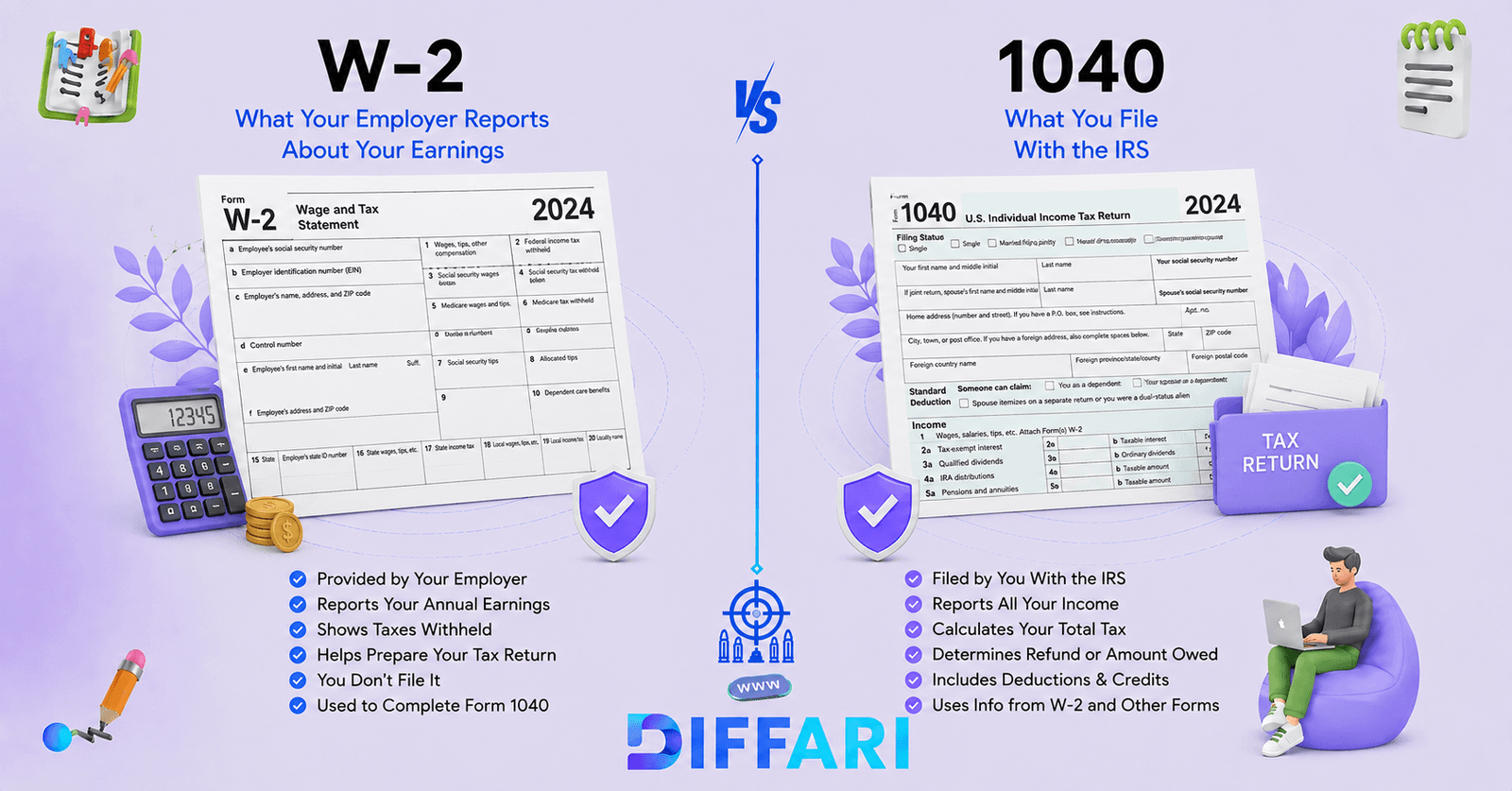

If you’re confused about the difference between W-2 and 1040, you’re not alone. Both forms are connected to U.S. income taxes, but they serve completely different purposes. A W-2 is a wage and tax statement that your employer provides to report your earnings and certain taxes withheld. Form 1040 is the annual federal income tax return that you file with the IRS.
The easiest way to remember the relationship is this: your W-2 provides important income information, while your 1040 is the tax return where that information is reported along with other income, deductions, credits, and tax information.
Quick Answer
Form W-2 reports wages paid to you by an employer and taxes withheld from those wages.
Form 1040 is the federal individual income tax return you use to report your income and calculate your overall federal tax liability.
The main difference is that you receive a W-2 from your employer, but you file Form 1040 with the IRS. A W-2 is not a substitute for a 1040. Instead, information from your W-2 is used when preparing your tax return.
W-2 vs 1040 at a Glance
| Feature | Form W-2 | Form 1040 |
| Full name | Wage and Tax Statement | U.S. Individual Income Tax Return |
| Main purpose | Reports employee wages and tax information | Reports your annual federal income tax |
| Usually prepared by | Employer | Taxpayer or tax professional |
| Who receives/files it? | Employee receives it; employer files required copies | Taxpayer files it with the IRS |
| Main information | Wages and taxes withheld | Income, deductions, credits, tax, refund or amount due |
| Covers | Employment income reported by that employer | Overall individual tax return |
| Relationship | Provides information used for tax filing | Uses W-2 information as part of the return |
The IRS describes W-2 as the wage and tax statement used by employers to report employee compensation and certain withholding information. Form 1040 is the annual individual income tax return.
What Is a W-2?
Form W-2, Wage and Tax Statement, is an employment-related tax document.
Your employer prepares a W-2 to report information such as your wages and certain federal, Social Security, and Medicare tax information. The employer also sends the required information to the appropriate government agencies.
For an employee, the W-2 is important because it tells you what your employer reported for the tax year.
Example
Suppose you worked for a company throughout the year and earned $60,000 in wages.
Your employer would generally provide a W-2 showing your reported wages and applicable tax withholding information.
You then use that information when preparing your federal tax return.
What Is Form 1040?
Form 1040 is the U.S. individual income tax return.
It is the form taxpayers use to file their annual federal income tax return with the IRS. Depending on your circumstances, your return can include information about wages, other income, deductions, credits, and your resulting tax liability.
Unlike a W-2, Form 1040 is not simply an employer’s report of your wages.
It is your overall federal tax return.
For example, someone might have:
- wages reported on one or more W-2s
- interest income
- investment income
- self-employment income
- deductions
- tax credits
The applicable information is brought together when preparing the person’s federal return.
What Is the Main Difference Between W-2 and 1040?
The most important difference is purpose.
A W-2 reports employment income and withholding information.
A 1040 reports your annual federal tax position to the IRS.
Think of the process this way:
Employer → W-2 → You → Form 1040 → IRS
Your W-2 is therefore one of the documents that can help you prepare your tax return. It is not the tax return itself.
How Does a W-2 Relate to Form 1040?
The two forms work together during tax filing.
For example:
- You work for an employer.
- Your employer reports your wages on Form W-2.
- You receive the W-2.
- You use the relevant information from the W-2 when preparing your Form 1040.
- Your 1040 incorporates that information with other applicable tax information.
- You file the completed return with the IRS.
The IRS specifically distinguishes the employer’s W-2 reporting from the taxpayer’s Form 1040 filing.
When Do You Use a W-2?
You use your W-2 primarily as an income and withholding record from your employer.
You may need it when:
- preparing your federal tax return
- checking reported wages
- reviewing federal tax withholding
- checking Social Security and Medicare wage information
- providing income documentation when requested
If you worked for multiple employers, you may receive multiple W-2s.
Each employer generally reports the wages and applicable tax information associated with that employment.
When Do You Use Form 1040?
You use Form 1040 when filing your annual federal individual income tax return.
The IRS states that Form 1040 is used by U.S. taxpayers to file an annual income tax return.
Your return may incorporate information from several tax documents, not just a W-2.
Depending on your circumstances, those documents can include forms reporting other types of income, deductions, or tax-related information.
Are W-2 and 1040 Interchangeable?
No.
You cannot use a W-2 as a replacement for Form 1040.
They perform different functions:
- W-2: reports employment wages and certain taxes withheld.
- 1040: reports your annual federal income tax information to the IRS.
A simple way to remember this is:
W-2 = income information from an employer.
1040 = your federal income tax return.
Do You Need Both a W-2 and a 1040?
For an employee who is required to file a federal income tax return, the W-2 and 1040 can both be relevant, but they are not the same document.
Your employer provides the W-2, while you file the 1040.
If you have multiple jobs, you may have several W-2s that contribute information to one federal tax return.
The exact filing requirements depend on your individual tax situation.
Common Mistakes With W-2 and 1040
Mistake 1: Thinking a W-2 is a tax return
Incorrect idea: “My employer gave me a W-2, so my taxes are already filed.”
Correct: A W-2 reports information from your employment. It does not mean that you have filed your individual federal income tax return.
Mistake 2: Treating the W-2 and 1040 as interchangeable
Incorrect: “I can submit my W-2 instead of a 1040.”
Correct: They serve different purposes. Your W-2 can provide information needed to prepare your 1040.
Mistake 3: Assuming the 1040 only contains W-2 income
A Form 1040 can involve information beyond wages from an employer.
Depending on the taxpayer’s circumstances, other income, deductions, credits, and schedules may be relevant. The IRS provides schedules and instructions for situations requiring additional reporting.
Mistake 4: Forgetting about multiple W-2s
If you worked for more than one employer, you may have more than one W-2.
Make sure all applicable income documents are considered when preparing your tax return.
W-2 vs W-4 vs 1040
These three forms are often confused because they are all connected to taxes.
| Form | Main purpose | Who generally handles it? |
| W-2 | Reports wages and tax withholding | Employer prepares it; employee receives it |
| W-4 | Provides withholding information to an employer | Employee completes it |
| 1040 | Annual federal individual income tax return | Taxpayer or tax professional prepares and files it |
The easiest distinction is:
W-4 → tells your employer about withholding
W-2 → tells you and the government what your employer reported
1040 → reports your annual federal income tax return
W-2 and 1040 in Real-Life Examples
Example 1: One employer
Maria works for one company.
Her employer gives her a W-2 showing her wages and tax withholding.
When Maria prepares her federal tax return, she uses the applicable W-2 information on her Form 1040.
Result: W-2 provides employment information; 1040 is the tax return.
Example 2: Two employers
James works two jobs during the year.
He receives a W-2 from Employer A and another W-2 from Employer B.
James does not file one 1040 for each W-2. Instead, the applicable information from his W-2s is considered when preparing his individual federal tax return.
Result: Multiple W-2s can contribute information to one Form 1040.
Example 3: W-2 plus other income
Sarah has a regular job and also receives another type of reportable income.
Her W-2 provides information about her employment income. Her Form 1040 may incorporate information from additional tax documents as applicable.
Result: The 1040 provides a broader picture than a single W-2.
Can a W-2 Be Used as Proof of Income?
It can serve as income documentation, depending on what the requesting organization accepts.
A W-2 shows important employment and wage information, so it may be useful when someone asks for income documentation.
However, a Form 1040 can provide a broader view of a person’s federal tax return and may be requested for purposes such as financial applications.
The exact document required depends on the organization and the purpose of the request.
How to Remember the Difference
Use this simple rule:
W-2 = What your employer reported.
1040 = What you report on your federal tax return.
Or remember the workflow:
Employer → W-2 → Taxpayer → 1040 → IRS
That distinction eliminates most of the confusion.
Which One Should I Use?
The answer depends on what you’re trying to do.
Need your employer’s wage and withholding information? Choose W-2.
For your annual federal income tax return, use Form 1040.
When you need to tell your employer how to handle federal income tax withholding, complete Form W-4.
Income from sources other than regular employee wages may require additional tax forms or records.
The W-2 and 1040 are therefore not competing choices. They serve different purposes within the tax-reporting process.
W-2 or 1040? Practice Examples
Choose W-2 or 1040.
- Your employer gives you a year-end wage statement.
- You file your annual federal individual income tax return.
- You want to review wages reported by your employer.
- You need to complete your federal tax return using employment income information.
- Your employer reports your wages and withholding.
- You report your annual tax information to the IRS.
Answers
- W-2
- 1040
- W-2
- 1040
- W-2
- 1040
Frequently Asked Questions
Is a W-2 the same as a 1040?
No. A W-2 is a wage and tax statement, while Form 1040 is the annual U.S. individual income tax return.
What is the biggest difference between W-2 and 1040?
The W-2 reports employment wages and certain withholding information. Form 1040 is the federal tax return used to report your annual tax information.
Do I use my W-2 to complete my 1040?
Yes. Information from your W-2 can be used when preparing your Form 1040. Your 1040 may also require information from other tax documents, depending on your circumstances.
Can I file my W-2 instead of a 1040?
No. A W-2 is not a substitute for an individual federal income tax return.
Who gives me a W-2?
Your employer generally prepares and provides Form W-2 when you have reportable employee wages. IRS instructions specify employer W-2 filing requirements.
Who files Form 1040?
The taxpayer, or a tax professional acting on the taxpayer’s behalf, prepares and files the individual federal income tax return.
Can I have more than one W-2?
Yes. If you worked for multiple employers, you may receive a separate W-2 from each employer that has a W-2 reporting obligation.
Does Form 1040 only include W-2 income?
No. A Form 1040 can incorporate information about other income, deductions, credits, and tax situations in addition to wages reported on W-2s.
What is the easiest way to remember W-2 vs 1040?
Remember:
W-2 = employer’s wage statement.
1040 = your federal income tax return.
Conclusion
The difference between W-2 and 1040 comes down to their roles. A W-2 is an employer-provided wage and tax statement that reports your employment income and applicable withholding information. Form 1040 is the annual federal individual income tax return you file with the IRS.

Sajid Ali is an English language educator and content specialist with 7+ years of teaching experience. He holds master’s degrees in Information Technology and Education from the Virtual University of Pakistan and writes SEO-optimized, learner-friendly vocabulary content for diffari.com.