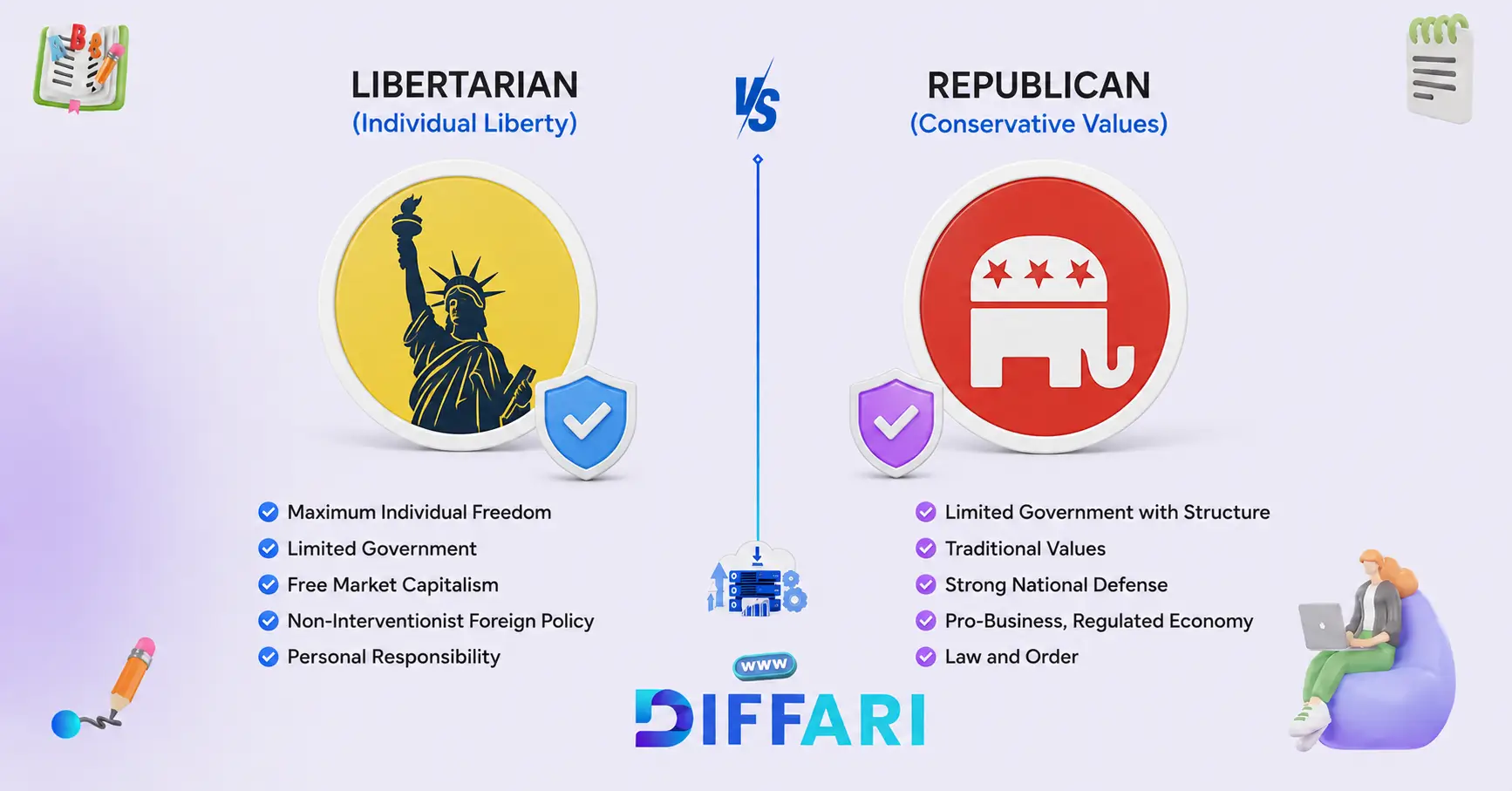

Libertarians and Republicans are often grouped together because they can share views on lower taxes, free markets, gun rights, individual responsibility, and limiting government. However, they are not the same political position.
The biggest difference is their starting point. Libertarianism places individual liberty and minimizing government coercion at the center of its political philosophy. Republicanism, in the context of U.S. politics, refers primarily to affiliation with the Republican Party, a broad political coalition that combines economic, social, national-security, immigration, and other priorities. The Republican Party’s current platform supports constitutional freedoms and economic growth while also emphasizing border security, national defense, family policy, and an America First approach.
Quick Answer
A libertarian generally wants the government to play a much smaller role in both personal and economic life, while a Republican may support limited government but also supports government action in areas such as national security, immigration enforcement, law enforcement, and other policy priorities.
The two groups overlap on some issues, especially taxes, regulation, private property, and gun rights. They can differ substantially, however, on questions involving personal behavior, government authority, immigration, foreign intervention, and the proper size and role of the state.
Libertarian vs Republican at a Glance
| Libertarian | Republican | |
| Basic category | Political philosophy / political movement | U.S. political party |
| Central emphasis | Individual liberty | Conservative and Republican policy priorities |
| Government | Minimize government power and coercion | Limited government is important, but government has broader roles |
| Economy | Strong preference for free markets and less regulation | Generally supports markets and tax cuts, with selected government intervention |
| Personal freedom | Very strong emphasis | Supports constitutional and individual freedoms, but positions vary |
| Social issues | Usually favors individual choice | Party coalition includes stronger socially conservative positions |
| Immigration | Libertarian philosophy generally favors freer movement | Republican platform emphasizes border security and enforcement |
| Foreign policy | Often favors restraint and non-intervention | Supports strong national defense and “peace through strength” |
| Taxes | Generally favors substantial tax reduction | Supports tax cuts while maintaining major government programs |
| Party affiliation | Libertarian Party or independent libertarian | Republican Party |
The Libertarian Party’s platform explicitly centers individual sovereignty, personal liberty, voluntary action, and opposition to government interference.
What Is a Libertarian?
A libertarian is generally someone who places a very high value on individual freedom and believes government power should be tightly limited.
The Libertarian Party describes its philosophy around individual sovereignty and the right of people to make peaceful and honest choices without unnecessary government interference. It also rejects the idea that government should have broad authority to control individuals simply because officials believe a particular choice is undesirable.
Libertarian views commonly emphasize:
- individual liberty
- personal responsibility
- private property
- free markets
- limited taxation
- fewer regulations
- freedom of speech
- privacy
- gun rights
- reduced government intervention
- civil liberties
This does not mean every person who calls themselves libertarian agrees on every issue. Libertarianism is a political philosophy, and individual libertarians can differ on specific policies.
What Is a Republican?
A Republican, in the context of U.S. politics, is generally a member, supporter, or voter associated with the Republican Party.
The Republican Party is a broad political organization rather than a single philosophical theory. Its current national platform emphasizes economic growth, lower taxes, reduced regulation, border security, national defense, constitutional freedoms, election policies, and traditional social priorities.
The Republican Party’s 2024 platform, which remains the party’s most recent national platform identified in the sources reviewed, calls for securing the southern border, large-scale immigration enforcement, tax cuts, deregulation, strong military capabilities, protection of gun rights, and other priorities.
Therefore, Republicans can share libertarian ideas without being libertarians.
What Is the Main Difference Between Libertarian and Republican?
The simplest distinction is this:
Libertarianism asks, “How much government power is necessary to protect individual liberty?” Republican politics asks a broader set of questions about how government should promote conservative, economic, national-security, immigration, and other policy goals.
A libertarian’s position is usually derived from a general principle of individual freedom and limited government.
A Republican’s position is more likely to be shaped by the Republican Party’s platform, conservative traditions, current political priorities, and the views of the individual Republican.
That distinction matters because libertarianism is primarily an ideology, while Republican is primarily a party identity.
Government and Individual Liberty
This is one of the clearest areas of difference.
Libertarians generally want government intervention kept to a minimum, particularly when an individual’s peaceful behavior does not violate another person’s rights. The Libertarian Party’s platform explicitly places individual rights and self-ownership at the center of its principles.
Republicans also frequently advocate limited government and individual freedom. However, the Republican platform supports government action in areas that many libertarians would approach differently, including immigration enforcement, national defense, law enforcement, and regulation of certain social and cultural issues.
Simple example
A libertarian might ask:
“Does the government need to regulate this peaceful personal choice?”
A Republican might instead ask:
“Does government regulation protect public order, security, families, or other important interests?”
Individual Republicans will answer differently, but the two approaches often begin from different priorities.
Economic Policy
Libertarians and Republicans frequently overlap economically.
Both can support:
- lower taxes
- private enterprise
- entrepreneurship
- property rights
- reduced regulation
- economic growth
The difference is often one of degree and principle.
The Libertarian Party advocates broad economic freedom and opposes extensive government interference in voluntary economic activity.
Republicans also support tax cuts and deregulation. The Republican platform calls for reducing regulations, cutting taxes, increasing domestic energy production, and encouraging economic growth.
However, Republicans may support tariffs, industrial policy, government programs, or other interventions that a strict libertarian would question.
For example, the 2024 Republican platform supports baseline tariffs on foreign-made goods and an America First trade policy.
Social Issues
This is another major area where libertarians and Republicans can diverge.
Libertarian thinking generally emphasizes personal choice. If an action is peaceful and does not violate another person’s rights, libertarians are more likely to oppose government restrictions on it.
The Libertarian Party’s platform, for example, emphasizes personal freedom and opposes government interference in consensual adult behavior.
Republicans include a broad range of social views, but the party’s current platform contains specific positions involving abortion, gender-related policies, education, family policy, and religious liberty.
Therefore, a person can be economically conservative but socially libertarian, or economically and socially conservative and strongly Republican.
Immigration
Immigration is an especially important distinction.
The Republican Party’s national platform strongly emphasizes border security, immigration enforcement, deportation of people who are in the country illegally, and merit-based immigration.
Libertarian thinking can lead to a significantly different position because libertarians generally place a strong emphasis on freedom of movement and limiting government restrictions on peaceful individuals.
The Libertarian Party’s platform supports removing government barriers to migration and does not support criminalizing undocumented migration across national borders as a general principle.
This means libertarians and Republicans can be particularly far apart on immigration even when they agree on taxes or government spending.
Foreign Policy and the Military
Libertarians commonly favor a more restrained foreign policy and are skeptical of unnecessary military intervention abroad.
That does not necessarily mean libertarians oppose a military. Rather, the question is when and why government should use military power outside the country.
Republicans generally place greater emphasis on military strength and national security. The Republican platform calls for maintaining a powerful military and describes its foreign-policy approach as “peace through strength.”
This creates an important difference:
Libertarian approach: Use military force cautiously and limit foreign intervention.
Republican approach: Maintain strong military capabilities as a central part of national security.
Individual Republicans and libertarians can, of course, hold positions outside these general patterns.
Gun Rights
Gun rights are an area of significant overlap.
Libertarians generally strongly support the individual right to own firearms and view gun ownership as part of individual liberty and self-defense.
Republicans also strongly support the Second Amendment. The Republican Party platform explicitly calls for defending the right to keep and bear arms.
So, unlike immigration or foreign policy, this issue often brings libertarians and Republicans closer together.
Drug Policy
Drug policy can reveal a significant ideological difference.
Libertarian philosophy generally favors allowing adults greater control over what they consume and opposes government punishment for many forms of voluntary behavior.
The Libertarian Party explicitly calls for ending the war on drugs.
Republicans have historically included stronger law-and-order approaches to drug policy, although individual Republicans differ considerably.
This is one reason it is inaccurate to describe libertarians simply as Republicans who want smaller government. Their views about personal behavior and government authority can be substantially different.
Where Libertarians and Republicans Overlap
Despite their differences, the two groups can share important political ground.
Common areas may include:
- lower taxes
- less government spending
- reduced regulation
- free enterprise
- private property
- gun rights
- individual responsibility
- free speech
- skepticism toward excessive government power
This overlap helps explain why some libertarians vote Republican or participate in Republican politics.
Research has also documented a historical relationship between libertarian-minded voters and the Republican coalition.
However, political cooperation does not mean the underlying philosophies are identical.
Are Libertarians Republicans?
No, not necessarily.
A libertarian may be a member of the Libertarian Party, an independent voter, or someone who simply identifies with libertarian political philosophy.
A Republican is generally associated with the Republican Party.
There can also be libertarian Republicans—people who identify with the Republican Party while holding strongly libertarian views on particular issues. The existence of this group demonstrates the overlap between the two, but it does not make libertarianism and Republicanism synonymous.
Are Libertarians Conservative?
Sometimes, but not always.
Libertarians often appear economically conservative because they favor free markets, private property, lower taxes, and less regulation.
At the same time, libertarians can be more permissive than traditional social conservatives on issues involving personal behavior and government control.
This produces a combination that does not fit neatly into a simple left-right political spectrum.
Pew Research has noted that libertarianism is associated with limited government involvement in the social sphere and that self-described libertarians can differ from the broader public on issues such as marijuana legalization and civil liberties.
Can Libertarians and Republicans Agree?
Yes.
A libertarian and a Republican can agree on taxes, gun rights, deregulation, government spending, free speech, or other issues while disagreeing strongly on immigration, foreign policy, drug laws, or social regulation.
Political identities are not always all-or-nothing categories.
For example:
A person may support lower taxes and gun rights like many Republicans while also supporting drug legalization and a highly restrained foreign policy like many libertarians.
That person may identify more strongly with one group than the other—or with neither.
Common Mistakes About Libertarians and Republicans
Incorrect:
“All libertarians are Republicans.”
Correct: Libertarianism and Republican Party membership are different political identities.
Why: Libertarianism is a political philosophy, while the Republican Party is a political organization.
Incorrect:
“Republicans and libertarians always want exactly the same economic policies.”
Correct: They often favor free markets and lower taxes, but they can disagree about tariffs, government programs, trade, spending, and regulation.
Why: The Republican Party is a broad coalition, while libertarian economic policy is derived from a stronger general preference for limited government intervention.
Incorrect:
“Libertarians are simply Republicans with different social views.”
Correct: Libertarian differences can extend to economic policy, civil liberties, immigration, foreign policy, drug policy, and the overall role of government.
Why: Libertarianism is based on a broader theory of individual liberty rather than a single set of social positions.
Common Political Terms to Know
Libertarianism
A political philosophy emphasizing individual liberty, voluntary action, private rights, and limited government.
Libertarian Party
A U.S. political party that promotes libertarian principles and maintains a national platform.
Republican Party
One of the two major U.S. political parties, with a broad platform covering economic, social, immigration, national-security, and other issues.
Conservative
A broader political description that can include Republicans but is not identical to Republican Party membership.
Which One Should I Identify With?
A useful way to think about the distinction is:
If your main principle is maximum individual freedom and minimizing government interference → you may lean libertarian.
If you generally support Republican candidates, policies, and the Republican Party’s broader platform → you may identify as Republican.
If you support some libertarian economic ideas but also strongly support Republican positions on immigration, national defense, or social policy → you may be a Republican with libertarian views on certain issues.
The important point is that political labels are broad. Your position on one issue does not automatically determine your position on every other issue.
X or Y? Practice Examples
Choose Libertarian, Republican, or Both/Overlap.
- Strong emphasis on individual liberty and minimizing government coercion.
- Support for the Republican Party’s national platform.
- Support for lower taxes and reduced regulation.
- Strong preference for free-market economic policies.
- Strong emphasis on border security and immigration enforcement.
- Strong opposition to unnecessary foreign military intervention.
- Support for Second Amendment rights.
- Belief that peaceful adults should have greater freedom over personal choices.
Answers
- Libertarian
- Republican
- Both/Overlap
- Both/Overlap
- Republican
- Libertarian
- Both/Overlap
- Libertarian
These are simplified examples, not absolute rules. Individual members of either group can hold different positions.
Frequently Asked Questions
What is the main difference between a libertarian and a Republican?
The main difference is that libertarianism is centered on individual liberty and minimizing government coercion, while Republicanism in the United States primarily refers to affiliation with a broad political party whose platform covers economic, social, immigration, national-security, and other priorities.
Are libertarians Republicans?
Not necessarily. Some libertarians are Republicans or vote Republican, but the Libertarian Party and Republican Party are separate political organizations.
Are libertarians conservative?
Libertarians often share conservative economic views, such as support for free markets and lower taxes, but they can differ from traditional conservatives on personal freedom, drug policy, immigration, and foreign intervention.
Do Republicans and libertarians agree on taxes?
Often, yes. Both may favor lower taxes, but libertarians generally connect tax reduction to a broader philosophy of limiting government power and spending.
Do libertarians support gun rights?
Generally, yes. Gun rights are a significant area of overlap between libertarians and Republicans.
Do libertarians and Republicans agree on immigration?
Not necessarily. The Republican Party’s platform emphasizes strong border security and immigration enforcement, while the Libertarian Party’s platform takes a much more permissive approach to migration.
Who wants smaller government: libertarians or Republicans?
Both can favor smaller government, but libertarians generally make limiting government power a more fundamental and consistent principle across personal and economic matters.
Can someone be both libertarian and Republican?
Yes. A person can identify as Republican while holding libertarian views on issues such as taxes, regulation, civil liberties, or government power.
Conclusion
The difference between libertarian and Republican is mainly a difference between a political philosophy and a political party identity. Libertarianism puts individual liberty, personal choice, and limited government at the center of its worldview. The Republican Party is a broader coalition that supports economic freedom and constitutional rights while also emphasizing issues such as border security, national defense, trade, law enforcement, and social policy.

Sajid Ali is an English language educator and content specialist with 7+ years of teaching experience. He holds master’s degrees in Information Technology and Education from the Virtual University of Pakistan and writes SEO-optimized, learner-friendly vocabulary content for diffari.com.