
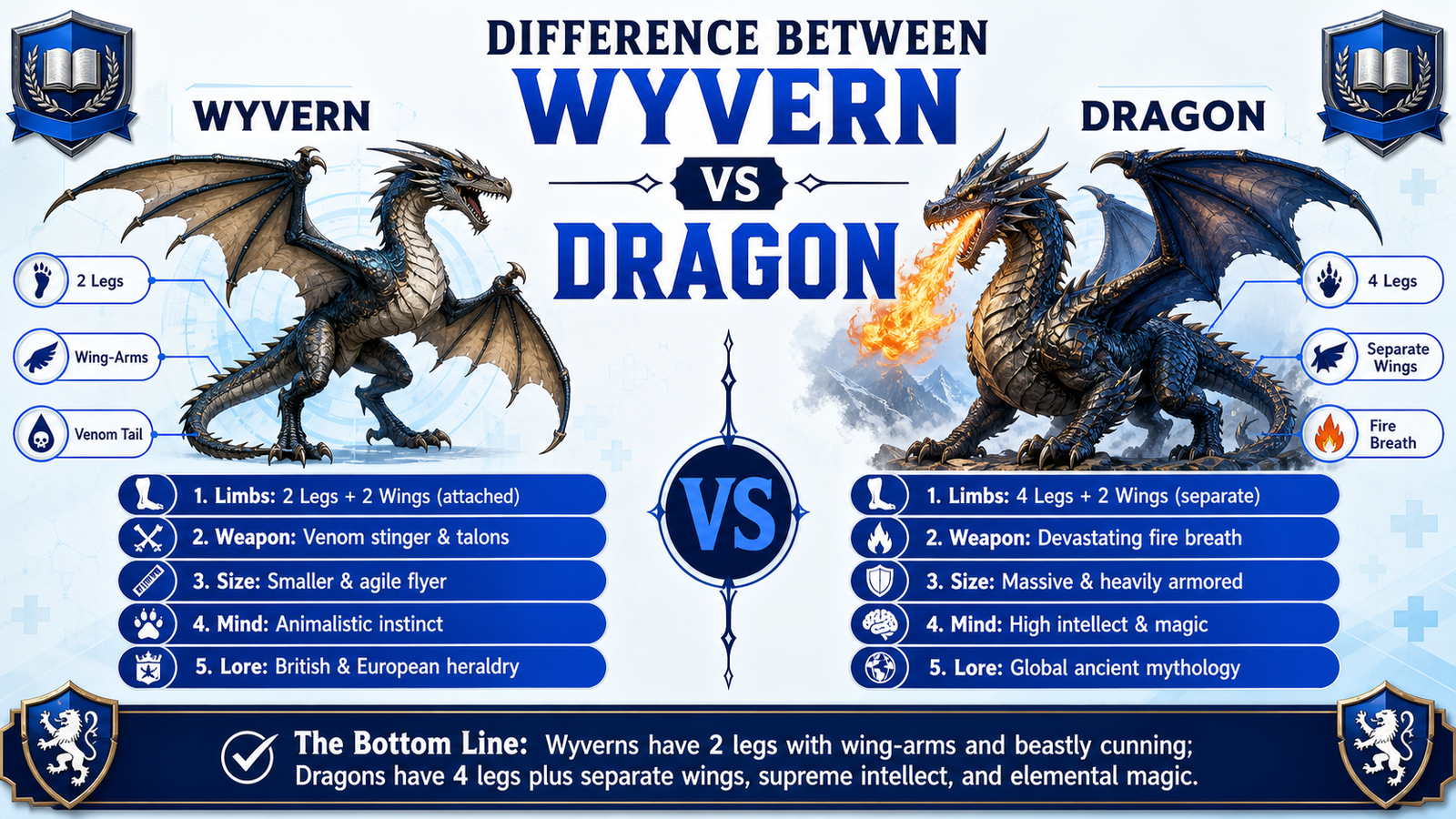
Wyverns and dragons are both legendary, dragon-like creatures, so the two names are often used interchangeably. The easiest way to distinguish them is by their anatomy: under the common English heraldic and modern fantasy convention, a dragon has four legs and a separate pair of wings, while a wyvern has two legs and two wings that form its forelimbs.
But that rule needs an important qualification. “Dragon” is a much broader term that covers many forms across mythology and fiction, and historical heraldry did not always use the dragon-wyvern distinction consistently. In other words, the four-leg/two-leg rule is useful, but it is not a universal law of dragon lore.
Quick Answer
A dragon is a broad term for a legendary or mythical creature that can take many forms. In the common Western design, a dragon has four legs and two separate wings.
A wyvern is usually depicted with two legs and two wings, with the wings serving as its forelimbs. The distinction is especially associated with English heraldry.
So, the simplest rule is:
Four legs + separate wings = dragon.
Two legs + winged forelimbs = wyvern.
However, a fictional work may call a two-legged creature a “dragon,” so the terminology used by the creator takes priority within that fictional world.
Wyvern vs Dragon at a Glance
| Feature | Dragon | Wyvern |
|---|---|---|
| Common modern form | Four legs + two wings | Two legs + two wings |
| Total limbs in the common form | Six | Four |
| Forelimbs | Separate from wings | Wings function as forelimbs |
| Tail | Usually long and reptilian | Often long and sometimes barbed |
| Historical association | Broad dragon traditions; English heraldry | Particularly English heraldry |
| Fire-breathing | Common in some traditions, but not universal | Not a defining feature |
| Venom | Not a defining feature | Sometimes depicted with venom, especially a barbed tail |
| Universal classification? | No | No |
| Modern fantasy usage | Very broad | Often more anatomically specific |
The anatomical distinction is clearest in English heraldic convention, where the dragon has four legs and the wyvern has two.
What Is a Wyvern?
A wyvern is a legendary dragon-like creature traditionally represented with two legs, wings, and a long tail. It is particularly associated with heraldry, where the two-legged form became distinguishable from the four-legged heraldic dragon.
The important anatomical point is that the wyvern’s wings occupy the position that a dragon’s front legs would occupy.
Think of it this way:
Wyvern:
- two hind legs
- two wings
- no separate pair of front legs
- usually a long tail
- often a reptilian or dragon-like head
In modern fantasy artwork, the wings may have claws or wing fingers that help emphasize their role as forelimbs.
The word itself has a serpentine history. Wyvern developed through Middle English and Anglo-French forms related to wivre, ultimately connected with Latin vipera, meaning a viper or similar venomous snake.
What Is a Dragon?
A dragon is a much broader mythical or legendary creature category.
There is no single worldwide dragon anatomy. Dragons appear in different forms across European, Asian, and other cultural traditions. Some are winged, some are wingless, and some have long serpentine bodies.
When people make a dragon vs wyvern comparison today, however, they usually have the familiar Western fantasy dragon in mind: a large reptilian creature with:
- four legs
- two wings
- a long tail
- claws
- scales
- a large head
Fire-breathing is also a common feature of Western fantasy dragons, but it should not be treated as the definition of a dragon. Dragon traditions vary considerably.
This is why “dragon” is broader than “four-legged winged reptile.”
What Is the Difference Between a Wyvern and a Dragon?
The clearest difference is the number and function of their limbs.
Under the common English heraldic convention:
- A dragon has four legs.
- A wyvern has two legs.
- A dragon’s wings are separate from its four legs.
- A wyvern’s wings function as its forelimbs.
This distinction is particularly useful when identifying fantasy artwork.
Imagine two creatures standing next to each other.
The first has:
front legs + back legs + wings
That is the classic six-limbed dragon.
The second has:
back legs + wings that act as front limbs
That is the classic wyvern.
Why the distinction is not absolute
The important historical detail is that this was not always a universal distinction.
Fox-Davies’s A Complete Guide to Heraldry specifically describes the two-legged wyvern as a distinction found “at any rate in English heraldry” and notes that other countries could use the name dragon for similar forms.
So it is better to say:
A wyvern is conventionally distinguished from a heraldic dragon by having two legs rather than four.
It is less accurate to say:
Every dragon in mythology must have four legs.
Why Does the Number of Legs Matter?
The leg count became useful because heraldry needed precise visual terminology.
A coat of arms had to be described clearly enough that another person could reproduce the design. Distinguishing a four-legged dragon from a two-legged wyvern therefore provided a practical descriptive convention.
Historical heraldic sources show that the distinction was not always consistently applied in earlier periods, and the two-legged form could appear under the name dragon in other traditions.
That historical context explains why modern discussions can become confusing: people sometimes apply a later heraldic classification to much older dragon imagery.
When to Use the Word “Wyvern”
Use wyvern when the creature is being described according to the conventional two-legged form, especially in:
- English heraldry
- fantasy creature classification
- creature design
- games that explicitly distinguish wyverns from dragons
- discussions where the two-legged anatomy is important
For example:
The shield depicts a wyvern with two legs and broad wings.
The game separates wyverns from four-legged dragons.
The term is especially useful when the anatomical distinction is relevant.
When to Use the Word “Dragon”
Use dragon when:
- the creature belongs to a broader dragon tradition;
- the source itself calls it a dragon;
- the creature has the conventional four-legged Western form;
- you are discussing dragons generally rather than a specific anatomical subtype.
For example:
The knight fought a dragon with four legs and enormous wings.
Dragons appear in many different forms across mythology.
The second example is particularly important because dragon does not refer to one standardized body plan.
Are Wyverns a Type of Dragon?
Sometimes, depending on the classification system.
In broad language, a wyvern can be described as a dragon-like creature or a particular form of dragon. Modern references commonly describe it in those terms.
In English heraldry, however, dragon and wyvern are distinct heraldic forms, differentiated primarily by their number of legs.
Modern fantasy adds another layer: an author or game designer can establish their own taxonomy.
Therefore:
Broad category: A wyvern is dragon-like and may be treated as a type of dragon.
Heraldic classification: Dragon and wyvern are distinct forms.
Fictional setting: The creator’s terminology determines what the creature is called.
Are Wyverns Always Poisonous?
No.
A barbed or pointed tail is common in wyvern imagery, and some fantasy settings associate wyverns with venom or poison. But poison is not the defining feature of a wyvern.
The defining conventional distinction is primarily anatomical: two legs rather than four.
Likewise, you should not assume that every wyvern has a poisonous tail unless the particular mythology, book, game, or other source says so.
Are Dragons Always Fire-Breathing?
No.
Fire-breathing is one of the most familiar characteristics of Western fantasy dragons, but it is not a universal requirement.
Dragon traditions vary considerably, and different fictional settings can give dragons different powers.
Therefore:
Fire-breathing → common dragon trait
but not:
Fire-breathing → definition of a dragon
The same principle applies to size, intelligence, magical powers, and temperament.
Dragon and Wyvern in Fantasy Fiction
Modern fantasy often uses dragon and wyvern as separate creature categories.
A fantasy author or game designer might establish:
- dragons as four-legged creatures;
- wyverns as two-legged creatures;
- dragons as intelligent;
- wyverns as animal-like;
- dragons as capable of speech;
- wyverns as primarily predators.
But these characteristics are fiction-specific, not universal properties of the words.
This distinction matters when discussing fictional creatures.
If a fictional universe calls a two-legged winged creature a dragon, it is a dragon within that fictional setting, even if its anatomy resembles the conventional heraldic wyvern.
In other words:
Anatomy can tell you what the creature resembles; the fictional source tells you what it is called.
This is a particularly useful rule for discussing fantasy books, films, television series, and games.
Common Mistakes With Wyvern and Dragon
Mistake 1: Assuming every dragon has four legs
Incorrect idea:
Every dragon in mythology has four legs.
Why:
Dragon traditions are much more varied than the modern Western fantasy image.
Better approach:
A four-legged, winged creature is the conventional Western dragon form, especially in the English heraldic distinction.
Mistake 2: Assuming every two-legged dragon is technically a wyvern
Incorrect idea:
If a fictional creature has two legs, it must be a wyvern.
Why:
A fictional creator can call the creature a dragon. The heraldic distinction does not automatically override fictional terminology.
Mistake 3: Treating poison as the defining difference
Incorrect idea:
Wyverns are poisonous, while dragons breathe fire.
Why:
Those are common fictional characteristics, not the fundamental anatomical distinction.
Mistake 4: Treating “dragon” as a precise biological category
Incorrect idea:
Dragons have one standardized anatomy.
Why:
Dragons are legendary creatures represented in many different forms and traditions.
Mistake 5: Assuming the distinction was universal throughout medieval Europe
Incorrect idea:
Medieval Europeans always distinguished dragons and wyverns by leg count.
Why:
The distinction is especially associated with English heraldry, while other heraldic traditions could use dragon for two-legged forms as well.
Common Collocations With Dragon and Wyvern
Dragon
- fire-breathing dragon
- dragon’s lair
- dragon’s tail
- dragon’s wings
- dragon rider
- dragon egg
- dragon slayer
- ancient dragon
- mythical dragon
- Western dragon
Wyvern
- two-legged wyvern
- winged wyvern
- heraldic wyvern
- wyvern’s wings
- wyvern’s tail
- wyvern emblem
- wyvern crest
- wyvern rider
- wyvern species
- mythical wyvern
The word dragon naturally occurs in a much wider range of general-language expressions because it is the broader and more familiar term.
Can Wyvern and Dragon Be Used Interchangeably?
Sometimes, but not always.
In casual conversation, someone may call a wyvern a dragon because a wyvern is a dragon-like legendary creature.
But they should not be treated as interchangeable when a specific classification matters.
For example:
The heraldic emblem shows a wyvern.
Changing wyvern to dragon could remove the anatomical distinction.
Likewise, if a fantasy game specifically defines dragons and wyverns as different creatures, substituting one for the other could change the meaning.
The safest rule is:
Use “dragon” for the broad category and “wyvern” when the specific two-legged form matters.
How to Remember the Difference
Use the simplest visual mnemonic:
Dragon = Four Legs
Think:
D = four-legged Dragon
Wyvern = Wings + Two Legs
A wyvern’s wings take the place of the front limbs in the familiar design.
So when looking at an illustration, ask:
Does it have four separate legs?
If yes, it resembles the conventional dragon.
If it has only two hind legs and its wings serve as the forelimbs, it resembles the conventional wyvern.
Remember that this is a visual convention, not an absolute rule for every myth or fictional universe.
Which One Should I Use?
Use this quick decision guide:
For a broad mythical or legendary creature → choose “dragon.”
The conventional four-legged Western form is generally called a “dragon.”
A two-legged, winged form is commonly described as a “wyvern.”
In English heraldry, however, the dragon–wyvern distinction should be treated carefully because historical usage is not always consistent.
When a fictional work explicitly calls the creature a “dragon,” follow the terminology used by that work.
If the source makes no distinction between the terms, “dragon” may be the broader and safer choice.
Wyvern or Dragon? Practice Examples
Choose dragon or wyvern according to the conventional distinction.
- The creature has four legs and two separate wings. → _____
- The creature has two hind legs, while its wings function as forelimbs. → _____
- A heraldic beast has four legs and a dragon-like head. → _____
- A fantasy game specifically describes a two-legged winged creature as a wyvern. → _____
- The story simply refers to its enormous reptilian creature as a dragon. → _____
- You are discussing mythical reptiles in general rather than one specific body plan. → _____
- A creature has two legs and a long tail but the fictional author calls it a dragon. → _____
- An English heraldic design follows the conventional two-legged form. → _____
Answers
- Dragon
- Wyvern
- Dragon
- Wyvern
- Dragon
- Dragon
- Dragon within that fictional setting
- Wyvern
The last two examples demonstrate why anatomy and terminology should not always be treated as identical.
Frequently Asked Questions
What is the main difference between a wyvern and a dragon?
The conventional difference is the number of legs. A dragon is commonly represented with four legs and separate wings, while a wyvern has two legs and wings functioning as its forelimbs. This distinction is especially associated with English heraldry.
Is a wyvern a dragon?
A wyvern is a dragon-like mythical creature and can be treated as a type or form of dragon in broad usage. In English heraldry, however, the two are distinguished by anatomy.
How many legs does a wyvern have?
A conventional wyvern has two legs. Its wings serve as its forelimbs in the familiar modern representation.
How many legs does a dragon have?
The conventional Western or English heraldic dragon has four legs, with its wings separate from its legs. But dragons in mythology and fiction do not all follow one standardized anatomy.
Do wyverns have wings?
Yes. The conventional wyvern has two wings and two legs.
Are wyverns smaller than dragons?
Not necessarily. Some fantasy settings depict wyverns as smaller, but size is not what defines a wyvern. The key conventional distinction is its anatomy.
Are wyverns weaker than dragons?
There is no universal rule. Strength depends on the mythology, story, game, or other fictional setting.
Are all dragons fire-breathing?
No. Fire-breathing is a common feature of some Western dragon traditions and modern fantasy, but it is not a universal requirement for something to be called a dragon.
Are dragons and wyverns the same in heraldry?
Not under the conventional English heraldic classification. A dragon has four legs, while a wyvern has two. Other heraldic traditions have used the word dragon more broadly.
What is the easiest way to tell a dragon from a wyvern?
Count the legs. Four separate legs plus wings usually indicates the conventional dragon form; two legs with wings functioning as forelimbs indicates the conventional wyvern form.
Conclusion
The simplest difference between a wyvern and a dragon is anatomical: a conventional wyvern has two legs and two wings, while a conventional Western or English heraldic dragon has four legs and two separate wings.
But the distinction is not universal across all mythology, heraldry, or fantasy. “Dragon” is a broad term covering many forms, and fictional creators can define their own creature categories.
For everyday identification, remember:
Four legs → conventional dragon.
Two legs with winged forelimbs → conventional wyvern.