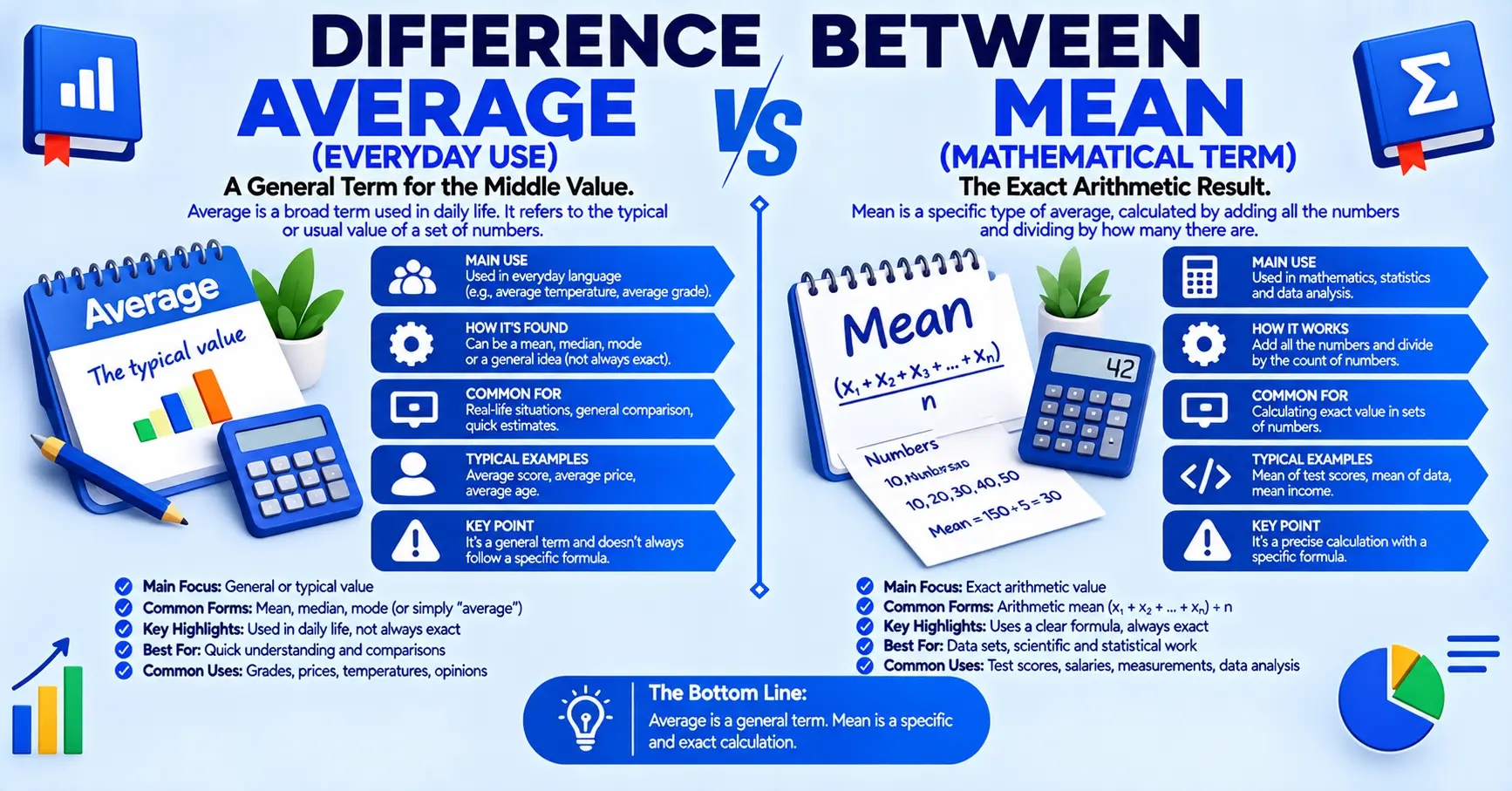
The words average and mean are often used as if they mean exactly the same thing, especially when talking about a set of numbers. In many everyday math problems, they do refer to the same calculation: add all the values and divide by the number of values. However, there is a small but important distinction in how the terms are used.
Mean is a specific mathematical concept, while average is a broader everyday term that often refers to the arithmetic mean. In some contexts, “average” can also describe a typical or representative value more generally.
Understanding this difference can help you use the terms more precisely in mathematics, statistics, schoolwork, and everyday conversations.
Quick Answer
Average and mean often mean the same thing when “average” refers to the arithmetic mean. Both can describe the result of adding all values in a data set and dividing the total by the number of values.
The main difference is that average is a broader, more general word, while mean is a more precise mathematical term. In mathematics, there are also different types of means, such as the arithmetic, geometric, and harmonic means.
Average vs Mean at a Glance
| Feature | Average | Mean |
| Basic meaning | A general or typical value | A mathematical measure calculated from values |
| Everyday use | Very common | Less common outside math/statistics |
| Arithmetic calculation | Often means the arithmetic mean | Arithmetic mean uses sum ÷ number of values |
| Mathematical precision | Can be broad | More precise |
| Can have different meanings? | Yes, depending on context | Yes; arithmetic, geometric, harmonic, etc. |
| Example | “The average score was 85.” | “The mean score was 85.” |
In a typical school math problem, average and arithmetic mean usually produce exactly the same result.
What Does Average Mean?
Average is a general term used to describe a value that represents a group of numbers or gives an idea of what is typical for that group.
In everyday mathematics, people usually use average to mean the arithmetic mean.
For example, suppose five students receive these scores:
70, 75, 80, 85, 90
To find the average:
(70 + 75 + 80 + 85 + 90) ÷ 5 = 80
So, the average score is 80.
The word average is especially common in everyday language:
- The average temperature was 75°F.
- Her average score was 88%.
- The average household spends $500 a month.
- The average employee works 40 hours a week.
In these examples, average generally refers to a numerical calculation representing the group.
What Does Mean Mean?
In mathematics and statistics, mean is a more precise term for a type of mathematical average.
The most familiar form is the arithmetic mean.
To calculate an arithmetic mean, add all the values and divide by the number of values.
Mean formula
Mean = Sum of all values ÷ Number of values
For example:
10, 20, 30, 40
The mean is:
(10 + 20 + 30 + 40) ÷ 4 = 25
Therefore, the mean is 25.
The mean is one of the most common measures of the center of a data set. It is commonly discussed alongside the median and mode.
What Is the Difference Between Average and Mean?
The simplest answer is that there is often no difference in the numerical result.
When someone says:
“The average of 10, 20, and 30 is 20.”
they are normally referring to the arithmetic mean.
You could also say:
“The mean of 10, 20, and 30 is 20.”
Both statements are correct.
The distinction becomes important when considering the scope of the word average.
Average is broader
In ordinary language, average can describe a typical or representative value more generally.
Mean is more precise
In mathematics and statistics, mean identifies a mathematical measure. Depending on context, it can refer to different types of means, including arithmetic, geometric, and harmonic means.
Therefore:
The arithmetic mean is an average, but the word “average” does not always tell you exactly which type of measure is intended.
That is the most useful distinction to remember.
When Are Average and Mean the Same?
They are effectively interchangeable when average means arithmetic mean.
For example:
Numbers: 4, 6, 8, 10
Average:
(4 + 6 + 8 + 10) ÷ 4 = 7
Arithmetic mean:
(4 + 6 + 8 + 10) ÷ 4 = 7
Both give the same answer.
This is why textbooks, teachers, and everyday speakers often use the two words interchangeably.
OpenStax, for example, describes the “mean, or average” as the arithmetic mean.
When Is “Average” Broader Than “Mean”?
The word average can be less precise when the speaker has not identified the specific statistical measure being used.
For example, someone might say:
“What is the average salary?”
That question does not automatically tell you whether the person wants the arithmetic mean, median, or another summary measure. In practical statistics, the appropriate measure depends on what the data and question require.
By contrast, asking:
“What is the arithmetic mean salary?”
specifies exactly what calculation is required.
This distinction is particularly important when a data set contains extreme values or has a skewed distribution.
Mean vs Median vs Mode
The terms mean, median, and mode are related, but they are not the same calculation.
Consider this data set:
2, 3, 3, 4, 6, 8, 9
Mean
Add all the numbers and divide by seven:
35 ÷ 7 = 5
The mean is 5.
Median
Arrange the values in order and find the middle value.
The median is 4.
Mode
The mode is the value that occurs most frequently.
The mode is 3 because it appears twice.
So:
| Measure | Result |
| Mean | 5 |
| Median | 4 |
| Mode | 3 |
These are different measures of central tendency. Dictionary.com similarly distinguishes the mean from the median and mode.
This is why it is better not to automatically treat average, mean, median, and mode as perfect synonyms.
Types of Mean
Another reason the word mean can be more precise is that mathematics uses different kinds of means.
Arithmetic mean
This is the familiar calculation:
Sum of values ÷ Number of values
For example:
10, 20, 30
Arithmetic mean:
60 ÷ 3 = 20
Geometric mean
The geometric mean uses multiplication rather than simple addition and division.
For two positive numbers, it can be calculated using the square root of their product.
For example:
4 and 9
Geometric mean:
√(4 × 9) = √36 = 6
Harmonic mean
The harmonic mean is another type of mean and is particularly useful in certain rate and ratio problems.
These different forms show why mean can be a more specific mathematical term than the everyday word average. Current educational references commonly distinguish arithmetic, geometric, and harmonic means.
Average and Mean in Real Sentences
Here are examples showing how the terms naturally appear.
Example 1: Test scores
The average score on the test was 86%.
Here, average normally means the arithmetic mean.
The mean score on the test was 86%.
This has essentially the same meaning but sounds more technical.
Example 2: Temperature
The average temperature in July was 82°F.
This is natural everyday English.
The mean temperature for July was 82°F.
This sounds more statistical or technical.
Example 3: Research
Researchers calculated the mean age of the participants.
Here, mean is preferred because the context is statistical.
Example 4: Conversation
The average person spends several hours a day online.
Here, average is natural because the sentence is making a general statement rather than explaining a specific statistical calculation.
Common Mistakes With Average and Mean
Mistake 1: Assuming they are always completely different
Incorrect idea:
Average and mean are two completely different calculations.
Correct:
In many mathematical contexts, average and arithmetic mean refer to the same calculation.
Why:
The arithmetic mean is commonly called the average.
Mistake 2: Saying mean is only used when numbers are far apart
Incorrect idea:
Use mean when the values have large differences.
Correct:
The arithmetic mean can be calculated regardless of whether the values are close together or widely separated.
Why:
The difference between the values does not determine whether the arithmetic mean can be calculated.
Mistake 3: Treating mean, median, and mode as identical
Incorrect:
The mean, median, and mode are three names for the average.
Correct:
Mean, median, and mode are different measures of central tendency.
Why:
They use different methods to summarize a data set.
Mistake 4: Assuming “average” always means one specific calculation
Incorrect:
Average always means arithmetic mean in every context.
Better:
In everyday math, average commonly means arithmetic mean, but the word can be broader depending on context.
Why:
The context determines what “average” is intended to represent.
Can Average and Mean Be Used Interchangeably?
Usually, yes—when “average” means arithmetic mean.
For example:
The average of 12, 18, and 24 is 18.
and:
The mean of 12, 18, and 24 is 18.
Both are correct.
However, mean is preferable when you need mathematical precision, especially in statistics or technical writing.
A useful rule is:
Use “average” for general communication; use “mean” when you want to identify a specific mathematical measure.
This does not mean that average is incorrect in mathematical writing. It simply means that mean can remove ambiguity.
How to Remember the Difference
Use this simple rule:
Average = general term
Mean = precise mathematical term
When someone casually asks for the “average” of several numbers, they usually want the arithmetic mean.
When a statistics problem specifically asks for the “mean,” use the appropriate mean described by the problem.
Remember:
The arithmetic mean is commonly called the average.
That one sentence resolves most confusion between the two terms.
Which One Should I Use?
For a typical numerical value in casual or general conversation, use average**.**
When referring to a specific statistical calculation, the more precise term is mean**.**
The arithmetic mean is calculated by adding the values and dividing the total by the number of values; in everyday contexts, this can simply be called the average when the meaning is clear.
When comparing different statistical measures, such as the mean, median, and mode, name the specific measure rather than using “average” vaguely.
Average or Mean? Practice Examples
Choose the more appropriate term.
1. “The ___ score for the class was 91%.”
Answer: Average
Both average and mean can work, but average sounds natural in general communication.
2. “The researcher calculated the ___ age of the participants.”
Answer: Mean
Mean is more precise in a statistical context.
3. “What is the ___ of 5, 10, and 15?”
Answer: Average or mean
Both can refer to the arithmetic mean here.
4. “The ___, median, and mode were calculated for the data set.”
Answer: Mean
The standard trio is mean, median, and mode.
5. “The ___ household income increased last year.”
Answer: Average
This is a natural everyday use, although a statistical report should specify the exact measure if the distinction matters.
6. “Calculate the arithmetic ___.”
Answer: Mean
The phrase is arithmetic mean.
7. “What is the ___ temperature this month?”
Answer: Average
This is the natural everyday expression.
8. “The study reports the geometric ___ of the values.”
Answer: Mean
The phrase is geometric mean, not geometric average.
Frequently Asked Questions
What is the difference between average and mean?
In many contexts, there is no difference in the numerical result because average commonly refers to the arithmetic mean. The main distinction is terminology: average is broader and more common in everyday language, while mean is more precise in mathematics and statistics.
Is average the same as mean?
Usually, when average means the arithmetic mean, yes. For example, the average of 10, 20, and 30 is 20, and the arithmetic mean is also 20.
Is mean more accurate than average?
Neither word is automatically more accurate. However, mean is more precise when you are describing a particular mathematical measure. Average can be broader depending on context.
Can average mean median?
In some contexts, average can be used broadly to describe a typical or central value, so the intended measure should be clarified. In precise mathematical or statistical writing, it is better to say mean, median, or mode explicitly.
Can average mean mode?
The word average can be used loosely to mean a typical value, but mode has a specific mathematical definition: the value that occurs most frequently. Use mode when that is the measure you actually mean.
Should I use mean or average?
Use average for general, everyday communication when the intended calculation is obvious. Use mean when discussing mathematics or statistics and you want to identify the specific mathematical measure.
What is the formula for the mean?
For the arithmetic mean:
Mean = Sum of all values ÷ Number of values
For example, the mean of 5, 10, and 15 is:
(5 + 10 + 15) ÷ 3 = 10
Are mean and average interchangeable?
They are often interchangeable when average means arithmetic mean. They are not necessarily interchangeable when average is being used as a broader description of a typical or representative value.
Conclusion
The difference between average and mean is mainly one of scope and precision. In everyday mathematics, average commonly means the arithmetic mean, so the two terms often produce the same result. In more technical contexts, mean is the more precise mathematical term and can refer to different types of means, including arithmetic, geometric, and harmonic means.
The easiest rule is simple: use “average” for general communication and “mean” when you need precise mathematical terminology. When discussing different measures of central tendency, name the exact measure—mean, median, or mode—rather than relying on the broad word average.