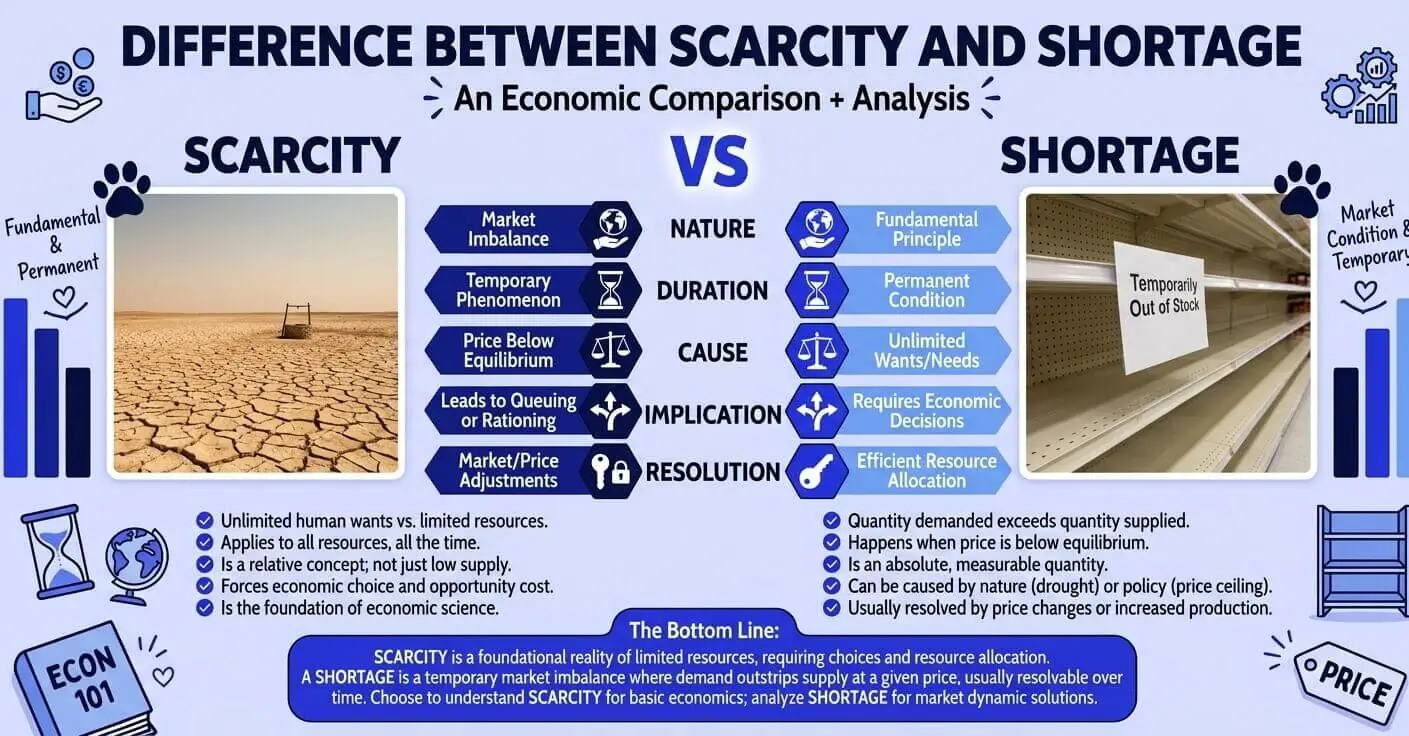

Scarcity and shortage both describe situations involving limited availability, so the terms are easy to confuse. In economics, however, they describe different problems. Scarcity is the fundamental condition that resources are limited relative to human wants, while a shortage occurs when the quantity demanded of a particular good or service exceeds the quantity supplied at a particular price.
The distinction matters because scarcity is a basic condition of economic life, whereas a shortage is a specific market situation. Understanding the difference makes it easier to interpret prices, supply and demand, resource allocation, and everyday economic examples.
Quick Answer
Scarcity means that available resources are limited compared with the many wants and uses people have for them. It is a fundamental economic condition.
Shortage means that, at a particular price and time, buyers want more of a good or service than sellers are supplying.
In simple terms:
Scarcity is about limited resources and unlimited wants; shortage is about demand exceeding supply in a particular market situation.
A shortage can occur within a world where scarcity already exists. Scarcity is therefore the broader economic concept, while shortage is a more specific market condition.
Scarcity vs. Shortage at a Glance
| Feature | Scarcity | Shortage |
|---|---|---|
| Basic meaning | Resources are limited relative to wants | Quantity demanded exceeds quantity supplied |
| Scope | Broad and fundamental | Specific to a good, service, market, or situation |
| Main relationship | Limited resources vs. unlimited wants | Demand vs. supply |
| Price required? | No | Usually analyzed at a particular price |
| Duration | Fundamental and ongoing | Often temporary or situation-specific |
| Typical causes | Finite resources and competing uses | Demand increases, supply disruptions, price controls, or other market conditions |
| Can it be eliminated completely? | No, not while wants exceed available resources | A particular shortage can be resolved or reduced |
| Example | Limited land, time, labor, or natural resources | Not enough gasoline available at the current market price |
This distinction is consistent with standard economics teaching materials from Georgia Public Broadcasting, Pearson, and OpenStax.
What Does Scarcity Mean?
Scarcity is the basic economic condition in which resources are limited while human wants and possible uses for those resources are greater.
Resources can include:
- land
- water
- labor
- time
- capital
- raw materials
- energy
- productive capacity
Because resources have limits and can often be used for different purposes, people must make choices about how to allocate them. Scarcity therefore leads to trade-offs and opportunity costs.
For example, a person has only 24 hours in a day. Those hours can be used for work, sleep, education, exercise, entertainment, or other activities. Time is therefore scarce because there are competing uses for a limited resource.
Scarcity does not necessarily mean that something is extremely rare or almost nonexistent. A resource can be widely available and still be scarce in the economic sense because it has limits and alternative uses.
The Federal Reserve Bank of St. Louis describes scarcity as existing because there are not enough resources to produce everything people want.
Example of Scarcity
Imagine a farmer has 100 acres of land.
The land could be used for:
- wheat
- vegetables
- livestock
- housing
- another crop
The farmer cannot use the same acre for every purpose at the same time. The limited land creates a need to choose how it will be allocated.
That is scarcity.
What Does Shortage Mean?
A shortage occurs when the quantity demanded of a particular good or service exceeds the quantity supplied at the prevailing price.
In other words:
At the current price, buyers want more than sellers are offering.
Shortages are therefore closely connected to supply, demand, and market prices.
For example, suppose a store normally sells bottled water for $1 per bottle. A sudden heat wave causes many more people to want bottled water, but the store cannot immediately increase its inventory.
If customers want 1,000 bottles while only 600 are available at that price, there is a shortage of 400 bottles.
The underlying resources used to produce bottled water are scarce, but the shortage describes the particular market imbalance between what buyers want and what is available for sale at the current price.
Georgia Public Broadcasting gives a similar example in which severe weather can create a temporary shortage of bottled water even though the underlying resources used to produce bottled water remain scarce.
What Is the Main Difference Between Scarcity and Shortage?
The central difference is what is being compared.
Scarcity compares:
Limited resources → unlimited wants and competing uses
Shortage compares:
Quantity demanded → quantity supplied at a particular price
This gives you a useful rule:
Scarcity is a fundamental resource problem. A shortage is a specific market imbalance.
For example, clean water can be scarce because water resources are limited relative to all possible uses.
A city may also experience a water shortage if, at the current price or under current supply conditions, residents want more water than suppliers can provide.
The two concepts can therefore exist at the same time without meaning the same thing.
Why Scarcity Exists Even Without a Shortage
This is one of the most important distinctions.
Suppose a supermarket has plenty of apples on its shelves. There is no shortage of apples in that store because customers can currently buy the quantity they want at the listed price.
Apples are nevertheless produced using scarce resources such as:
- land
- water
- labor
- fertilizer
- machinery
- transportation
- time
Those resources have alternative uses. The economy cannot produce an unlimited quantity of apples, houses, cars, healthcare, entertainment, and every other desirable product simultaneously.
So:
No shortage does not mean no scarcity.
Scarcity is the broader condition underlying economic choice.
When to Use “Scarcity”
Use scarcity when discussing:
- limited economic resources
- unlimited human wants
- competing uses of resources
- opportunity cost
- resource allocation
- fundamental economic choices
- long-term limitations on production
Example
Scarcity forces businesses to decide how to use their limited resources.
Here, the statement is about the broader economic problem rather than a temporary lack of a particular product.
When to Use “Shortage”
Use shortage when discussing:
- a specific good or service
- insufficient supply for current demand
- a particular market
- a particular price
- sudden demand increases
- supply disruptions
- price controls
- temporary or persistent market imbalances
Example
The city experienced a shortage of fuel after deliveries were disrupted.
The statement refers to a particular product and a specific supply problem.
Scarcity and Shortage in Real Sentences
Scarcity
Scarcity of land makes urban development more expensive.
The sentence describes a limited resource with competing uses.
Scarcity forces consumers to make choices about how to spend their income.
The focus is on the broader economic condition of limited resources.
Shortage
The supermarket faced a shortage of bottled water after demand suddenly increased.
The focus is on a specific product and a supply-demand imbalance.
A shortage of workers delayed construction projects.
The focus is on insufficient labor supply relative to demand for workers in a particular situation.
Common Causes of Shortages
A shortage can develop for several reasons.
1. Sudden Increase in Demand
If consumers suddenly want much more of a product and suppliers cannot immediately increase production, a shortage can develop.
2. Supply Disruption
Natural disasters, transportation problems, production failures, geopolitical events, or other disruptions can reduce available supply.
3. Price Controls
A price ceiling below the market-clearing price can create a situation in which quantity demanded exceeds quantity supplied. OpenStax identifies excess demand at such a price as a shortage.
4. Production Constraints
Manufacturers may temporarily lack workers, raw materials, equipment, or other inputs needed to satisfy demand.
The Federal Reserve’s 2026 research on shortages also discusses supply disruptions, demand pressures, geopolitical events, production constraints, and other factors associated with shortage episodes.
Common Mistakes With Scarcity and Shortage
Mistake 1: Treating Them as Exact Synonyms
Incorrect:
Scarcity and shortage mean exactly the same thing in economics.
Correct:
Scarcity is the broader condition of limited resources relative to wants, while a shortage is a specific situation in which quantity demanded exceeds quantity supplied at a given price.
Why: The terms overlap in everyday language but have distinct meanings in economics.
Mistake 2: Thinking Scarcity Means Something Is Extremely Rare
Incorrect:
Gold is scarce only because very little of it exists.
Better:
Gold is economically scarce because its available quantity is limited relative to its possible uses and demand.
Why: Economic scarcity concerns limitations relative to wants and alternative uses, not simply whether something is rare.
Mistake 3: Assuming Every Shortage Is Permanent
Incorrect:
A shortage means there will never be enough of the product.
Correct:
A shortage can persist, but it is a specific imbalance between demand and supply under particular market conditions.
Why: Many shortages are temporary, but some can last for extended periods. The Federal Reserve’s research demonstrates that shortages can have persistent economic effects.
Mistake 4: Thinking More Supply Eliminates Scarcity
Incorrect:
If we produce more goods, scarcity disappears.
Correct:
Greater production can reduce scarcity for particular resources or goods, but scarcity remains a fundamental economic condition when resources are limited relative to human wants.
Common Collocations
Scarcity
Common phrases include:
- resource scarcity
- scarcity of resources
- scarcity of water
- scarcity of land
- scarcity of labor
- scarcity of capital
- economic scarcity
- natural resource scarcity
Shortage
Common phrases include:
- food shortage
- water shortage
- labor shortage
- housing shortage
- fuel shortage
- supply shortage
- shortage of workers
- shortage of goods
- temporary shortage
- severe shortage
These combinations reflect the different ways the two concepts are normally used: scarcity commonly describes limitations on resources, while shortage commonly describes a specific insufficiency affecting a good, service, or market.
How Price Relates to a Shortage
Price is one of the clearest ways to distinguish a shortage from scarcity.
In a basic supply-and-demand model, a shortage occurs when buyers want to purchase more than sellers are willing to supply at the current price.
If the price can adjust upward, the quantity demanded may decrease while the quantity supplied may increase, moving the market toward equilibrium.
A price ceiling can prevent that adjustment. OpenStax explains that when a binding price ceiling keeps price below equilibrium, quantity demanded can exceed quantity supplied, producing a shortage.
This does not mean that every real-world shortage is caused by a price ceiling. Supply disruptions and sudden demand increases can also produce shortages.
Can Scarcity and Shortage Be Used Interchangeably?
Usually not in economics.
In ordinary conversation, people may use the words interchangeably to describe limited availability. But in an economics context, the distinction is important.
Use scarcity when discussing the fundamental limitation of resources relative to wants.
Use shortage when discussing a specific situation in which demand exceeds supply at a particular price.
Simple comparison
Scarcity = limited resources relative to wants.
Shortage = quantity demanded greater than quantity supplied at a particular price.
How to Remember the Difference
Think of the two questions:
Scarcity asks:
“Do we have enough resources to satisfy every possible want?”
No. Resources are limited, so choices must be made.
Shortage asks:
“At this price, are buyers trying to obtain more than sellers are supplying?”
If yes, there is a shortage.
A useful memory phrase is:
Scarcity is the big economic problem; shortage is the specific market problem.
Which One Should I Use?
Use This Quick Decision Guide
The correct term depends on whether you are discussing a general economic constraint or a specific market situation.
Scarcity describes a situation in which resources are limited while human wants are unlimited.
For a specific good or service, shortage refers to a situation where buyers want more than sellers are currently supplying.
When discussing opportunity cost, resource allocation, or limited resources, the concept of scarcity is generally the appropriate choice.
On the other hand, topics such as excess demand, market prices, or insufficient supply of a particular product are usually associated with the term shortage.
X or Y? Practice Examples
Choose scarcity or shortage in each sentence.
- The country has limited freshwater resources, creating economic ______.
- A sudden increase in demand caused a ______ of concert tickets.
- ______ forces people and businesses to make choices about how to use limited resources.
- The supermarket experienced a temporary ______ of cooking oil.
- Limited land is an example of ______.
- A price ceiling can contribute to a ______ when quantity demanded exceeds quantity supplied.
- The economy must decide how to allocate its ______ resources.
- A supply-chain disruption created a ______ of computer chips.
Answers
- scarcity
- shortage
- scarcity
- shortage
- scarcity
- shortage
- scarce
- shortage
The key is to ask whether the sentence describes a fundamental limitation of resources or a specific supply-demand imbalance.
Frequently Asked Questions
What is the difference between scarcity and shortage?
Scarcity is the fundamental economic condition in which resources are limited relative to human wants and competing uses. A shortage occurs when quantity demanded exceeds quantity supplied for a particular good or service at a particular price.
Is scarcity permanent?
Scarcity is considered a fundamental and ongoing condition of economics because resources remain limited relative to the full range of human wants and possible uses.
Is a shortage temporary?
A shortage is often temporary or situation-specific, but it does not have to disappear immediately. Some shortages can persist for long periods depending on supply constraints, demand, prices, and other conditions.
Can scarcity cause a shortage?
Scarcity and shortage are related, but they are not simply cause and effect. Scarcity describes the broader limitation of resources, while a shortage describes a specific market imbalance. A scarce resource can be involved in a shortage, but a shortage can also result from sudden demand changes, supply disruptions, or price restrictions.
Can a shortage be solved?
A particular shortage can often be reduced or eliminated by changes in supply, demand, prices, production, imports, substitution, or other market adjustments. The specific solution depends on why the shortage occurred.
Are scarcity and shortage the same in economics?
No. They overlap in everyday language but represent different economic concepts. Scarcity concerns limited resources relative to wants; shortage concerns quantity demanded exceeding quantity supplied at a particular price.
What is an example of scarcity?
Limited land, time, labor, water, and other productive resources are examples of scarcity. People and organizations must decide how to allocate these resources among competing uses.
What is an example of a shortage?
If a sudden increase in demand causes consumers to want 10,000 units of a product while only 7,000 units are supplied at the current price, the market has a shortage of 3,000 units.
Conclusion
The difference between scarcity and shortage comes down to the level of the economic problem. Scarcity is the fundamental condition of limited resources relative to unlimited wants and competing uses. Shortage is a specific market situation in which quantity demanded exceeds quantity supplied at a particular price.
Remember the practical rule: use “scarcity” for the broader limitation of economic resources, and use “shortage” for a specific supply-and-demand imbalance. A shortage can change or disappear, while scarcity remains a fundamental feature of economic choice.

Sajid Ali is an English language educator and content specialist with 7+ years of teaching experience. He holds master’s degrees in Information Technology and Education from the Virtual University of Pakistan and writes SEO-optimized, learner-friendly vocabulary content for diffari.com.