If you have ever compared two Bibles, you may have noticed that the same verse can use noticeably different words. One version may sound traditional, another may use modern English, and a third may explain the same idea in a much more conversational way. This can make it seem as though different Bible versions are saying different things.
The main reason is that Bible versions make different translation choices. Translators work from ancient Hebrew, Aramaic, and Greek texts and must communicate those texts in another language. Some versions stay closer to the wording and structure of the source languages, while others place greater emphasis on communicating the meaning naturally in modern English. Other differences can come from textual traditions, revisions, editorial decisions, and, in some editions, the number of biblical books included.
Understanding these differences makes it much easier to choose and use a Bible version wisely.
Quick Answer
Bible versions differ mainly in how translators render the original biblical languages into English. Some emphasize close correspondence to the wording and structure of the original text, while others emphasize communicating its meaning in clear, natural English.
Differences can also result from the manuscripts or textual editions consulted, revision history, translation philosophy, and the biblical canon represented by a particular edition.
So, a different Bible version does not necessarily mean a completely different message. Often, it is a different way of expressing the same underlying passage.
Bible Versions at a Glance
| Feature | Bible Versions |
| Main purpose | Communicate biblical texts in a particular language |
| Original languages | Hebrew, Aramaic, and Greek |
| Main difference | Translation and editorial choices |
| Some emphasize | Close wording and structure |
| Others emphasize | Meaning and natural readability |
| Examples | KJV, NKJV, NIV, ESV, NLT, NRSVue, NASB |
| Can wording differ? | Yes |
| Can textual notes differ? | Yes |
| Can the number of books differ? | In some editions and traditions, yes |
What Is a Bible Version?
A Bible version is an English presentation of the biblical text produced through a particular translation, revision, or editorial tradition.
The term version is often used interchangeably with translation in everyday discussion. However, not every difference between two Bibles comes simply from replacing one English word with another.
A Bible translation has to deal with differences between ancient languages and modern English. Hebrew, Aramaic, and Greek do not always express ideas using the same grammar, sentence structure, idioms, or vocabulary as English.
For that reason, translating the Bible involves interpretation and communication, not merely substituting individual words.
Why Are Bible Versions Different?
Several factors can cause differences between Bible versions.
1. Translation philosophy
This is one of the most important differences.
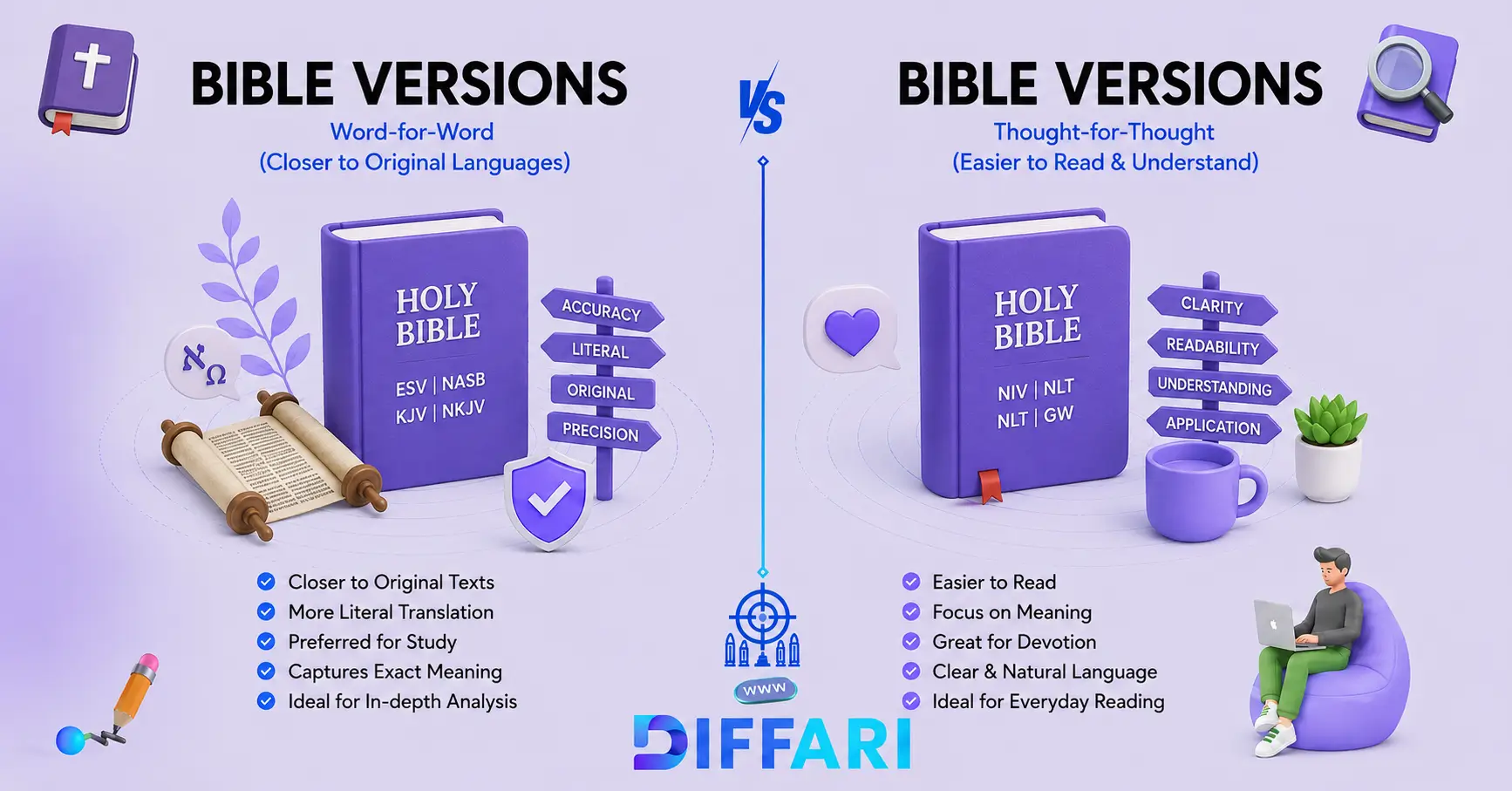
Some translations try to preserve the wording and structure of the source text as closely as practical. This approach is commonly called formal equivalence or is described as word-for-word translation.
Other translations place more emphasis on communicating the intended meaning naturally in modern English. This is commonly called functional equivalence, dynamic equivalence, or thought-for-thought translation.
There are also translations that deliberately occupy a middle position.
Bible Gateway describes these approaches as a spectrum rather than a simple either-or choice.
2. Readability
Ancient expressions do not always make sense when translated literally into modern English.
A highly literal rendering may preserve an original expression but leave modern readers wondering what it means. A more meaning-focused translation may replace that expression with something that communicates the same idea more naturally.
The NIV, for example, says its approach seeks to balance transparency to the original text with clear, natural English.
3. Textual sources
Bible translators also have to evaluate the ancient manuscript evidence available to them.
Different translations may sometimes differ because their translators are working from different textual traditions or editions of the Hebrew and Greek texts.
The King James Version, for example, was produced using sources including the Masoretic Text for the Old Testament and the Textus Receptus for the New Testament.
Modern translations may use editions of the Hebrew and Greek texts that incorporate a broader range of manuscript evidence.
4. Revision history
Some versions are revised editions of earlier translations.
The KJV, for example, was originally published in 1611 and underwent later revision, including the well-known 1769 revision. The ESV was published in 2001 and has also received subsequent updates.
Therefore, two Bibles carrying related names may not have identical wording.
5. Canon and edition
The number of books represented can also vary between Bible traditions and editions.
For example, some NRSVue editions include Deuterocanonical/Apocryphal books, and a Catholic Edition is also available.
This is a different issue from translation style. It concerns which books are included in a particular biblical canon or edition.
Word-for-Word vs Thought-for-Thought
One of the easiest ways to understand Bible-version differences is to look at the translation spectrum.
Formal Equivalence
Formal equivalence attempts to stay relatively close to the wording, grammatical structures, and forms of the original languages while still producing understandable English.
Examples commonly associated with this approach include the ESV, NASB, KJV, and NKJV, although each has its own translation philosophy and history.
The ESV describes itself as an “essentially literal” translation that seeks to reproduce the precise wording and style of the original text as far as possible while accounting for differences between the languages.
Functional Equivalence
Functional equivalence focuses more strongly on communicating the meaning of the original text in natural language.
The translator may restructure a phrase when a literal rendering would be confusing or unnatural.
The NLT and CEB are examples of translations commonly placed toward the thought-for-thought end of the spectrum.
Balanced Approaches
Some versions deliberately seek a balance between close attention to the original wording and natural communication.
The NIV is a good example. Biblica describes its approach as balancing transparency to the original with clarity of meaning.
This is why it is misleading to classify every Bible simply as either “literal” or “paraphrased.” Most translations involve many decisions across a spectrum.
How Popular Bible Versions Differ
There is no universally correct version for every reader because different versions can serve different purposes.
King James Version (KJV)
The KJV was originally published in 1611 and has had enormous influence on English literature, worship, and Christian language.
Its English is distinctly traditional, and its translation philosophy is generally associated with formal equivalence.
Best suited to: readers who value traditional language, historical influence, literary style, or a church tradition that uses the KJV.
Potential challenge: its older English can make some passages difficult for modern readers.
New King James Version (NKJV)
The NKJV preserves much of the traditional KJV heritage while updating the language for contemporary readers.
Best suited to: readers who appreciate the KJV tradition but want more modern English.
New International Version (NIV)
The NIV aims to communicate the biblical message in clear, natural contemporary English while maintaining attention to the original languages.
Best suited to: general reading, devotional use, church reading, and readers who want a balance between accuracy and readability.
English Standard Version (ESV)
The ESV describes itself as an essentially literal translation in contemporary English, emphasizing word-for-word correspondence while accounting for English grammar and idiom.
Best suited to: readers who want a modern translation with a strong emphasis on close correspondence to the original text.
New Living Translation (NLT)
The NLT places greater emphasis on communicating the meaning of Scripture in accessible modern English.
Best suited to: beginners, devotional reading, and readers who find more formal translations difficult to follow.
New Revised Standard Version Updated Edition (NRSVue)
The NRSVue is a modern revision used in a range of academic, church, and study settings. Different editions can also address different canonical traditions, including editions containing Deuterocanonical/Apocryphal books.
Best suited to: readers interested in academic study, church use, and contemporary scholarship.
Why Do Bible Verses Look Different?
Two translations can express the same passage using different English words or sentence structures.
For example, one translation might preserve a metaphor more closely, while another might express the underlying idea in more familiar English.
Bible Gateway notes that formal translations may preserve expressions that can sound unfamiliar to modern readers, whereas functional translations may make the intended meaning clearer through natural English.
Therefore, a wording difference does not automatically mean that one translation has changed the entire meaning.
The important question is:
Why did the translators make this particular choice?
The answer may involve grammar, idiom, context, manuscript evidence, or translation philosophy.
Do Bible Versions Use Different Manuscripts?
Sometimes the differences between versions are connected to the textual sources used by their translators.
Ancient biblical texts survive through manuscripts and other textual witnesses. Translators and textual scholars must evaluate this evidence when establishing the wording of the source text.
This can produce differences in certain passages.
For example, Bible Gateway’s textual notes show places where the Textus Receptus differs from other Greek textual evidence.
This is one reason some modern Bibles place certain words or verses in footnotes or brackets rather than printing them in the main text.
It is important not to confuse these textual questions with translation philosophy. They are related but separate issues.
Do Bible Versions Have Different Books?
Sometimes.
Different Christian traditions do not always use exactly the same biblical canon. Some editions contain Deuterocanonical or Apocryphal books in addition to the books found in many Protestant Bibles.
Therefore, when comparing two Bibles, it can be useful to ask two separate questions:
- How does this Bible translate the text?
- Which books does this edition include?
Those are not the same issue.
Are Bible Versions Interchangeable?
Usually, they can be used together, but they are not identical.
If you are reading a passage for general understanding, several translations may communicate essentially the same central idea while using different wording.
For detailed study, however, comparing translations can be especially useful. One version may make a grammatical relationship easier to notice, while another may make the meaning clearer in contemporary English.
Using more than one translation can therefore help you see both the structure and the communicative meaning of a passage.
Which Bible Version Should I Use?
There is no single version that is best for every person or purpose.
Choose KJV if:
You prefer traditional English, historical language, and the literary style associated with the King James tradition.
Choose NKJV if:
You want the KJV tradition but prefer updated English.
Choose ESV if:
You want a modern Bible that emphasizes essentially literal translation.
Choose NIV if:
You want a balance between close attention to the original text and natural contemporary English.
Choose NLT if:
You prioritize accessibility and want an especially easy-to-follow reading experience.
Consider NRSVue if:
You want a contemporary translation commonly used in academic and church settings and need an edition appropriate to your canonical tradition.
The important point is that “best” depends on what you are trying to accomplish.
Bible Versions in Practice
Consider these situations:
You are a new reader and struggle with older English.
A contemporary translation may make the text easier to understand.
You are studying a passage closely.
A more formally oriented translation may help you observe relationships between the English wording and the structure of the original text.
Your church uses one specific version.
Using that version can make group reading and teaching easier.
You want to compare a difficult passage.
Reading two or three translations side by side can reveal where translators made different interpretive or linguistic choices.
You want to memorize traditional passages.
A historically influential version such as the KJV may be preferable if its wording is already familiar in your tradition.
Common Misunderstandings About Bible Versions
Misunderstanding 1: “More literal always means more accurate.”
Not necessarily.
Languages do not map perfectly word-for-word. A literal translation can sometimes produce an English sentence that fails to communicate the original meaning clearly. Biblica uses this principle to explain why accuracy involves meaning as well as wording.
Misunderstanding 2: “Modern English means less accurate.”
Modern language by itself does not determine accuracy.
A translation can use contemporary English while carefully working from the original languages.
Misunderstanding 3: “Every difference means the Bibles contradict each other.”
No.
Differences can result from grammar, idioms, translation philosophy, manuscript evidence, textual decisions, or English style.
Misunderstanding 4: “There is one Bible version that is best for everyone.”
Different readers have different needs.
A version that works exceptionally well for detailed study may not be the easiest choice for someone reading the Bible for the first time.
How to Remember the Difference
Think of Bible versions as different windows looking toward the same ancient textual tradition.
One window may give you a clearer view of the original wording and structure.
Another may make the scene easier to understand through modern language.
A third may preserve a traditional literary style.
The window is different, but the reason for using it is the same: to understand the biblical text.
Which One Should I Use?
If you want traditional English → KJV
If you want traditional style with updated English → NKJV
If you want an essentially literal modern translation → ESV
If you want balanced accuracy and readability → NIV
If you want highly accessible modern English → NLT
If you want a contemporary study-oriented translation → NRSVue
The best choice depends on your reading ability, purpose, preferred style, church tradition, and study needs.
Bible Version Practice Questions
Choose the factor that best explains the difference.
- Two versions use different sentence structures but communicate the same idea. What is the most likely reason?
- One version uses older English such as “thee” and “thou.” What does this tell you?
- One translation explains an ancient idiom using modern English. What translation approach is this closer to?
- Two versions place a disputed passage differently because of textual evidence. What type of difference is involved?
- A Bible edition contains additional Deuterocanonical books. What kind of difference is this?
Answers
- Different translation choices involving grammar, syntax, or translation philosophy.
- It uses traditional or archaic English.
- It is closer to a functional or meaning-focused approach.
- A textual-source or textual-critical difference.
- A canon or edition difference.
Frequently Asked Questions
What is the difference between Bible versions?
Bible versions differ mainly in translation choices, including how closely translators follow the wording and structure of the original languages versus how naturally they communicate meaning in modern English. Textual sources, revisions, editorial decisions, and canon can also contribute to differences.
Are Bible versions the same as Bible translations?
The terms are often used interchangeably. In everyday English, a Bible version usually refers to a particular English translation or edition, although “version” can encompass more than translation alone.
Why are there so many Bible versions?
Different translation teams have different goals, methods, source-text decisions, audiences, and approaches to language. Over time, new translations and revisions have also been produced to address changes in English and advances in textual scholarship.
Which Bible version is easiest to understand?
Readability varies by reader, but translations such as the NLT are designed to communicate the biblical message in accessible modern English. The NIV is also widely recognized for balancing readability with attention to the original text.
Which Bible version is best for study?
There is no universal answer. Readers who want closer attention to wording and structure may prefer a more formally oriented translation such as the ESV, while others may benefit from comparing a formal translation with a more meaning-focused version.
Why do some Bible verses differ between versions?
Differences can come from translation philosophy, English grammar, interpretation of idioms, textual evidence, manuscript differences, and editorial decisions.
Are KJV and modern Bible versions based on the same texts?
They share the same broad biblical writings, but their translators did not necessarily rely on exactly the same textual editions or manuscript evidence. The KJV’s New Testament was based on the Textus Receptus tradition, while modern translations may draw on broader or different critical editions of the Greek New Testament.
Can I read more than one Bible version?
Yes. Comparing translations can be useful because different versions can highlight different aspects of a passage’s wording, structure, and meaning.
Are Bible versions interchangeable?
They can often be compared for general reading, but they are not identical. For detailed study, it is better to recognize each translation’s philosophy and textual notes rather than treating every version as interchangeable.
Conclusion
The difference between Bible versions is mainly a difference in how the biblical texts are translated and presented, not simply a matter of one version being modern and another being old. Translation philosophy, readability, textual sources, revisions, editorial decisions, and canon can all affect what readers see on the page.