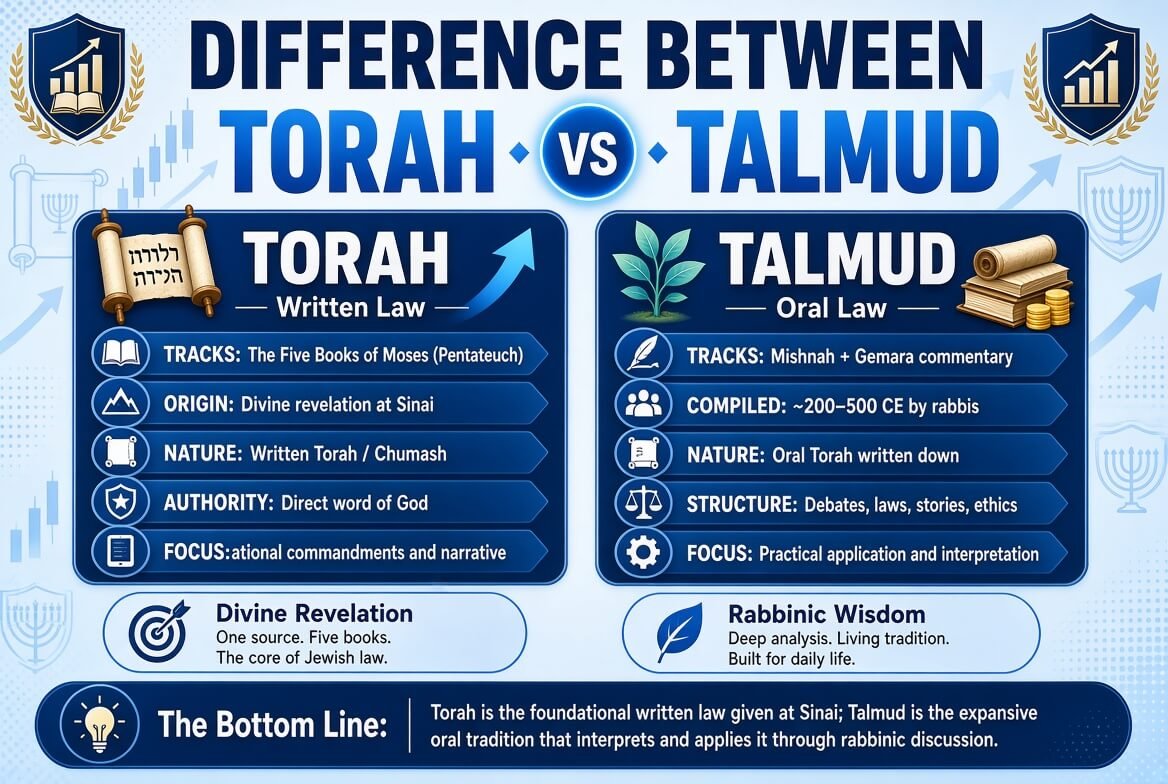
The Torah and Talmud are both foundational to Jewish learning and tradition, but they are not the same thing. In its most common narrow sense, the Torah refers to the Five Books of Moses—Genesis, Exodus, Leviticus, Numbers, and Deuteronomy. The Talmud is a much later collection of rabbinic teachings, discussions, interpretations, and legal reasoning that developed around Jewish tradition and the Torah.
The relationship becomes clearer when you distinguish the Written Torah from the Oral Torah. The Talmud is one of the major written records of the Oral Torah, consisting of the Mishnah and Gemara.
Quick Answer
The Torah is the foundational biblical text containing the Five Books of Moses, while the Talmud is a later body of rabbinic literature that records discussions, interpretations, traditions, and legal reasoning related to the Torah and Jewish law.
In simple terms, the Torah provides the foundational text; the Talmud preserves generations of rabbinic analysis about how that tradition is understood and applied.
There is one important qualification: Torah can also be used more broadly to mean Jewish teaching or tradition, so the word does not always refer only to the Five Books of Moses.
Torah vs Talmud at a Glance
| Torah | Talmud | |
|---|---|---|
| Basic meaning | The Five Books of Moses | Rabbinic literature containing Mishnah and Gemara |
| Main content | Biblical narrative, commandments, teachings and laws | Rabbinic discussions, interpretation, legal reasoning and tradition |
| Historical layer | Biblical | Mainly rabbinic, developed centuries later |
| Language | Primarily Biblical Hebrew | Hebrew and Aramaic |
| Structure | Five books | Mishnah + Gemara |
| Primary relationship | Foundational written text | Discusses and develops interpretations of Jewish tradition |
| Common forms | Torah scroll / Chumash | Babylonian Talmud and Jerusalem Talmud |
| Typical study | Reading, interpretation and study of the biblical text | Detailed analysis and debate over rabbinic and legal traditions |
The Talmud is specifically described as being composed of the Mishnah and Gemara.
What Is the Torah?
In its narrow and most common sense, the Torah is the Five Books of Moses:
- Genesis
- Exodus
- Leviticus
- Numbers
- Deuteronomy
These books form the beginning of the Tanakh, the Hebrew Bible. A Torah scroll contains these five books and is traditionally used for public reading in the synagogue.
The Hebrew word torah has a broader meaning related to instruction, teaching, direction, or law. Consequently, Jewish usage does not always restrict Torah to the Five Books of Moses. It can refer more broadly to Jewish learning and tradition.
That distinction matters when comparing Torah and Talmud.
When someone asks, “What does the Torah say?” they will usually mean the Five Books of Moses. When someone speaks about “Torah study” (talmud Torah), however, the subject can encompass a much wider body of Jewish learning, including rabbinic texts.
What Is the Talmud?
The Talmud is a major body of rabbinic literature. It contains generations of discussions about Jewish law, interpretation, tradition, ethics, and other subjects.
The Talmud has two principal components:
- Mishnah — an early compilation of rabbinic teachings and legal traditions.
- Gemara — later rabbinic discussion and analysis of the Mishnah.
Together, the Mishnah and Gemara constitute the Talmud.
There are two major Talmudic compilations:
- Babylonian Talmud (Talmud Bavli)
- Jerusalem Talmud (Talmud Yerushalmi)
They developed in different rabbinic environments, and the Babylonian Talmud became especially influential in traditional Jewish legal interpretation.
What Is the Difference Between Torah and Talmud?
The simplest distinction is type and historical role.
The Torah, in the narrow sense, is the foundational biblical text of the Five Books of Moses. The Talmud is a later body of rabbinic literature that explores, interprets, debates, and develops Jewish legal and intellectual traditions.
But calling the Talmud merely a “commentary” can be misleading.
A conventional commentary might explain a difficult passage in a text. The Talmud does much more. It preserves arguments between rabbis, compares different traditions, investigates how legal positions relate to biblical sources, and works through difficult cases and principles.
My Jewish Learning describes the Talmudic process as involving the analysis of Mishnah traditions and attempts to understand the reasoning behind different rabbinic positions.
So the relationship can be summarized as:
Torah → foundational biblical text
Talmud → later rabbinic discussion, interpretation and analysis connected to Torah and Jewish tradition
Written Torah vs Oral Torah
This is one of the most important distinctions for understanding the subject.
The Written Torah generally refers to the written biblical tradition, especially the Five Books of Moses in the narrow sense.
The Oral Torah refers to the interpretive and legal tradition transmitted through rabbinic teaching and eventually recorded in works such as the Mishnah and Gemara.
According to traditional Jewish accounts, the written and oral dimensions of Torah belong together. My Jewish Learning describes the Oral Torah as including the rabbinic works that explain and expand upon the statutes of the Written Torah.
The Talmud is therefore closely connected to the Oral Torah, but the terms are not simply synonyms:
Oral Torah = a broader concept and tradition.
Talmud = a major written record of that rabbinic tradition, specifically the Mishnah together with the Gemara.
Mishnah vs Gemara: How They Fit Into the Talmud
The terms Mishnah, Gemara, and Talmud are sometimes confused.
The basic relationship is:
Mishnah + Gemara = Talmud
The Mishnah is an early compilation of rabbinic legal teachings. The Gemara contains subsequent discussions and analysis of the Mishnah.
This means that the Talmud is not simply another name for the Torah.
For example:
Torah → biblical text
Mishnah → early rabbinic compilation
Gemara → discussion and analysis of the Mishnah
Talmud → Mishnah + Gemara
Understanding this structure makes the terminology much easier to remember.
How Does the Talmud Relate to Jewish Law?
The Torah contains commandments and laws that form a foundation for Jewish practice. The Talmud preserves extensive rabbinic discussion about how those laws and traditions should be interpreted and understood.
However, the Talmud should not be thought of simply as a straightforward modern law code.
The Talmud frequently presents multiple opinions and unresolved arguments. It is a record of a legal and intellectual process rather than a book in which every discussion ends with one clearly stated rule. My Jewish Learning notes that the Talmud contains numerous debates and elaborations and is not itself simply a code of law.
Later Jewish legal authorities used Talmudic discussions as major sources for determining halakhah, or Jewish law.
Are the Torah and Talmud Interchangeable?
No.
The terms should not normally be used interchangeably.
If you mean the Five Books of Moses, use Torah.
If you mean the rabbinic corpus made up principally of Mishnah and Gemara, use Talmud.
There is some potential confusion because Torah can have a broader meaning. In Jewish contexts, it can refer to Jewish teaching and learning generally, and some sources use it broadly enough to encompass rabbinic literature.
So the safest rule is:
“Torah” has both narrow and broad meanings; “Talmud” refers to a specific body of rabbinic literature.
Torah and Talmud in Real Examples
Consider a simple example involving a commandment.
The Torah may contain the foundational command or principle.
The Talmud may then preserve rabbinic discussion asking questions such as:
- What exactly does the command mean?
- What situations fall within its scope?
- How should apparently conflicting passages be understood?
- How did earlier sages interpret the command?
- What happens in an unusual case?
This is why the Talmud is much more argumentative and discursive than the biblical Torah.
The Talmud can contain legal reasoning alongside stories, ethical teachings, interpretation, and other material.
Common Misconceptions About Torah and Talmud
Misconception 1: “The Talmud is another name for the Torah.”
Incorrect.
The Talmud and Torah are distinct bodies of Jewish literature, although they are closely connected.
Misconception 2: “The Talmud is only a commentary on the Torah.”
Too simple.
The Talmud includes commentary and interpretation, but it also records extensive rabbinic debate, legal analysis, traditions, stories, and intellectual discussion.
Misconception 3: “Torah always means only the Five Books of Moses.”
Not necessarily.
That is the standard narrow meaning, but Torah can also refer more broadly to Jewish teaching and tradition.
Misconception 4: “There is only one Talmud.”
There are two major Talmudic compilations: the Babylonian Talmud and the Jerusalem Talmud.
Common Collocations
Torah
Common expressions include:
- Torah scroll
- Torah reading
- Torah study
- Five Books of Moses
- Written Torah
- Oral Torah
- Torah law
- Torah portion
Talmud
Common expressions include:
- Talmud study
- Talmudic discussion
- Talmudic interpretation
- Babylonian Talmud
- Jerusalem Talmud
- Talmudic law
- Talmudic scholars
- study the Talmud
Pronunciation
The commonly given English pronunciations are approximately:
- Torah: TORE-uh
- Talmud: TALL-mud
- Mishnah: MISH-nuh
- Gemara: guh-MAHR-uh
These terms are not homophones and are not pronounced alike.
How to Remember the Difference
Use this simple framework:
Torah = the foundational biblical text.
Talmud = rabbinic discussion and analysis.
Then remember the Talmud’s internal structure:
Mishnah + Gemara = Talmud.
One further distinction makes the whole topic easier:
Written Torah ≠ Oral Torah ≠ Talmud, although these concepts are closely related.
The Oral Torah is the broader tradition; the Talmud is one of its most important written records.
Which One Should I Use?
If you mean the Five Books of Moses, use:
→ Torah
If you mean the rabbinic compilation containing Mishnah and Gemara, use:
→ Talmud
If you mean the broader body of Jewish teaching and tradition, the word:
→ Torah
may also be appropriate depending on context.
If you are discussing the broader rabbinic tradition that includes material transmitted orally and later recorded in rabbinic literature, use:
→ Oral Torah
Torah or Talmud? Practice Examples
Choose Torah or Talmud in each sentence.
- The Five Books of Moses are known as the ______.
- The Mishnah and Gemara together form the ______.
- The ______ contains Genesis, Exodus, Leviticus, Numbers, and Deuteronomy.
- Rabbinic discussions and legal analysis are prominent in the ______.
- A traditional Torah scroll contains the five books of the ______.
- The Babylonian and Jerusalem versions are both ______ compilations.
- The ______ is divided into five books.
- The Mishnah is a component of the ______.
Answers
- Torah
- Talmud
- Torah
- Talmud
- Torah
- Talmud
- Torah
- Talmud
Frequently Asked Questions
Is the Talmud part of the Torah?
It depends on how the word Torah is being used. In the narrow sense of the Five Books of Moses, the Talmud is not part of those five books. In broader Jewish usage, Torah can refer to Jewish teaching more generally and can include rabbinic learning.
Is the Talmud the same as the Oral Torah?
No. The Oral Torah is a broader concept referring to the transmitted interpretive and legal tradition. The Talmud is a major written record of that tradition, principally consisting of Mishnah and Gemara.
What is the main difference between Torah and Talmud?
The Torah, in its narrow sense, is the Five Books of Moses. The Talmud is a later rabbinic corpus containing the Mishnah and Gemara and extensive discussion of Jewish law, interpretation, tradition, and related subjects.
Which came first, Torah or Talmud?
The Torah came first in the traditional Jewish textual framework. The Talmud developed much later through generations of rabbinic teaching and discussion. The Mishnah was compiled in the early centuries of the Common Era, followed by the development of the Gemara and the two Talmudic compilations.
Are there two Talmuds?
Yes. The two major Talmuds are the Babylonian Talmud and the Jerusalem Talmud.
Is the Torah the whole Hebrew Bible?
No, not in the narrow sense. The Torah is the first five books of the Tanakh. The Tanakh also includes the Prophets (Nevi’im) and Writings (Ketuvim).
Does the Talmud contain only laws?
No. Legal discussion is a major component, but the Talmud also contains stories, ethical material, interpretation, traditions, and other forms of rabbinic discussion.
Conclusion
The Torah and Talmud are closely connected but distinct. In its narrow sense, the Torah is the Five Books of Moses and forms the foundational written text of Jewish tradition. The Talmud is a later rabbinic body of literature made up principally of the Mishnah and Gemara, preserving generations of interpretation, debate, legal reasoning, and tradition.
The easiest rule is: Torah refers to the foundational biblical text; Talmud refers to a major body of rabbinic discussion and interpretation. Just remember that Torah can also be used more broadly for Jewish teaching and tradition.