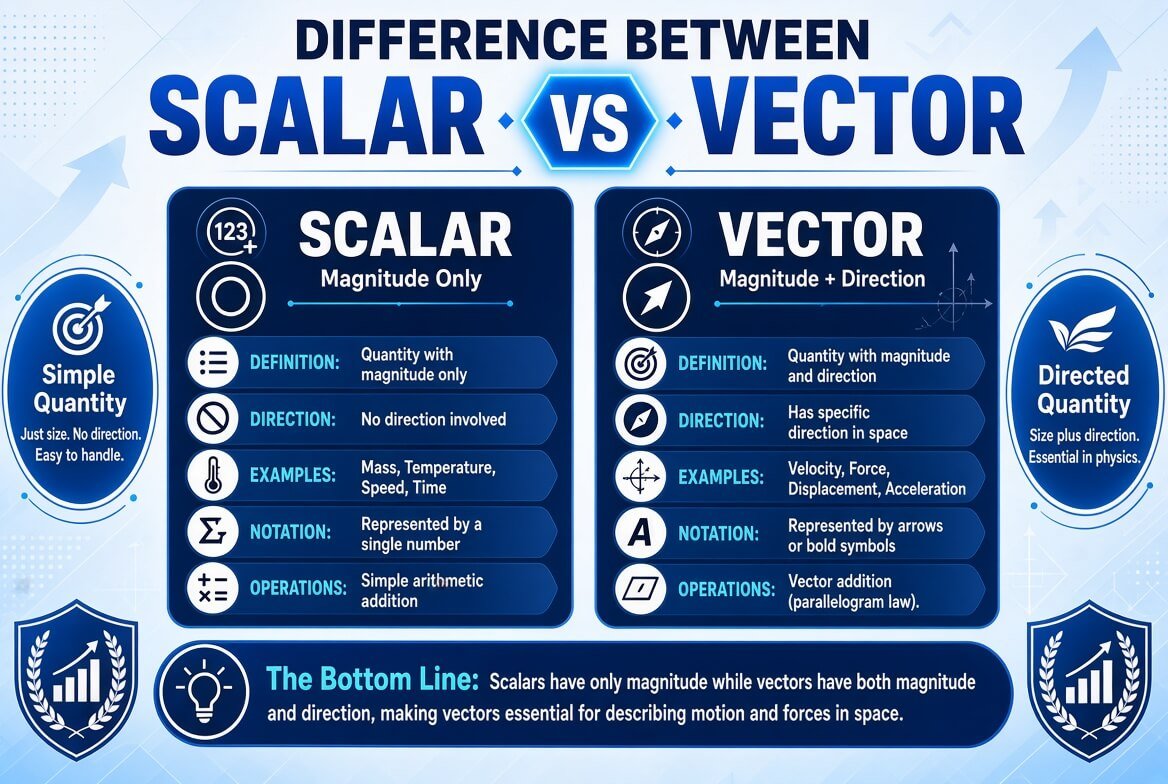
In physics, scalar and vector describe two different ways of representing physical quantities. The difference is simple but fundamental: a scalar quantity is completely described by its magnitude, while a vector quantity requires both magnitude and direction.
For example, saying a car is traveling at 60 km/h gives its speed, which is a scalar. Saying it is traveling at 60 km/h east gives its velocity, which is a vector because direction has been specified.
Understanding this distinction helps you classify physical quantities correctly and prevents common mistakes involving speed and velocity, distance and displacement, force, acceleration, and other quantities.
Quick Answer
A scalar is a physical quantity that has magnitude only, such as mass, time, temperature, distance, or speed.
A vector is a physical quantity that has magnitude and direction, such as displacement, velocity, acceleration, or force.
The easiest rule to remember is:
If direction is required to completely describe the quantity, it is a vector. If direction is not required, it is a scalar.
Scalar vs Vector at a Glance
| Feature | Scalar | Vector |
|---|---|---|
| What describes it? | Magnitude | Magnitude + direction |
| Direction required? | No | Yes |
| Common examples | Mass, time, distance, speed, temperature, energy | Displacement, velocity, acceleration, force, momentum |
| Representation | Number and unit | Magnitude with direction; often an arrow |
| Addition | Ordinary arithmetic when applicable | Direction must be considered |
| Example | 20 kg | 20 N east |
OpenStax and Khan Academy both describe the fundamental distinction in terms of magnitude and direction.
What Is a Scalar?
A scalar quantity is a physical quantity that can be completely described by its magnitude and appropriate unit, without specifying a direction.
Examples include:
- Mass: 5 kg
- Time: 30 s
- Temperature: 25°C
- Distance: 10 m
- Speed: 60 km/h
- Energy: 500 J
- Volume: 2 L
If you say that an object has a mass of 5 kg, there is no additional direction needed to make that measurement complete.
The same applies to a temperature of 20°C or a time interval of 10 seconds.
Scalars can be positive or, in some contexts, negative. A negative scalar does not automatically become a vector. For example, temperature can be below zero without having a physical direction.
What Is a Vector?
A vector quantity has both a magnitude and a direction.
For example:
- Velocity: 60 km/h east
- Displacement: 10 m north
- Force: 50 N downward
- Acceleration: 9.8 m/s² downward
- Momentum: 20 kg·m/s west
Simply saying “60 km/h” does not specify a direction, so it describes speed. Saying “60 km/h east” describes velocity.
Vectors are commonly represented graphically by arrows. The arrow’s length represents the magnitude, while the direction in which it points represents the vector’s direction.
In mathematical notation, vectors may be written using an arrow over a symbol, such as v⃗, or in bold type.
What Is the Difference Between Scalar and Vector?
The fundamental difference is the information needed to describe each quantity completely.
Scalar
Magnitude only
Example:
60 km/h
This tells you how fast something is moving, but not which way it is moving.
Vector
Magnitude + direction
Example:
60 km/h east
Now both the size of the velocity and its direction are known.
This difference also changes how the quantities are combined. Scalars can generally be handled using ordinary arithmetic, while vectors must account for direction. OpenStax specifically notes that vector addition and subtraction cannot be treated simply as ordinary addition of magnitudes.
For example:
3 + 4 = 7
for ordinary scalar quantities.
But two vectors with magnitudes 3 and 4 do not necessarily have a resultant magnitude of 7. They point in opposite directions, their resultant can be 1. If they point in the same direction, it can be 7. If they point at another angle, the result lies between these possibilities.
That is why direction matters.
Common Scalar Examples
Common scalar quantities include:
| Scalar quantity | Example |
|---|---|
| Mass | 5 kg |
| Time | 20 s |
| Temperature | 25°C |
| Distance | 100 m |
| Speed | 80 km/h |
| Energy | 500 J |
| Volume | 3 L |
The exact list can vary with the physics context, but these are standard examples used in introductory physics resources.
Common Vector Examples
Common vector quantities include:
| Vector quantity | Example |
|---|---|
| Displacement | 100 m north |
| Velocity | 80 km/h east |
| Acceleration | 9.8 m/s² downward |
| Force | 50 N to the right |
| Momentum | 20 kg·m/s west |
| Position | 5 m above the origin |
The important feature is not simply the unit. It is whether the quantity requires direction as part of its physical description.
Distance vs Displacement
One of the most useful examples of the scalar/vector distinction is distance versus displacement.
Distance is a scalar
Distance tells you the total length of the path traveled.
If you walk 500 m around a park, your distance traveled is 500 m.
You do not need to specify a direction.
Displacement is a vector
Displacement describes the change from your starting position to your final position, including direction.
Suppose you walk around a park and finish 100 m east of where you started. Your displacement is 100 m east.
Therefore:
Distance → scalar
Displacement → vector
This distinction is particularly important when an object’s path does not point directly from its starting position to its final position. OpenStax explicitly identifies distance as scalar and displacement as vector.
Speed vs Velocity
Another common pair is speed and velocity.
Speed is a scalar
Speed tells you how fast something is moving.
Example:
A car is traveling at 80 km/h.
No direction is given.
Velocity is a vector
Velocity includes both how fast the object is moving and the direction of motion.
Example:
A car is traveling at 80 km/h north.
So:
Speed → scalar
Velocity → vector
This is one of the easiest practical tests for distinguishing scalar and vector quantities.
How Are Vectors Represented?
Vectors are often represented using arrows.
The two important features are:
- Arrow length → magnitude
- Arrow direction → direction of the vector
For example, a longer arrow can represent a larger force, while an arrow pointing right can represent a force directed to the right.
In one-dimensional problems, direction can sometimes be represented using a positive or negative sign. However, the sign only has meaning after a coordinate system or positive direction has been chosen.
For example, if right is defined as positive:
+10 m/s = 10 m/s to the right
−10 m/s = 10 m/s to the left
The negative sign does not mean that the magnitude of the velocity is negative. It indicates direction relative to the chosen coordinate system.
How Scalar and Vector Addition Differ
Scalars can generally be combined using ordinary arithmetic.
For example, if you travel 5 km and then another 3 km, your total distance traveled is:
5 km + 3 km = 8 km
Vectors are different because direction affects the result.
Suppose two forces act on an object:
- 10 N to the right
- 10 N to the left
Their vector sum is 0 N.
The individual forces have not disappeared. They simply point in opposite directions and cancel when added as vectors.
For vectors that are not along the same line, components or geometric methods can be used to determine the resultant. Khan Academy describes vector addition using end-to-end, component, and related vector methods.
Common Mistakes With Scalars and Vectors
Mistake 1: Treating speed and velocity as the same thing
Incorrect: “Velocity is 60 km/h.”
Better: “Speed is 60 km/h” if no direction is specified.
Why: Velocity is a vector and requires direction.
Mistake 2: Treating distance and displacement as synonyms
Incorrect: “Distance always tells you how far you are from your starting point.”
Correct: Distance describes the total path traveled; displacement describes the change in position from start to finish.
Why: Distance is scalar, while displacement is vector.
Mistake 3: Assuming every negative quantity is a vector
Incorrect: “A negative number must represent a vector.”
Correct: A scalar can also be negative.
Why: A negative sign does not automatically create direction. In one-dimensional vector problems, the sign can represent direction relative to a chosen coordinate system, but negative scalar values can occur too.
Mistake 4: Adding vector magnitudes without considering direction
Incorrect: “Two forces of 5 N and 5 N always produce 10 N.”
Correct: Their resultant depends on their directions.
Why: Vector addition considers both magnitude and direction.
Can Scalars and Vectors Be Used Interchangeably?
No.
A scalar and a vector are different types of physical quantities, even when they have related units.
For example:
- speed and velocity both use units such as m/s;
- distance and displacement both use metres;
- mass and weight are both measured in SI-based units but represent different physical quantities.
Having the same or related units does not make two quantities the same type.
A useful test is:
Does the quantity need a direction to be completely specified?
If yes, treat it as a vector. If no, it is a scalar.
How to Remember the Difference
Use this simple rule:
Scalar = size.
Vector = size + direction.
Think of giving someone directions to a destination.
Saying:
“The destination is 5 km away.”
gives a distance.
Saying:
“The destination is 5 km north.”
gives both distance-like magnitude and direction.
The second statement contains information about orientation, which is the key feature of a vector.
Which One Should I Use?
Use this decision guide:
If you only need the amount or size → Scalar
Examples:
- 5 kg
- 20 seconds
- 30°C
- 100 m of distance
- 50 km/h speed
If you need both amount and direction → Vector
Examples:
- 5 m north
- 20 m/s east
- 30 N downward
- 9.8 m/s² downward
When you encounter an unfamiliar quantity, do not rely only on memorization. Ask whether direction is an essential part of its physical description.
Scalar or Vector? Practice Examples
Classify each quantity as scalar or vector.
- A mass of 10 kg
- A velocity of 20 m/s east
- A temperature of −5°C
- A force of 30 N downward
- A distance of 500 m
- A displacement of 500 m north
- A speed of 90 km/h
- An acceleration of 4 m/s² west
Answers
- Scalar — mass has magnitude but no direction.
- Vector — velocity includes direction.
- Scalar — temperature does not require a spatial direction.
- Vector — force has magnitude and direction.
- Scalar — distance does not require direction.
- Vector — displacement includes direction.
- Scalar — speed gives how fast, without direction.
- Vector — acceleration includes direction.
Frequently Asked Questions
What is the main difference between a scalar and a vector?
A scalar has magnitude only, while a vector has magnitude and direction.
Is speed a scalar or a vector?
Speed is a scalar because it describes how fast something is moving without specifying a direction.
Is velocity a scalar or a vector?
Velocity is a vector because it describes both the rate of motion and its direction.
Is distance a scalar or a vector?
Distance is a scalar. It measures the total length of the path traveled.
Is displacement a scalar or a vector?
Displacement is a vector because it describes a change in position with a direction.
Is force a scalar or a vector?
Force is a vector because both the magnitude and direction of the force matter.
Can a vector have a negative value?
In one-dimensional problems, a vector component can be negative when it points opposite to the chosen positive direction. The negative sign represents direction rather than a negative magnitude.
What is the easiest way to remember scalar and vector?
Remember:
Scalar = magnitude only.
Vector = magnitude + direction.
Then ask whether the quantity needs direction to be completely described.
Conclusion
The difference between scalar and vector quantities comes down to direction. A scalar is completely described by its magnitude, while a vector requires both magnitude and direction. Mass, time, temperature, distance, and speed are common scalars; displacement, velocity, acceleration, and force are common vectors.
The most useful practical rule is simple: if direction matters to the complete description of the quantity, it is a vector; if it does not, it is a scalar.