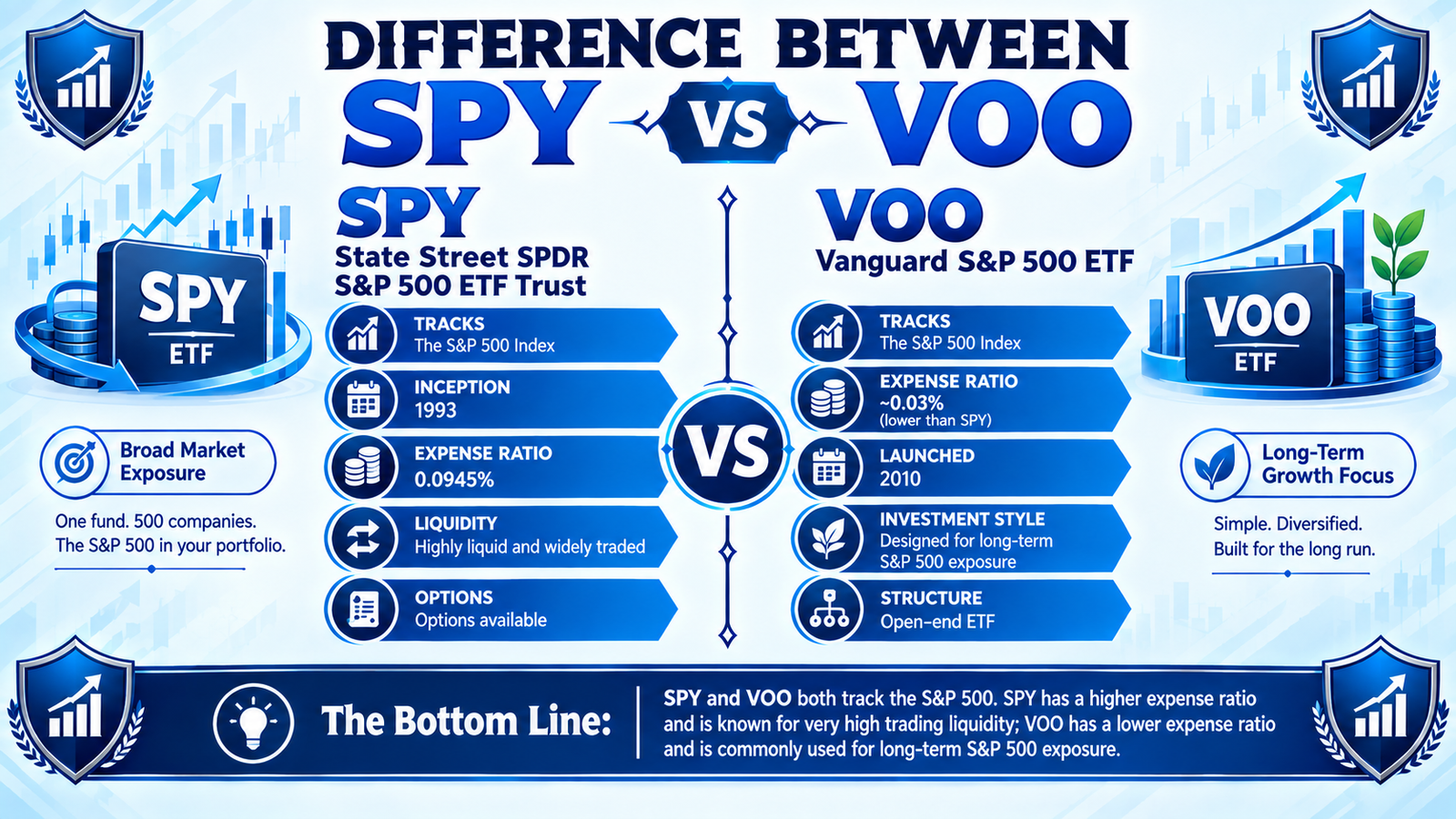
SPY and VOO are two exchange-traded funds designed to provide exposure to the S&P 500 Index, so their investment portfolios are extremely similar. The important differences are not primarily about which companies they track, but about fund structure, expenses, trading characteristics, size, and how investors may use them. SPY is the State Street SPDR S&P 500 ETF Trust, while VOO is the Vanguard S&P 500 ETF.
Quick Answer
SPY and VOO both track the S&P 500, but they are different ETFs with different structures and costs. SPY is a unit investment trust with a 0.0945% gross expense ratio, while VOO is an ETF share class of Vanguard 500 Index Fund with a 0.03% expense ratio based on current 2026 issuer information.
SPY also has a much longer trading history and is widely used as a highly liquid trading and options vehicle. VOO was launched later and has a lower ongoing expense ratio. The two funds nevertheless provide very similar exposure to the S&P 500.
SPY vs VOO at a Glance
| Feature | SPY | VOO |
|---|---|---|
| Full name | SPDR S&P 500 ETF Trust | Vanguard S&P 500 ETF |
| Provider | State Street | Vanguard |
| Benchmark | S&P 500 Index | S&P 500 Index |
| Structure | Unit investment trust | ETF share class of Vanguard 500 Index Fund |
| Expense ratio | 0.0945% gross | 0.03% |
| Inception | January 22, 1993 | September 7, 2010 |
| Dividends | Quarterly | Quarterly |
| Options | Available | Available |
| Main exposure | Large-cap U.S. stocks | Large-cap U.S. stocks |
Current fund information is time-sensitive. The expense ratios and other figures above are based on issuer information available in September 2026.
What Is SPY?
SPY is the ticker symbol for the State Street SPDR S&P 500 ETF Trust.
The fund seeks to provide investment results that correspond generally to the price and yield performance of the S&P 500 Index before expenses. State Street says the fund was launched in January 1993 and was the first exchange-traded fund listed in the United States.
SPY is designed to hold the stocks in the S&P 500 in substantially corresponding weights. Its 2026 prospectus identifies the fund as a unit investment trust.
The S&P 500 itself is a float-adjusted, market-capitalization-weighted index covering large U.S. companies across the major sectors of the U.S. equity market.
What Is VOO?
VOO is the ticker symbol for the Vanguard S&P 500 ETF.
VOO seeks to track the performance of a benchmark index measuring the investment return of large-capitalization stocks. Vanguard identifies the benchmark as the S&P 500 Index.
VOO was launched in 2010 and is an exchange-traded share class of Vanguard 500 Index Fund. Its current expense ratio is 0.03%.
Like SPY, VOO uses passive index tracking rather than attempting to select stocks through active management.
What Is the Difference Between SPY and VOO?
The biggest point to understand is this:
SPY and VOO give investors very similar S&P 500 exposure, but they are separate funds with different costs, structures and trading characteristics.
The major differences are:
- Expense ratio: VOO’s current expense ratio is lower.
- Fund structure: SPY is a unit investment trust, while VOO is an ETF share class of Vanguard 500 Index Fund.
- Trading history: SPY began trading in 1993; VOO launched in 2010.
- Trading characteristics: SPY is especially prominent in high-volume trading and options markets.
- Fund size: VOO has recently become larger by assets under management, although AUM changes over time.
- Portfolio exposure: Both primarily seek to replicate the same S&P 500 benchmark.
These differences do not mean that SPY and VOO represent completely different investments. Their underlying market exposure is highly similar.
Expense Ratio: SPY vs VOO
One of the clearest differences is cost.
As of 2026 issuer information:
- SPY: 0.0945% gross expense ratio
- VOO: 0.03% expense ratio
An expense ratio represents the fund’s annual operating expenses as a percentage of assets. It is not a separate bill that investors normally receive. Instead, fund expenses are reflected in the fund’s ongoing operation and performance.
For example, ignoring compounding and other costs:
- 0.0945% of $10,000 is about $9.45 per year
- 0.03% of $10,000 is about $3 per year
The difference becomes more meaningful as the amount invested and holding period increase.
However, the expense ratio is not the only cost that can matter. Investors may also encounter brokerage commissions, bid-ask spreads, taxes and other transaction-related costs depending on the account and trading activity.
Fund Structure
SPY and VOO are both ETFs, but their legal structures differ.
SPY is organized as a unit investment trust (UIT). Its 2026 prospectus identifies SPY as a unit investment trust and describes the trust’s objective of generally corresponding to the S&P 500’s price and yield performance before expenses.
VOO is an ETF share class of Vanguard 500 Index Fund. Vanguard’s 2026 prospectus identifies VOO as exchange-traded fund shares of that fund.
This distinction is mostly structural rather than a difference in the basic market exposure an ordinary investor sees.
Liquidity and Trading
Another important distinction is trading activity.
SPY has an exceptionally long history as an ETF and is heavily used in institutional and derivatives markets. Current comparison sources consistently identify SPY’s trading liquidity and options activity as major characteristics of the fund.
This can matter more to someone who trades frequently than to someone who simply purchases ETF shares and holds them.
For a frequent trader, factors such as:
- bid-ask spread
- trading volume
- order execution
- options liquidity
- market depth
can be more relevant than a small difference in annual fund expenses.
For a long-term holder, recurring fund expenses may receive more attention.
That does not establish a universal choice between the two. It shows why the relevant comparison depends on how the ETF is being used.
Do SPY and VOO Hold the Same Stocks?
SPY and VOO are both designed to track the S&P 500, so their portfolios are extremely similar.
The exact holdings and weights can change over time as the S&P 500 changes and as the funds implement those changes. Current comparison data shows very high overlap between the two portfolios. ETFIQ’s September 2026 comparison found that approximately 97% of their portfolio weight was in the same securities at the same weights in its measured snapshot.
Therefore, saying that SPY and VOO are “the same fund” is technically incorrect.
A better description is:
They are separate ETFs designed to provide very similar exposure to the same underlying index.
SPY vs VOO Performance
Because SPY and VOO track the same underlying index, their returns tend to be very close before accounting for differences in expenses, implementation and other small tracking effects.
For example, ETFIQ’s September 23, 2026 data showed one-year total returns of approximately 17.2% for SPY and 17.3% for VOO, with distributions reinvested.
Short-term performance figures should not be treated as permanent differences between the funds. Returns vary by measurement date, market conditions, distributions and tracking differences.
The important point is that investors should not expect SPY and VOO to behave like two fundamentally different asset classes. Both are designed around the same S&P 500 benchmark.
When Does the Difference Between SPY and VOO Matter?
The distinction becomes more relevant when considering how the ETF will be used.
For long-term ownership
The ongoing expense ratio may receive greater attention because fund expenses are recurring.
VOO currently has a 0.03% expense ratio compared with SPY’s 0.0945%.
For frequent trading
Trading conditions can become more important.
SPY has a long-established reputation as a heavily traded ETF, and its options market is particularly prominent. State Street confirms that options are available for SPY.
For someone comparing S&P 500 exposure
The two funds are highly similar because both are built around the same benchmark.
This means the question is less about obtaining completely different stock exposure and more about comparing cost, structure and trading characteristics.
Can SPY and VOO Be Used Interchangeably?
For broad S&P 500 exposure, they can serve very similar purposes, but they are not literally interchangeable in every respect.
They differ in:
- expense ratio
- fund structure
- trading characteristics
- trading history
- assets and market activity
- implementation details
If someone says, “I want an ETF that tracks the S&P 500,” both SPY and VOO fit that basic description.
If someone asks whether the two funds are identical products, the answer is no.
Common Mistakes About SPY and VOO
Mistake 1: Saying they are exactly the same fund
Incorrect:
SPY and VOO are the same ETF.
Correct:
SPY and VOO are different ETFs that track the same S&P 500 benchmark.
Why: They are separate funds with different issuers, structures and expenses.
Mistake 2: Assuming a different ticker means different market exposure
Incorrect:
SPY invests in one group of major companies and VOO invests in another.
Correct:
Both are designed to provide exposure to the S&P 500.
Why: Their underlying benchmark is the same.
Mistake 3: Looking only at the share price
A lower or higher share price does not tell you whether an ETF is cheaper to own.
The expense ratio, bid-ask spread, trading costs and other characteristics are separate considerations.
Mistake 4: Treating one year’s return as a permanent advantage
A small difference in return over a particular period does not establish that one fund will always outperform the other.
Both funds track the same underlying index, and their results can vary slightly because of expenses and implementation differences.
Commonly Confused Terms
SPY vs S&P 500
These are not the same thing.
S&P 500 is an index.
SPY is an ETF designed to track that index.
VOO vs S&P 500
The same distinction applies.
VOO is an ETF.
S&P 500 is the underlying benchmark.
SPY vs VOO vs IVV
SPY and VOO are not the only ETFs tracking the S&P 500. IVV, the iShares Core S&P 500 ETF, also tracks the S&P 500.
That means a three-way comparison can be useful, but it should be treated as a separate topic rather than expanding this page unnecessarily.
Which One Should I Use?
Rather than treating SPY and VOO as universally interchangeable or declaring one the right choice for everyone, use the characteristics that match your purpose:
If your main concern is the recurring expense ratio → compare the current fund costs.
If your main concern is frequent trading → examine liquidity, bid-ask spreads, trading volume and order execution.
If your main concern is options activity → examine the options market for the specific ETF.
If your main concern is S&P 500 exposure → both are designed to track the same benchmark.
If you are comparing long-term results → compare total returns over identical periods and account for expenses and distributions.
The key is to compare the feature that actually matters to your use case rather than assuming that one metric determines everything.
How to Remember the Difference
Use this simple rule:
Same index, different ETF.
Remember:
- SPY = State Street’s S&P 500 ETF trust
- VOO = Vanguard’s S&P 500 ETF
- Both = S&P 500 exposure
- Different = cost, structure and trading characteristics
That four-part distinction is usually enough to avoid the most common confusion.
SPY or VOO? Practice Examples
Choose SPY, VOO, both, or neither.
- Which fund is designed to track the S&P 500?
- Which fund is the State Street SPDR S&P 500 ETF Trust?
- Which fund has a 0.03% expense ratio based on current Vanguard data?
- Are SPY and VOO literally the same ETF?
- Which fund was launched first?
- Do both funds provide broad exposure to the S&P 500?
- Does a difference in share price alone tell you which fund is cheaper?
- Can the portfolios of SPY and VOO change over time?
Answers
- Both
- SPY
- VOO
- Neither — they are separate ETFs
- SPY
- Both
- No
- Yes
Frequently Asked Questions
What is the main difference between SPY and VOO?
SPY and VOO both track the S&P 500, but they are separate ETFs with different fund structures and expense ratios. SPY is a unit investment trust, while VOO is an ETF share class of Vanguard 500 Index Fund.
Is SPY the same as VOO?
No. They are different ETFs from different providers, but they seek to provide very similar exposure to the same S&P 500 Index.
Which has the lower expense ratio, SPY or VOO?
As of the latest issuer information available for this article, VOO has the lower expense ratio: 0.03% compared with SPY’s 0.0945% gross expense ratio.
Do SPY and VOO track the same index?
Yes. Both are designed around the S&P 500 Index.
Do SPY and VOO hold the same stocks?
Their holdings overlap heavily because both track the S&P 500, but they are separate funds and their holdings can differ slightly at a particular point in time. ETFIQ’s September 2026 comparison found approximately 97% portfolio-weight overlap in its snapshot.
Is SPY better for trading?
SPY has very strong trading and options-market characteristics, but whether those characteristics matter depends on the investor’s trading activity and objectives. Current sources consistently identify SPY’s liquidity and trading volume as important distinguishing features.
Is VOO cheaper than SPY?
Based on current 2026 issuer data, yes in terms of the stated annual expense ratio: VOO is 0.03%, while SPY’s gross expense ratio is 0.0945%.
Are SPY and VOO interchangeable?
They can provide very similar S&P 500 exposure, but they are not identical products. Their expenses, structures and trading characteristics differ.
Which one has been around longer?
SPY was launched in January 1993. VOO was launched in September 2010.
Conclusion
The difference between SPY and VOO is less about their underlying stock-market exposure and more about how each ETF is structured, priced and traded. Both are designed to track the S&P 500, so their portfolios and performance are generally very similar. SPY has a much longer trading history and strong trading and options-market characteristics, while VOO currently has a substantially lower expense ratio.
The practical rule is simple: SPY and VOO offer similar S&P 500 exposure, but they are separate ETFs, so compare cost, structure and trading characteristics rather than treating them as identical funds.