
Agile and Scrum are often mentioned together, especially in software development and project management. That can make them sound like two names for the same thing. They are related, but they are not identical.
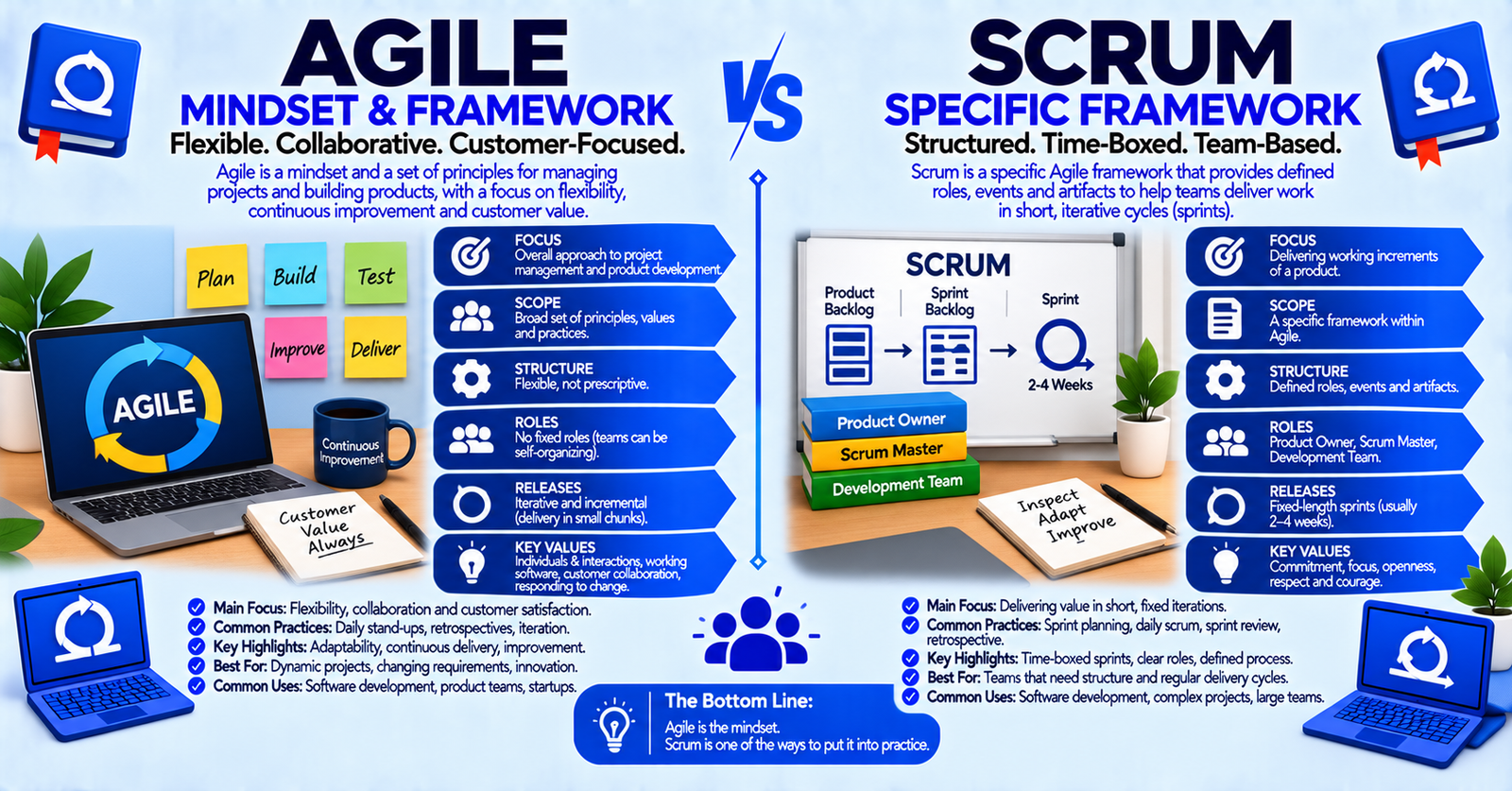
Agile is a broader set of values and principles for developing software and responding to change, while Scrum is a specific framework for managing complex work. Scrum can be used to put Agile ideas into practice, but Scrum is not the only way to work in an Agile way.
Understanding this distinction makes terms such as Sprint, Scrum Master, Product Owner, Agile principles, and Agile methodology much easier to understand.
Quick Answer
Agile is a broad approach to software development based on values and principles such as collaboration, frequent delivery, customer involvement, and responding to change.
Scrum is a specific framework for complex work that organizes a team around a Product Goal, Product Backlog, Sprints, defined accountabilities, and regular inspection and adaptation.
The simplest way to remember the difference is:
Agile describes a way of thinking and working; Scrum provides a specific framework for doing the work.
Agile vs. Scrum at a Glance
| Feature | Agile | Scrum |
|---|---|---|
| What it is | A set of values and principles/approaches | A specific framework |
| Main idea | Adapt, collaborate, deliver value, and respond to change | Organize complex work into an empirical framework |
| Scope | Broad | Specific |
| Roles | Does not prescribe one universal team structure | Product Owner, Scrum Master, and Developers |
| Sprints | Not required by Agile itself | Scrum uses Sprints |
| Product Backlog | Not universally required | Central Scrum artifact |
| Events | No single mandatory event structure | Defined Scrum events |
| Flexibility | Broad flexibility in implementation | Flexible within a defined framework |
| Relationship | Broader concept | One way to practice Agile |
Scrum’s current definition includes a Scrum Team consisting of a Product Owner, Scrum Master, and Developers, working through Sprints to create valuable Increments.
What Is Agile?
Agile is a way of developing software based on a set of values and principles that emphasize people, working software, customer collaboration, and responding to change.
The Agile Manifesto, published in 2001, identifies four core values:
- Individuals and interactions over processes and tools
- Working software over comprehensive documentation
- Customer collaboration over contract negotiation
- Responding to change over following a plan
These values do not provide one mandatory workflow that every Agile team must follow.
Instead, they establish principles for approaching software development and adapting to changing requirements.
For example, suppose a development team starts building an online store. After customers test an early version, the team discovers that the checkout process is confusing.
An Agile approach encourages the team to learn from that feedback and adapt the product rather than treating the original plan as permanently fixed.
Common Agile characteristics
Agile teams commonly emphasize:
- Frequent feedback
- Incremental development
- Collaboration
- Customer involvement
- Adaptability
- Continuous improvement
- Delivering useful software early and often
Agile therefore describes a broader way of working, rather than one fixed set of meetings or job titles.
What Is Scrum?
Scrum is a lightweight framework for helping people, teams, and organizations generate value through adaptive solutions to complex problems. That is how the current Scrum Guide defines it.
Scrum provides more structure than the general Agile concept.
Scrum framework defines:
- A Scrum Team
- Product Goal
- Product Backlog
- Sprint Goal
- Sprint Backlog
- Increment
- Sprint
- Scrum events
- Specific accountabilities
The Scrum Team has three accountabilities:
- Product Owner
- Scrum Master
- Developers
The Scrum Guide states that these people form one Scrum Team rather than separate sub-teams.
How Scrum works
A simplified Scrum cycle looks like this:
Product Goal → Product Backlog → Sprint Planning → Sprint → Increment → Review and adaptation → next Sprint
The team repeatedly inspects its work and adapts based on what it learns.
That makes Scrum compatible with the Agile emphasis on feedback and responding to change.
What Is the Difference Between Agile and Scrum?
The fundamental difference is scope and specificity.
Agile is broader. Scrum is more specific.
Agile establishes values and principles for adaptive software development. Scrum provides a defined framework for organizing complex work around short development cycles, accountabilities, events, and artifacts.
Think of it this way:
Agile answers: “How should we approach changing requirements, collaboration, feedback, and value delivery?”
Scrum answers: “What framework can this team use to organize complex work and inspect and adapt frequently?”
Agile is broader
There is no single universal “Agile meeting” or “Agile job title.”
A team can adopt Agile values while using different approaches.
Scrum is defined
Scrum has a specific framework with defined elements such as:
- Product Owner
- Scrum Master
- Developers
- Sprint
- Product Backlog
- Sprint Goal
- Sprint Review
- Sprint Retrospective
This makes Scrum more concrete than the general Agile concept.
Agile vs. Scrum: Values and Structure
One of the easiest ways to understand the difference is to compare principles with framework elements.
Agile emphasizes
- Responding to change
- Customer collaboration
- Working software
- Individuals and interactions
- Frequent delivery
- Continuous improvement
These ideas come from the Agile Manifesto and its principles.
Scrum provides
- A Scrum Team
- Product Goal
- Product Backlog
- Sprint Goal
- Sprint Backlog
- Increment
- Defined accountabilities
- Defined events
These elements come from the Scrum framework.
So, Agile provides the broader principles, while Scrum provides a specific structure.
Agile vs. Scrum: Roles
Agile does not require every team to use a particular set of job titles.
Scrum, however, defines three accountabilities:
Product Owner
The Product Owner is accountable for maximizing the value of the product resulting from the Scrum Team’s work.
Scrum Master
The Scrum Master is accountable for establishing Scrum as defined in the Scrum Guide and helping the Scrum Team become effective.
Developers
Developers are the members of the Scrum Team who create aspects of a usable Increment during each Sprint.
Therefore, if someone says:
“Our team has a Scrum Master and Product Owner.”
that is a strong indication that they are talking specifically about Scrum, not merely Agile in general.
Agile vs. Scrum: Sprints
A Sprint is a Scrum concept.
The Scrum framework organizes work into Sprints, during which the Scrum Team works toward a Sprint Goal and creates a valuable Increment.
Agile itself does not mean that every team must use a particular Sprint structure.
This distinction is important because people sometimes say:
“Agile means working in two-week sprints.”
That is too narrow.
Two-week Sprints are common in Scrum implementations, but Agile and Scrum should not be treated as synonyms.
Agile vs. Scrum: Meetings and Events
Agile does not prescribe one universal meeting schedule.
Scrum does define specific events within its framework, including:
- Sprint Planning
- Daily Scrum
- Sprint Review
- Sprint Retrospective
These events support inspection and adaptation within the Scrum framework.
Therefore:
Daily Scrum = Scrum-specific
but:
Frequent communication and collaboration = broader Agile principle/behavior
That distinction helps prevent one of the most common misunderstandings about Agile.
Can You Use Agile Without Scrum?
Yes.
Agile is broader than Scrum, so a team can follow Agile values and principles without implementing Scrum.
Other approaches associated with the Agile movement include:
- Kanban
- Extreme Programming (XP)
- Crystal
- Lean Software Development
- Feature-Driven Development
- DSDM
Scrum Alliance identifies several of these as approaches associated with the broader Agile movement.
For example, a team might emphasize continuous flow and visual work management through Kanban instead of organizing its work into Scrum Sprints.
The important point is that using Agile does not automatically mean using Scrum.
Can Scrum Be Used as an Agile Framework?
Yes.
This is the relationship most readers need to understand.
Scrum is specifically designed as a framework for complex work and incorporates practices that support frequent inspection, adaptation, incremental delivery, and continuous improvement.
This is why sources such as Atlassian describe Scrum as one way to practice Agile rather than as a separate competing philosophy.
A useful mental model is:
Agile → broad values and principles
Scrum → one framework that can implement those ideas
Agile and Scrum in a Real Software Project
Imagine a company is building a new mobile banking application.
The requirements are uncertain because customers may request changes after testing early versions.
Agile perspective
The team might decide to:
- release useful functionality incrementally
- collect customer feedback
- collaborate closely
- adapt requirements
- improve the product continuously
These behaviors align with Agile values and principles.
Scrum implementation
The same team could organize its work using:
- Product Owner
- Scrum Master
- Developers
- Product Backlog
- Sprint Goal
- Sprints
- Sprint Reviews
- Sprint Retrospectives
That is Scrum providing a concrete framework for organizing the work.
So the same project can be Agile in its broader approach and Scrum in its specific framework.
When to Use Scrum
The better question is not always “Should I choose Agile or Scrum?”
Instead, ask:
Would a defined Scrum framework help this team manage complex work through regular inspection and adaptation?
Scrum can be useful when a team needs a defined framework around:
- Product Goals
- prioritized work
- short development cycles
- regular feedback
- team accountabilities
- frequent inspection
- adaptation
Scrum is specifically designed for complex work and uses Sprints to create regular opportunities for inspection and adaptation.
When Agile Is the Broader Approach
Agile thinking can be relevant when an organization wants to emphasize:
- adaptability
- customer collaboration
- frequent delivery
- feedback
- continuous improvement
- responding to changing requirements
Agile does not require the organization to adopt Scrum.
A team can therefore think and work in an Agile way while selecting a different framework or combination of practices suited to its context.
Common Mistakes With Agile and Scrum
Mistake 1: Treating Agile and Scrum as synonyms
Incorrect:
Agile and Scrum are exactly the same thing.
Correct:
Scrum is a specific framework that can be used to practice Agile principles.
Why: Agile is broader, while Scrum defines a particular framework for complex work.
Mistake 2: Saying every Agile team must use Sprints
Incorrect:
If a team is Agile, it must work in two-week Sprints.
Correct:
Sprints are part of Scrum, not a universal requirement of Agile.
Why: Agile encompasses multiple approaches, while Scrum specifically organizes work through Sprints.
Mistake 3: Calling the Scrum Master an Agile requirement
Incorrect:
Every Agile team needs a Scrum Master.
Correct:
The Scrum Master is a Scrum accountability.
Why: Scrum defines the Scrum Master as one of its three accountabilities. Agile itself does not prescribe that specific role.
Mistake 4: Thinking Scrum means “daily stand-up”
A Daily Scrum is only one element of Scrum.
Scrum encompasses a broader framework involving accountabilities, events, artifacts, commitments, and the overall Scrum theory of empiricism.
Common Collocations With Agile and Scrum
Common Agile phrases
- Agile development
- Agile methodology
- Agile principles
- Agile values
- Agile approach
- Agile software development
- Agile practices
- Agile team
- Agile transformation
- Agile project management
Scrum phrases
- Scrum framework
- Scrum Team
- Scrum Master
- Product Owner
- Scrum Developer
- Scrum Sprint
- Sprint Planning
- Daily Scrum
- Sprint Review
- Sprint Retrospective
- Product Backlog
- Sprint Backlog
- Sprint Goal
These phrases help identify whether a discussion is about the broad Agile concept or the specific Scrum framework.
How to Remember the Difference
Use this simple rule:
Agile = principles and values.
Scrum = a framework.
Or remember the relationship:
Agile is the broader concept → Scrum is one specific way to organize work within that concept.
When you hear Product Owner, Scrum Master, Sprint, Product Backlog, or Sprint Retrospective, you are talking specifically about Scrum.
When you hear responding to change, customer collaboration, individuals and interactions, or working software, you are more likely discussing Agile values and principles.
Which One Should I Use?
Instead of treating Agile and Scrum as two mutually exclusive choices, use this practical guide:
For a broad approach focused on adaptability, collaboration, customer feedback, and responding to change, choose Agile.
When you need a specific framework with a Scrum Team, Product Backlog, Sprints, Product Owner, Scrum Master, and Developers, Scrum is the relevant term.
Teams looking to apply Agile principles through a defined framework for complex work may consider Scrum as one possible approach.
Those who want Agile principles without Scrum’s specific framework can explore other Agile approaches
Agile or Scrum? Practice Examples
Choose Agile, Scrum, or Both.
1. A company wants to respond quickly to changing customer requirements.
Answer: Agile
The statement describes a broad Agile principle rather than a specific Scrum mechanism.
2. A team has a Product Owner and Scrum Master.
Answer: Scrum
These are defined Scrum accountabilities.
3. A team works toward a Sprint Goal.
Answer: Scrum
Sprint Goals are part of the Scrum framework.
4. A development team prioritizes customer collaboration and responding to change.
Answer: Agile
These concepts directly reflect Agile Manifesto values.
5. A team uses Sprints, Sprint Reviews, and Retrospectives.
Answer: Scrum
These are Scrum framework elements.
6. A team follows Agile principles but uses Kanban.
Answer: Agile, not necessarily Scrum
Kanban is an approach that can be used within the broader Agile landscape.
7. A company says, “We are Agile because we have a daily meeting.”
Answer: Neither statement is sufficient
A daily meeting by itself does not establish that an organization is practicing Agile or Scrum properly.
Frequently Asked Questions
What is the difference between Agile and Scrum?
Agile is a broader set of values and principles for adaptive software development, while Scrum is a specific framework for managing complex work. Scrum can be used to put Agile ideas into practice.
Is Scrum part of Agile?
Yes, Scrum is commonly considered an Agile framework. It provides a specific structure for applying iterative and adaptive ways of working.
Is Agile the same as Scrum?
No. Agile is broader than Scrum. Scrum is one particular framework, while Agile encompasses broader values and principles and multiple approaches.
Can you use Agile without Scrum?
Yes. Teams can apply Agile values and principles using approaches other than Scrum, including Kanban and Extreme Programming.
Does Agile require Sprints?
No. Sprints are specifically associated with Scrum. Agile itself does not mandate a single Sprint structure.
Does Scrum require Agile?
Scrum is designed around adaptive, empirical work and is widely used as an Agile framework. However, simply adopting Scrum terminology or meetings does not automatically mean an organization is successfully applying all Agile values and principles.
Is Scrum a methodology or a framework?
The current Scrum Guide defines Scrum as a framework, specifically a lightweight framework for generating value through adaptive solutions to complex problems.
What are the three Scrum accountabilities?
The three Scrum accountabilities are:
- Product Owner
- Scrum Master
- Developers
They collectively make up the Scrum Team.
Which is more flexible, Agile or Scrum?
The question needs qualification because Agile and Scrum operate at different levels. Agile provides broad values and principles, while Scrum provides a defined framework within which teams can adapt their work.
Conclusion
The difference between Agile and Scrum is mainly one of scope.
Agile is the broader set of values and principles that emphasizes collaboration, customer value, frequent delivery, and responding to change. Scrum is a specific framework that organizes complex work through a Scrum Team, Product Backlog, Sprints, defined accountabilities, and regular inspection and adaptation.
The easiest rule to remember is:
Agile is the broader approach; Scrum is one framework used to put Agile ideas into practice.