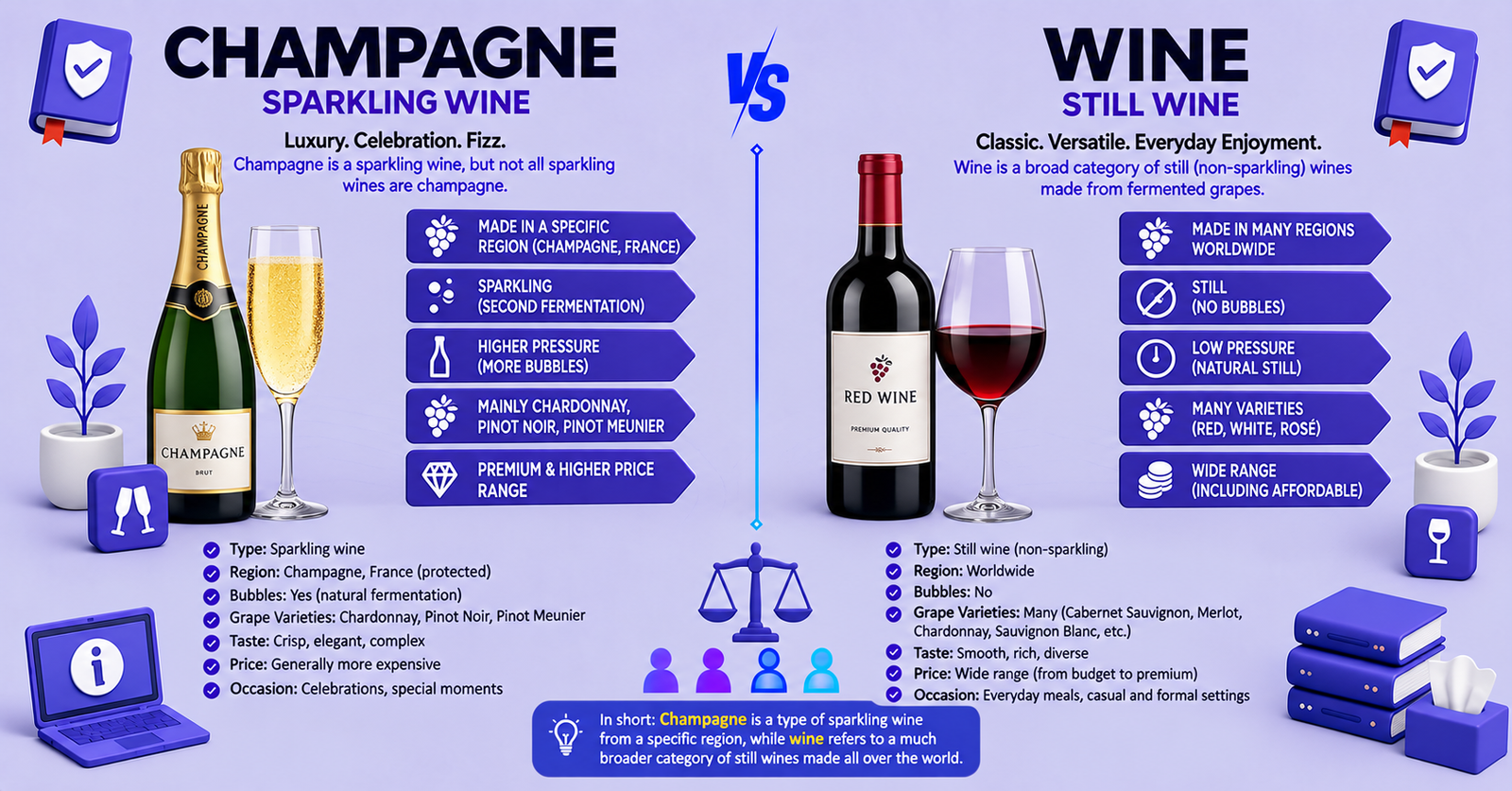

Champagne and wine are closely related, but they are not interchangeable terms. The simplest way to understand the difference is to think of wine as the broad category and Champagne as one specific type of wine.
Champagne is a sparkling wine associated with the Champagne region of France and is subject to specific rules governing its production and designation. Wine, by contrast, includes a much wider range of beverages, including red, white, rosé, and sparkling wines.
So, if you’re wondering whether Champagne is wine, the answer is yes. The more useful question is what makes Champagne different from other wines.
Quick Answer
Champagne is a type of sparkling wine, while wine is the broader category that includes many different styles of wine.
The key difference is that authentic Champagne must come from the Champagne region of France and meet the applicable production requirements, whereas wine can be produced in many regions and can be still or sparkling. Champagne is a protected wine name under a Protected Designation of Origin.
In short:
All Champagne is wine, but not all wine is Champagne.
Champagne vs Wine at a Glance
| Feature | Champagne | Wine |
| Category | Sparkling wine | Broad beverage category |
| Main characteristic | Bubbles | May be still or sparkling |
| Origin | Champagne region of France | Produced worldwide |
| Protected name | Yes | “Wine” is a broad generic category |
| Main grapes | Chardonnay, Pinot Noir, Meunier are the principal varieties | Thousands of grape varieties are used |
| Production | Specific regulated production methods | Methods vary widely |
| Examples | Brut, Vintage, Rosé Champagne | Red, white, rosé, sparkling, fortified and other styles |
| Pronunciation | /ʃæmˈpeɪn/ | /waɪn/ |
Champagne’s official sources identify Chardonnay, Pinot Noir, and Meunier as its principal grape varieties.
What Is Wine?
Wine is an alcoholic beverage generally made by fermenting grape juice. Merriam-Webster defines wine as an alcoholic beverage made from fermented grape juice, while the term can also be used more broadly for fermented fruit beverages.
Wine is a broad category rather than one particular style.
It can include:
- red wine
- white wine
- rosé wine
- sparkling wine
- fortified wine
- dessert wine
The production process varies according to the style. Some wines are fermented and bottled without carbonation, while others undergo processes that create or retain bubbles.
For example:
Cabernet Sauvignon is wine.
Chardonnay is wine.
Rosé is wine.
Champagne is also wine.
This broad category is the first key to understanding the comparison.
What Is Champagne?
Champagne is a specific type of sparkling wine associated with the Champagne region of France.
Its name is legally protected as a wine designation. The UK government register, for example, lists Champagne as a protected wine name with Protected Designation of Origin status and France as its country of origin.
Champagne is also characterized by a particular production tradition. Its sparkling character comes from a second fermentation in the bottle, followed by further cellar aging and other production steps.
The principal grape varieties are:
- Chardonnay
- Pinot Noir
- Meunier
These grapes contribute different characteristics to the finished wine. Chardonnay is associated with freshness and mineral or citrus notes, Pinot Noir with body and structure, and Meunier with fruitiness and roundness.
What Is the Difference Between Champagne and Wine?
The biggest difference is specificity.
Wine describes a broad category.
Champagne describes a specific kind of sparkling wine with a protected geographic identity and defined production requirements.
Think of the relationship like this:
Wine → Sparkling Wine → Champagne
Not every wine is sparkling.
Not every sparkling wine is Champagne.
But Champagne belongs to the sparkling-wine family and therefore belongs to the larger wine category.
1. Origin
Champagne is tied to the Champagne region of France. The protected designation is an important part of its identity.
Wine, however, is produced throughout the world.
For example, wine can come from:
- France
- Italy
- Spain
- Australia
- the United States
- Argentina
- South Africa
- Chile
- New Zealand
So geography is much more restrictive for Champagne than for wine generally.
2. Sparkling vs. Still
Champagne is sparkling.
Wine can be:
- still
- sparkling
- or, depending on classification, made in other specialized styles.
A typical red Cabernet Sauvignon is a still wine.
Champagne has visible effervescence because its production includes a secondary fermentation that creates carbon dioxide within the bottle.
3. Production Method
Wine can be produced using many different techniques.
Champagne follows a much more specifically regulated production tradition. The traditional method includes a secondary fermentation in the bottle, followed by aging and subsequent steps such as riddling and disgorgement.
For Champagne, minimum aging requirements include 15 months for non-vintage Champagne and 36 months for vintage Champagne under the cited industry sources.
That additional production complexity contributes to Champagne’s distinctive character.
4. Grapes
Wine can be made from a very large range of grape varieties.
Champagne primarily relies on:
- Chardonnay
- Pinot Noir
- Meunier
Champagne’s official organization explains that these three varieties were selected because they provide a useful balance of sugar, acidity, flavor, and suitability for producing sparkling wine.
5. Taste and Texture
Wine has an enormous range of flavors and textures.
Depending on the style, it can taste:
- fruity
- floral
- earthy
- spicy
- herbal
- oaky
- sweet
- dry
- tannic
- acidic
Champagne tends to combine acidity and freshness with effervescence, and bottle aging can contribute bready, toasty, or brioche-like characteristics.
However, it is important not to assume that every Champagne tastes exactly the same.
Champagne can vary according to:
- grape composition
- producer
- vintage
- aging
- dosage
- terroir
- style
When to Use the Word “Champagne”
Use Champagne when you specifically mean the protected sparkling wine associated with the Champagne region of France.
For example:
We opened a bottle of Champagne to celebrate.
She ordered a glass of Champagne.
The restaurant has an extensive Champagne list.
When you’re talking about sparkling wine from another region, a more accurate term is sparkling wine.
For example:
We bought an Italian sparkling wine.
Calling every sparkling wine “Champagne” is one of the most common terminology mistakes.
When to Use the Word “Wine”
Use wine when you’re referring to the broader category or when the specific style is not important.
For example:
Would you like some wine?
This restaurant has a large wine selection.
Red wine pairs well with many rich foods.
You can also be more specific:
red wine
white wine
rosé wine
sparkling wine
Champagne
The more specific terms identify particular styles within the broader category.
Champagne and Wine in Real Sentences
Example 1
Champagne is a type of wine.
This is correct because Champagne belongs to the wine category.
Example 2
I prefer red wine to Champagne.
This is also correct because red wine and Champagne are different styles.
Example 3
We served Champagne at the celebration.
Here, the specific sparkling wine is being identified.
Example 4
They produce wine in several countries.
“Wine” is being used as the broad category.
Example 5
This sparkling wine is not Champagne.
This is correct when the sparkling wine comes from somewhere other than the Champagne appellation or does not meet the applicable Champagne requirements.
Champagne vs. Wine: Common Collocations
Common collocations with Champagne
- bottle of Champagne
- glass of Champagne
- Champagne house
- Champagne region
- Champagne producer
- Champagne grapes
- vintage Champagne
- non-vintage Champagne
- Brut Champagne
- Champagne toast
Common collocations with wine
- bottle of wine
- glass of wine
- red wine
- white wine
- rosé wine
- sparkling wine
- wine region
- wine producer
- wine list
- wine tasting
- wine cellar
These combinations help show that Champagne is much more specific than wine.
Common Mistakes With Champagne and Wine
Mistake 1: Treating Champagne and wine as completely separate categories
Incorrect idea:
Champagne is not wine.
Correct:
Champagne is a type of wine.
Why:
Champagne belongs to the sparkling-wine category, which belongs to the broader wine category. The official Champagne organization explicitly states that Champagne is a type of sparkling wine.
Mistake 2: Calling every sparkling wine Champagne
Incorrect:
Prosecco is Champagne.
Correct:
Prosecco is sparkling wine.
Why:
Champagne is geographically protected. Sparkling wines produced elsewhere are not automatically Champagne.
Mistake 3: Assuming Champagne always means sweet wine
Champagne is available in different sweetness categories.
For example, Brut is a dry style, while other categories range toward sweeter styles.
Therefore:
Champagne ≠ automatically sweet
Mistake 4: Assuming Champagne is simply another name for sparkling wine
The terms are related, but they are not equivalent.
Sparkling wine is the broader category.
Champagne is a specific protected type of sparkling wine.
Are Champagne and Wine Interchangeable?
No—not generally.
You can use “wine” to describe Champagne because Champagne is wine.
However, you cannot use “Champagne” to describe every wine.
For example:
Champagne is wine. — Correct
All wine is Champagne. — Incorrect
Champagne is sparkling wine. — Correct
All sparkling wine is Champagne. — Incorrect
This is the most important usage distinction to remember.
Is Champagne the Same as Sparkling Wine?
No.
Champagne is a type of sparkling wine, but sparkling wine is a much broader category.
Examples of sparkling wines include:
- Champagne from France
- Prosecco from Italy
- Cava from Spain
- other sparkling wines produced in different regions
Therefore:
Champagne ⊂ sparkling wine ⊂ wine
This is the clearest way to visualize the relationship.
How to Remember the Difference
Use this simple rule:
Wine is the category. Champagne is the specific sparkling wine.
Or remember:
Wine = broad
Champagne = specific
If a drink is Champagne, it is wine.
If a drink is wine, it does not necessarily mean it is Champagne.
Which One Should I Use?
Champagne when you specifically mean the protected sparkling wine from France’s Champagne region.
Wine when you’re talking about wine generally.
Use sparkling wine when you mean bubbly wine but don’t specifically mean Champagne.
Quick decision guide
If you mean wine in general → use wine.
you mean bubbly wine generally → use sparkling wine.
If you mean the protected French product from Champagne → use Champagne.
Champagne or Wine? Practice Examples
Choose Champagne, sparkling wine, or wine.
- We bought a bottle of ___ for dinner, but we didn’t specify the style.
- The Italian bottle was a type of ___.
- They opened a bottle of ___ from France’s Champagne region.
- Cabernet Sauvignon is a type of ___.
- Prosecco is ___, but it is not Champagne.
- She ordered a glass of ___ for the wedding toast.
- The restaurant has a long ___ list.
- Champagne is a type of ___.
Answers
- wine
- sparkling wine
- Champagne
- wine
- sparkling wine
- Champagne
- wine
- wine
Frequently Asked Questions
Is Champagne a type of wine?
Yes. Champagne is a type of sparkling wine.
What is the main difference between Champagne and wine?
The main difference is that wine is the broad category, while Champagne is a specific type of sparkling wine associated with the Champagne region of France and protected by geographical rules.
Is all sparkling wine Champagne?
No. Champagne is only one type of sparkling wine. Sparkling wines from other regions are not automatically Champagne.
Is Champagne the same as sparkling wine?
No. Champagne is a type of sparkling wine, but sparkling wine includes many products that are not Champagne.
Is Champagne always white?
No. Champagne can also be produced as rosé. The official Champagne organization recognizes rosé Champagne among its styles.
What grapes are used to make Champagne?
The three principal varieties are Chardonnay, Pinot Noir, and Meunier.
Why does Champagne have bubbles?
Its traditional production involves a secondary fermentation in the bottle, which produces the carbon dioxide responsible for its sparkling character.
Can Champagne be called wine?
Yes. Champagne is wine, specifically sparkling wine.
Can I call Prosecco Champagne?
No. Prosecco is a separate sparkling wine category associated with Italy.
Which is better, Champagne or wine?
There is no universal winner because Champagne is itself a type of wine. The better question is which style of wine suits your taste, meal, or occasion.
Conclusion
The difference between Champagne and wine is mainly a difference in scope and specificity. Wine is the broad category, while Champagne is a specific type of sparkling wine associated with the Champagne region of France and protected by geographical and production rules.
The easiest rule is:
All Champagne is wine, but not all wine is Champagne.

Sajid Ali is an English language educator and content specialist with 7+ years of teaching experience. He holds master’s degrees in Information Technology and Education from the Virtual University of Pakistan and writes SEO-optimized, learner-friendly vocabulary content for diffari.com.