
Put and post can both describe doing something with an object, message, or piece of information, but they are not normally interchangeable. Put usually focuses on placing or moving something into a particular position, while post commonly means sending something by mail, publishing information, making an announcement, or assigning someone to a particular place. The correct choice depends on what action you mean.
Quick Answer
Put means to place, move, or position someone or something in a particular place, position, or condition. Post can mean to send something by mail, publish information online, announce information publicly, or assign someone to a particular location or job.
For example, you put your keys on the table, but you post a photo on Instagram. You can also post a letter, especially in British English, meaning to send it by mail.
Put vs Post at a Glance
| Put | Post | |
|---|---|---|
| Basic meaning | Place or move something into a position | Send, publish, announce, or assign |
| Part of speech | Verb | Verb and noun |
| Common context | Physical or abstract placement | Mail, websites, social media, notices, assignments |
| Example | Put the book on the shelf. | Post the photo online. |
| Past tense | Put | Posted |
| Main question | “Where should it go?” | “Is it being sent, published, announced, or assigned?” |
What Does Put Mean?
Put is a very common verb meaning to move or place someone or something into a particular place, position, or direction.
For example:
- Put the keys on the table.
- She put the milk in the refrigerator.
- He put his phone in his pocket.
- Please put your shoes by the door.
The word put can also be used for abstract ideas and situations. You can put something into practice, put pressure on someone, put an idea into words, or put someone in a difficult position. Cambridge and Oxford both document this broader range of meanings.
Put in Different Contexts
Physical placement:
Put the laptop on the desk.
Writing:
Put your name at the top of the page.
Expression:
I don’t know how to put my feelings into words.
Condition or situation:
The mistake put us in a difficult position.
So, put is not limited to physical objects.
What Does Post Mean?
Post has several meanings, so context is especially important.
One common meaning is to send a letter or parcel by mail. In British English, post is commonly used where American English often uses mail.
I need to post this letter today.
Another common meaning is to publish or make information available online.
She posted a photo on Instagram.
He posted a comment on the website.
Post can also mean to make information publicly available, such as an announcement or warning:
The company posted a notice about the change.
Another meaning is to assign someone to a particular place as part of their work:
She was posted to London for two years.
Oxford lists these as distinct uses of the verb post, including mailing, online publishing, official announcements, and job assignments.
What Is the Difference Between Put and Post?
The easiest way to understand the difference is to look at the main action.
Put focuses on placement or position.
Post focuses on sending, publishing, announcing, or assigning.
Compare:
Put the letter on the desk.
Here, the important action is placing the letter on the desk.
Post the letter.
Here, the important action is sending the letter through the postal system.
Another example:
Put the photo on your desk.
The photo is being physically placed somewhere.
Post the photo online.
The photo is being published or shared so other people can see it.
This distinction is more useful than trying to memorize a list of isolated definitions.
When to Use Put
Use put when you mean place, position, move, or cause something to be in a particular state or situation.
Physical placement
Put the dishes in the cupboard.
Positioning a person
The teacher put the students in two groups.
Writing something
Put your answer in the box.
Expressing something
How should I put this?
Creating a situation
The delay put us under pressure.
A useful question is:
Where or into what position is something being placed?
If that is the main idea, put will often be the natural choice.
When to Use Post
Use post when the meaning involves sending, publishing, announcing, or assigning.
Sending by mail
I will post the letter tomorrow.
In American English, mail is generally the more usual term for this meaning.
Publishing online
She posted a new video on YouTube.
Sharing on social media
He posted a photo from his vacation.
Publishing a notice
The school posted the examination results.
Assigning someone to a location
The officer was posted to another city.
A useful question is:
Is something being sent, published, announced, or assigned?
If so, post may be the appropriate verb.
Put and Post in Sentences
Here are some examples showing the difference clearly.
Example 1
Put the book on the table.
Use put because the book is being placed in a particular position.
Example 2
Post the article on the website.
Use post because the article is being published online.
Example 3
Put the letter on my desk.
The letter is being physically placed on a desk.
Example 4
Post the letter before Friday.
The letter is being sent through the postal system.
Example 5
Put the announcement on the noticeboard.
Here, put focuses on physically placing the announcement.
Example 6
Post the announcement on the website.
Here, post means publish or make the announcement available online.
Common Collocations With Put and Post
Learning common combinations can make the difference easier to recognize.
Common collocations with put
- put something on the table
- put something in a box
- put something away
- put something down
- put something aside
- put something into practice
- put something into words
- put pressure on someone
- put something in place
- put someone in charge
Common collocations with post
- post a letter
- post a parcel
- post a photo
- post a video
- post a comment
- post a message
- post an article
- post an announcement
- post a notice
- post something online
- post something on social media
- post someone to a location
The collocations show why the words cannot simply be treated as synonyms.
Common Mistakes With Put and Post
Mistake 1: Using put when you mean publish
Incorrect:
I put a new video on YouTube yesterday.
This sentence can be understood, and put can sometimes be used informally to mean make something available, but posted is more precise when the intended meaning is publishing content online.
Better:
I posted a new video on YouTube yesterday.
Why: Post specifically describes making information, photos, videos, or other content available online.
Mistake 2: Using post when you simply mean physical placement
Incorrect:
Please post the keys on the table.
Correct:
Please put the keys on the table.
Why: The action is physical placement, so put is the natural verb.
Mistake 3: Thinking post only means social-media publishing
Incorrect idea:
Post always means sharing something online.
Correct idea:
Post has several meanings. It can refer to mailing a letter, publishing online, making an announcement, or assigning someone to a location.
Mistake 4: Thinking put only applies to physical objects
Incorrect idea:
Put can only be used for things you can touch.
Correct idea:
You can put an idea into words, put pressure on someone, or put someone in a difficult situation.
Can Put and Post Be Used Interchangeably?
Usually not.
They can overlap in certain contexts, especially when something is being made available somewhere, but their normal meanings are different.
Compare:
Put the photo on the wall.
This means physically place the photo on the wall.
Post the photo on the website.
This means publish the photo online.
The context can occasionally make both verbs possible, but changing the verb can change the meaning or make the sentence sound less natural.
The safest approach is to identify the action first:
- Place it somewhere → put
- Send it by mail → post
- Publish it online → post
- Make an announcement → post
- Assign someone to a location → post
How to Remember the Difference
Use this simple rule:
PUT = PLACE
POST = SEND or PUBLISH
Think of put as answering:
“Where does it go?”
Think of post as answering:
“Is it being sent or made available to someone?”
For example:
Put the book on the shelf.
The book is being placed.
Post the article online.
The article is being published.
Which One Should I Use?
Use this quick decision guide:
For placing something somewhere → use PUT.
Put the keys on the table.
When you’re sending a letter or parcel → use POST in British English; mail is usual in American English.
Post the letter today.
For publishing something online → use POST.
Post the article on the website.
A photo or video shared publicly online → use POST.
She posted a picture on Instagram.
When information is being announced publicly → use POST.
The company posted a warning.
For assigning someone to a particular location for work → use POST.
He was posted to another office.
Put or Post? Practice Examples
Choose put or post in each sentence.
- Please ___ the keys on the kitchen counter.
- She ___ a new photo on Instagram.
- I need to ___ this letter before noon.
- He ___ the groceries in the refrigerator.
- The company ___ an announcement on its website.
- Please ___ your name at the top of the form.
- The officer was ___ to a remote location.
- Don’t forget to ___ the books back on the shelf.
Answers
- put
- posted
- post
- put
- posted
- put
- posted
- put
Frequently Asked Questions
What is the main difference between put and post?
Put usually means to place or move something into a particular position. Post commonly means to send something by mail, publish information, announce something, or assign someone to a location.
Is “put a photo online” correct?
Yes, put a photo online can be grammatically possible when the intended meaning is to place or make the photo available online. However, post a photo online is more specific when you mean publishing or sharing it online.
Is “post a letter” correct?
Yes. In British English, post a letter means to send it through the postal system. American English generally uses mail a letter for the same meaning.
Can I use put instead of post?
Not generally. If you mean physical placement, put is appropriate. If you mean sending mail, publishing content, announcing information, or assigning someone to a location, post may be required.
Can I use post instead of put?
Usually not. For ordinary physical placement, put is the natural choice.
Are put and post synonyms?
They are not general synonyms. Their meanings overlap only in limited contexts. Put centers on placement and positioning, while post has meanings involving sending, publishing, announcing, and assigning.
What is the difference between PUT and POST in web development?
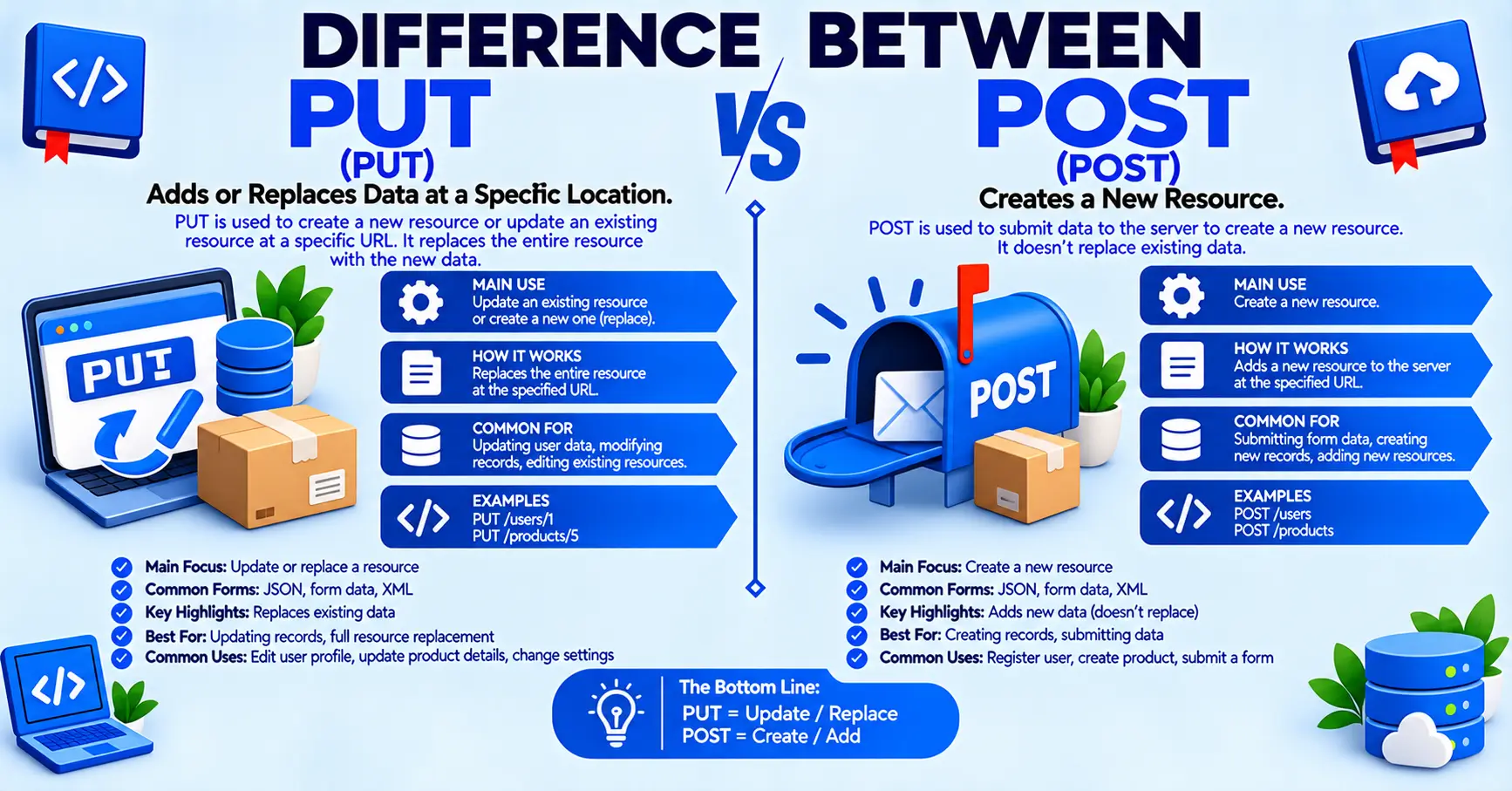
That is a different meaning from the English vocabulary comparison. In HTTP, PUT is used to create or replace the representation of a target resource and is idempotent, while POST submits data for processing and is not generally idempotent.
Conclusion
The simplest way to remember the difference between put and post is that put focuses on placing or positioning, while post commonly focuses on sending, publishing, announcing, or assigning. You put your phone on the table, but you post a photo online. You can post a letter in British English, while American English commonly uses mail for that meaning. When choosing between the two, identify the action first: place → put; send or publish → post.

Sajid Ali is an English language educator and content specialist with 7+ years of teaching experience. He holds master’s degrees in Information Technology and Education from the Virtual University of Pakistan and writes SEO-optimized, learner-friendly vocabulary content for diffari.com.