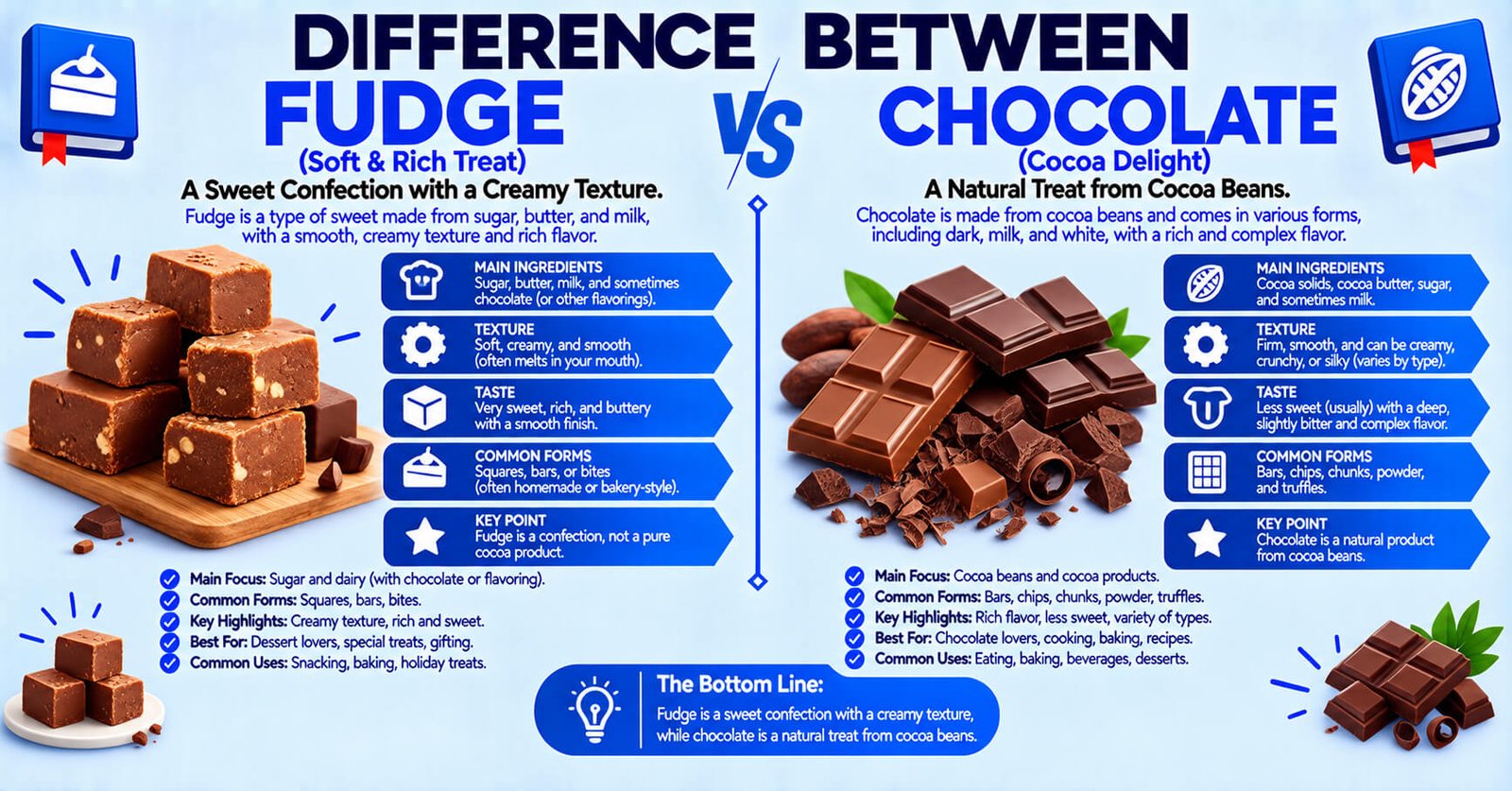
Fudge and chocolate are often confused because chocolate fudge looks and tastes similar to chocolate. But they are not the same thing. Chocolate is a cacao-based food, while fudge is a soft confection traditionally made from sugar, butter, and milk or cream. Chocolate can be used as an ingredient or flavor in fudge, but fudge can also be made without chocolate.
The biggest differences appear in their ingredients, texture, preparation, and culinary use. Chocolate is commonly produced from processed cacao and is available in forms such as dark, milk, and white chocolate. Fudge is made by cooking a sweet mixture and controlling how it cools and crystallizes.
Quick Answer
Fudge is a soft, rich confection made primarily from sugar, butter, and milk or cream, while chocolate is a cacao-based food made from cacao-derived ingredients, usually combined with sugar and sometimes milk.
The main difference is that chocolate gets its identity from cacao, while fudge gets its characteristic structure from a cooked sugar mixture and controlled crystallization.
Chocolate can be used to make chocolate fudge, but fudge does not have to contain chocolate.
Fudge vs. Chocolate at a Glance
| Feature | Fudge | Chocolate |
|---|---|---|
| What it is | A soft confection | A cacao-based food/product |
| Main base | Sugar, butter, milk or cream | Cacao-derived ingredients |
| Texture | Soft, dense, creamy | Usually firm or solid |
| Flavor | Often very sweet and buttery | Cocoa flavor ranges from mild to intense |
| Chocolate required? | No | Yes, by definition |
| Can it contain chocolate? | Yes | Chocolate is the product itself |
| Common forms | Squares, pieces, sauces | Bars, chips, coatings, drinks, baking chocolate |
| Main structural process | Sugar crystallization | Processing and, for many chocolate products, tempering |
What Is Fudge?
Fudge is a soft confection traditionally made by combining sugar, butter, and milk or cream and heating the mixture before cooling it under controlled conditions.
Its characteristic texture comes from the formation of very small sugar crystals. When the process is controlled properly, the result is dense, smooth, and creamy rather than hard and brittle.
Fudge can have many flavors. Chocolate is one of the most popular, but fudge can also be:
- Vanilla
- Peanut butter
- Maple
- Caramel
- Chocolate
- Mint
- Coffee
- Nut-based
- Fruit-flavored
This is an important distinction: fudge does not need chocolate to be fudge.
Cambridge Dictionary similarly defines fudge as a soft sweet made from sugar, butter, and milk, while also recognizing chocolate as a possible flavor.
What Is Chocolate?
Chocolate is a food made from cacao seeds, which are processed into cacao-derived ingredients and combined with other ingredients such as sugar and, depending on the type, milk.
Common varieties include:
- Dark chocolate
- Milk chocolate
- White chocolate
Chocolate can be eaten on its own, but it is also widely used as an ingredient in:
- Cakes
- Cookies
- Brownies
- Ice cream
- Pastries
- Sauces
- Drinks
- Candy
- Coatings
Unlike fudge, chocolate’s identity is directly connected to cacao. Cambridge Dictionary describes chocolate as a sweet food made from cacao seeds and notes its use both as a food and as a flavoring ingredient.
What Is the Difference Between Fudge and Chocolate?
The central difference is what defines each product.
Fudge is defined by its nature as a soft confection made through the controlled cooking and cooling of a sweet mixture. Chocolate is defined by its cacao-based composition.
This leads to several practical differences.
1. Ingredients
Traditional fudge is built around ingredients such as:
- Sugar
- Butter
- Milk or cream
- Flavorings
Chocolate is based on cacao-derived ingredients and commonly contains:
- Cocoa or chocolate liquor/cacao mass
- Cocoa butter
- Sugar
- Milk ingredients in milk chocolate
Recipes vary, so there is no single ingredient list that applies to every version of either product.
2. Texture
Texture is one of the easiest ways to distinguish them.
Fudge is generally soft, dense, and creamy.
Chocolate is generally firmer and can have a clean snap when properly set.
The difference comes from how their structures are formed. Fudge depends heavily on controlled sugar crystallization, while chocolate products depend on the properties of cocoa butter and the way the chocolate is processed.
3. Taste
Traditional fudge tends to have a very sweet, rich, buttery flavor.
Chocolate has a broader flavor range. Depending on the type and formulation, it can taste:
- Sweet
- Creamy
- Roasted
- Bitter
- Fruity
- Nutty
- Intensely cocoa-like
Dark chocolate, for example, generally has a stronger cocoa character than many milk chocolates.
4. Preparation
Traditional fudge is made by heating a sugar-based mixture, bringing it to the appropriate stage, then cooling and working the mixture so that the desired small sugar crystals form.
Chocolate production is much more closely connected to the processing of cacao. Finished chocolate may also be tempered to produce desirable characteristics such as a glossy appearance and firm snap.
The processes are therefore fundamentally different even when the finished products may look similar.
When to Use Fudge
Choose or use fudge when you want a soft, dense confection that can be cut into pieces or used as a rich dessert component.
For example:
We bought a box of chocolate fudge for the holiday party.
She made vanilla fudge with chopped nuts.
The dessert was topped with warm fudge sauce.
Fudge is particularly associated with candy shops, homemade sweets, gifts, dessert toppings, and rich snack-sized pieces.
When to Use Chocolate
Use chocolate when you are referring to the cacao-based food itself or using it as an ingredient.
For example:
I bought a bar of dark chocolate.
Melt the chocolate before adding it to the cake mixture.
The recipe calls for milk chocolate.
Chocolate is much broader in culinary application and can be used as a standalone food, baking ingredient, coating, flavoring, or drink base.
Fudge and Chocolate in Sentences
Fudge
The chocolate fudge was soft and creamy.
Here, fudge refers to the confection itself. “Chocolate” tells us its flavor.
Chocolate
She melted the chocolate for the cake.
Here, chocolate refers to the cacao-based ingredient being melted.
Both Together
The recipe uses dark chocolate to give the fudge a deeper flavor.
This sentence demonstrates the relationship clearly: chocolate can be an ingredient in fudge.
Does Fudge Contain Chocolate?
Sometimes, but not always.
Chocolate fudge contains chocolate or cocoa-based ingredients, which give it its chocolate flavor.
But fudge can be made without chocolate. Vanilla fudge, peanut-butter fudge, maple fudge, and other varieties demonstrate that chocolate is not essential to the definition of fudge.
This is one of the most important points to remember:
Chocolate can be part of fudge, but fudge does not have to be chocolate.
Can Fudge Be Made Without Chocolate?
Yes.
Fudge can be flavored with ingredients other than chocolate, including vanilla, peanut butter, maple, caramel, nuts, fruit, and various extracts.
For example:
The vanilla fudge contained no chocolate.
Calling something “fudge” does not automatically mean it contains cocoa or chocolate.
Chocolate Fudge vs. Chocolate
It is not simply a softer chocolate bar.
Chocolate fudge is a type of fudge that has been flavored with chocolate or cocoa-based ingredients.
A chocolate bar, on the other hand, is a chocolate product whose composition and structure come from processed cacao ingredients.
So:
Chocolate → a cacao-based product
Fudge → a soft confection
Chocolate fudge → fudge that contains chocolate/cocoa for flavor
This three-way distinction removes much of the confusion surrounding the two terms.
Common Mistakes With Fudge and Chocolate
Mistake 1: Assuming all fudge contains chocolate
Incorrect idea:
Fudge is always made from chocolate.
Correct:
Fudge can be chocolate-flavored, but it can also be made with other flavors.
Why:
Chocolate is optional to many fudge recipes; the defining idea is the soft confection itself.
Mistake 2: Treating fudge and chocolate as synonyms
Incorrect idea:
Fudge and chocolate mean the same thing.
Correct:
They refer to different food products, although chocolate can be used to make fudge.
Why:
Chocolate is cacao-based, whereas fudge is a confection based on a cooked sweet mixture.
Mistake 3: Assuming chocolate fudge is the same as a chocolate bar
Incorrect idea:
Chocolate fudge is just chocolate in a different shape.
Correct:
Chocolate fudge has the composition and texture of fudge, with chocolate providing much of its flavor.
Why:
The two products use different structures and production methods.
Mistake 4: Assuming all chocolate has the same texture
Chocolate can vary considerably depending on its type and formulation. Dark, milk, and white chocolate do not necessarily taste or behave exactly alike.
Common Collocations
Fudge
Common phrases include:
- chocolate fudge
- vanilla fudge
- homemade fudge
- creamy fudge
- soft fudge
- fudge sauce
- fudge squares
- peanut butter fudge
- fudge brownies
Chocolate
Common phrases include:
- dark chocolate
- milk chocolate
- white chocolate
- chocolate bar
- chocolate chips
- melted chocolate
- baking chocolate
- chocolate sauce
- chocolate cake
- chocolate dessert
These combinations show another important difference: chocolate has a much wider role as an ingredient and food category, while fudge more often identifies a particular confection or preparation.
Can Fudge and Chocolate Be Used Interchangeably?
Usually not.
You cannot automatically replace chocolate with fudge in a recipe because they have different compositions and textures.
For example, if a cake recipe asks for melted chocolate, replacing it with pieces of fudge would introduce additional sugar, dairy, fat, and a very different structure.
Likewise, if a recipe specifically requires fudge, ordinary chocolate will not automatically produce the same soft, dense texture.
They can be related ingredients in some desserts, but they are not one-for-one substitutes.
How to Remember the Difference
Use this simple rule:
Chocolate comes from cacao; fudge is a soft confection.
Then remember the relationship:
Chocolate can become part of fudge, but fudge does not have to contain chocolate.
If you see a soft square labeled vanilla fudge, you already know that it does not need to taste like chocolate.
If you see dark chocolate, you know cacao is central to what the product is.
Which One Should I Use?
Choose chocolate when you want a cacao-based ingredient or food.
For a soft, dense confection, choose fudge.
When the goal is a soft confection with chocolate flavor, chocolate fudge is the better term.
A simple decision guide:
| If you mean… | Use |
|---|---|
| A cacao-based food | Chocolate |
| A chocolate bar | Chocolate |
| A soft candy made from sugar, butter, and milk/cream | Fudge |
| A chocolate-flavored type of fudge | Chocolate fudge |
| A non-chocolate soft confection | Fudge |
Fudge or Chocolate? Practice Examples
Choose fudge or chocolate in each sentence.
- I bought a bar of dark ______.
- She made vanilla ______ for the holiday.
- Melt the ______ before adding it to the cake.
- The peanut-butter ______ was soft and rich.
- He prefers milk ______ to dark chocolate.
- We made chocolate ______ with chopped walnuts.
- The recipe requires melted ______.
- This dessert has a creamy ______ topping.
Answers
- Chocolate
- Fudge
- Chocolate
- Fudge
- Chocolate
- Fudge
- Chocolate
- Fudge
The key is to identify whether the sentence refers to the cacao-based food or the soft confection.
Frequently Asked Questions
What is the main difference between fudge and chocolate?
Chocolate is a cacao-based food, while fudge is a soft confection traditionally made from sugar, butter, and milk or cream. Chocolate can be used as an ingredient in fudge.
Is fudge just chocolate?
No. Chocolate and fudge are different products. Chocolate can be used to flavor fudge, but fudge can also be made without chocolate.
Does all fudge contain chocolate?
No. Fudge can be flavored with vanilla, peanut butter, maple, caramel, fruit, nuts, or other ingredients.
Is chocolate fudge the same as chocolate?
No. Chocolate fudge is a type of fudge that contains chocolate or cocoa-based ingredients. A chocolate bar is a chocolate product rather than fudge.
Which is softer, fudge or chocolate?
Fudge is generally softer and denser, while chocolate is generally firmer. The exact texture varies according to the recipe and type of product.
Can I substitute chocolate for fudge?
Usually not. They have different compositions and behave differently in recipes.
Can I make fudge without chocolate?
Yes. Chocolate is not required for fudge. Vanilla and peanut-butter fudge are common examples of non-chocolate fudge.
Why does fudge have a creamy texture?
Traditional fudge gets its characteristic texture from controlled sugar crystallization during cooking and cooling. The goal is to create very small crystals rather than a hard, brittle sugar structure.
Conclusion
The difference between fudge and chocolate comes down to what defines each one. Chocolate is a cacao-based food, while fudge is a soft confection made from a cooked sweet mixture, traditionally involving sugar, butter, and milk or cream.
Chocolate can be used as an ingredient in fudge, which is why chocolate fudge can look and taste similar to chocolate. But fudge does not have to contain chocolate at all.
Remember the simplest rule: chocolate is defined by cacao; fudge is defined by its confectionery form and soft texture.