
Modern and contemporary are often treated as synonyms because both can describe something current, recent, or connected with the present. In many ordinary sentences, either word may work. But they are not identical in every context.
The key difference is that modern commonly describes something current, recent, or based on newer ideas, while contemporary can mean either existing in the present or existing at the same time as something else. In art, architecture, and design, the distinction becomes more specialized: modern can refer to a historical movement, whereas contemporary generally refers to current work.
Quick Answer
Modern usually means current, recent, or based on newer ideas, methods, or technology. Contemporary can also mean current or present-day, so the two words are sometimes interchangeable.
However, contemporary has another important meaning: belonging to or existing during the same period as someone or something else. For example, Shakespeare and Ben Jonson were contemporaries.
In art and design, modern may refer to a specific historical movement, while contemporary generally refers to work of the present period.
Modern vs Contemporary at a Glance
| Modern | Contemporary | |
|---|---|---|
| Basic meaning | Current, recent, or up-to-date | Current or belonging to the same time |
| Can refer to the present? | Yes | Yes |
| Can refer to two things from the same historical period? | Not usually | Yes |
| Can mean “up-to-date”? | Yes | Sometimes |
| Can be a noun? | Yes, in some specialized uses | Yes |
| Common contexts | Technology, society, methods, life, design | Art, culture, literature, present-day issues |
| Historical/design sense | Can refer to Modernism | Usually describes current work |
| Example | modern technology | contemporary literature |
Oxford lists modern as meaning the present/recent time and also “using the latest technology, designs, materials, ideas, etc.”
Oxford defines contemporary both as “belonging to the same time” and “belonging to the present time.”
What Does Modern Mean?
Modern is an adjective with several related meanings.
In ordinary English, it can describe something associated with the present or recent past:
- modern society
- modern life
- modern history
- modern medicine
- modern technology
It can also mean using recent or advanced ideas, methods, designs, or materials:
The hospital has modern medical equipment.
Here, modern emphasizes that the equipment uses newer or up-to-date technology.
Oxford also records modern as a term used for styles in art, music, fashion, and other fields that were intended to differ from traditional styles.
Examples of modern
- Modern technology has changed communication.
- She prefers modern furniture.
- The company uses modern manufacturing methods.
- He has modern ideas about education.
- We live in a modern society.
The important idea is that modern often carries a sense of newness, recency, or departure from older methods or traditions.
What Does Contemporary Mean?
Contemporary has two major meanings.
1. Existing or happening now
In this sense, contemporary is close to modern:
- contemporary music
- contemporary literature
- contemporary culture
- contemporary art
- contemporary society
For example:
She studies contemporary literature.
This means literature associated with the present period.
Cambridge defines this sense as being of the present time, while Oxford gives “belonging to the present time” as a separate meaning.
2. Existing during the same time
This is where contemporary becomes more distinctive.
For example:
Shakespeare was a contemporary of Ben Jonson.
This does not mean Shakespeare was modern.
It means Shakespeare and Jonson lived during roughly the same period.
Likewise:
The museum displayed a contemporary account of the battle.
Here, contemporary means an account produced around the time the battle happened, not an account produced today.
Oxford specifically gives contemporary with somebody/something for this meaning.
What Is the Difference Between Modern and Contemporary?
The simplest distinction is:
Modern usually relates to what is current, recent, or up-to-date. Contemporary can mean current, but it can also mean existing during the same period as something else.
Consider these examples:
Modern technology is changing rapidly.
Here, modern means current or based on newer technology.
Contemporary writers often address current social issues.
Here, contemporary means writers of the present period.
But:
Shakespeare and Cervantes were contemporaries.
Here, contemporaries means people who lived during roughly the same historical period.
You could not replace contemporaries with moderns without changing the meaning.
Another useful distinction
Modern often answers:
“Is this current, recent, or up-to-date?”
Contemporary can answer:
“Is this current?”
or
“Did this exist at the same time?”
That second question is the most important distinction between the words.
When to Use Modern
Use modern when you are talking about:
Current or recent life
Modern life can be stressful.
Newer technology
Modern computers can process huge amounts of data.
Current methods
The company uses modern teaching methods.
Newer ideas
She has modern views on education.
Something contrasted with the old or traditional
The building combines traditional architecture with modern materials.
Modern is particularly natural when the idea of newness, advancement, or departure from older practices matters.
Oxford specifically associates modern with the latest technology, designs, materials, and ideas.
When to Use Contemporary
Use contemporary when you mean:
Current or present-day
Contemporary music reflects many different influences.
Present-day culture
The museum explores contemporary culture.
Work from the current period
She is a well-known contemporary artist.
Someone from the same period
Newton and Leibniz were contemporaries.
Something produced during the period being discussed
The historian examined contemporary accounts of the event.
This last use is especially important because it can refer to a past period.
For example:
Historians compared contemporary accounts of the French Revolution.
Here, contemporary means accounts from the period of the French Revolution—not necessarily accounts written today.
Modern and Contemporary in Sentences
Modern
The university has a modern computer laboratory.
Why? The laboratory has current or up-to-date equipment and facilities.
Contemporary
The gallery specializes in contemporary art.
Why? The art belongs broadly to the present period.
Contemporary meaning “same time”
Darwin and Charles Dickens were contemporaries.
Why? They lived and worked during overlapping periods.
Modern and contemporary together
The museum displays both modern and contemporary art.
Why can both appear together?
Because in an art context, modern can identify a historical artistic period or movement, while contemporary generally refers to more recent/current art.
Modern vs Contemporary in Art, Architecture, and Design
This is one of the biggest sources of confusion.
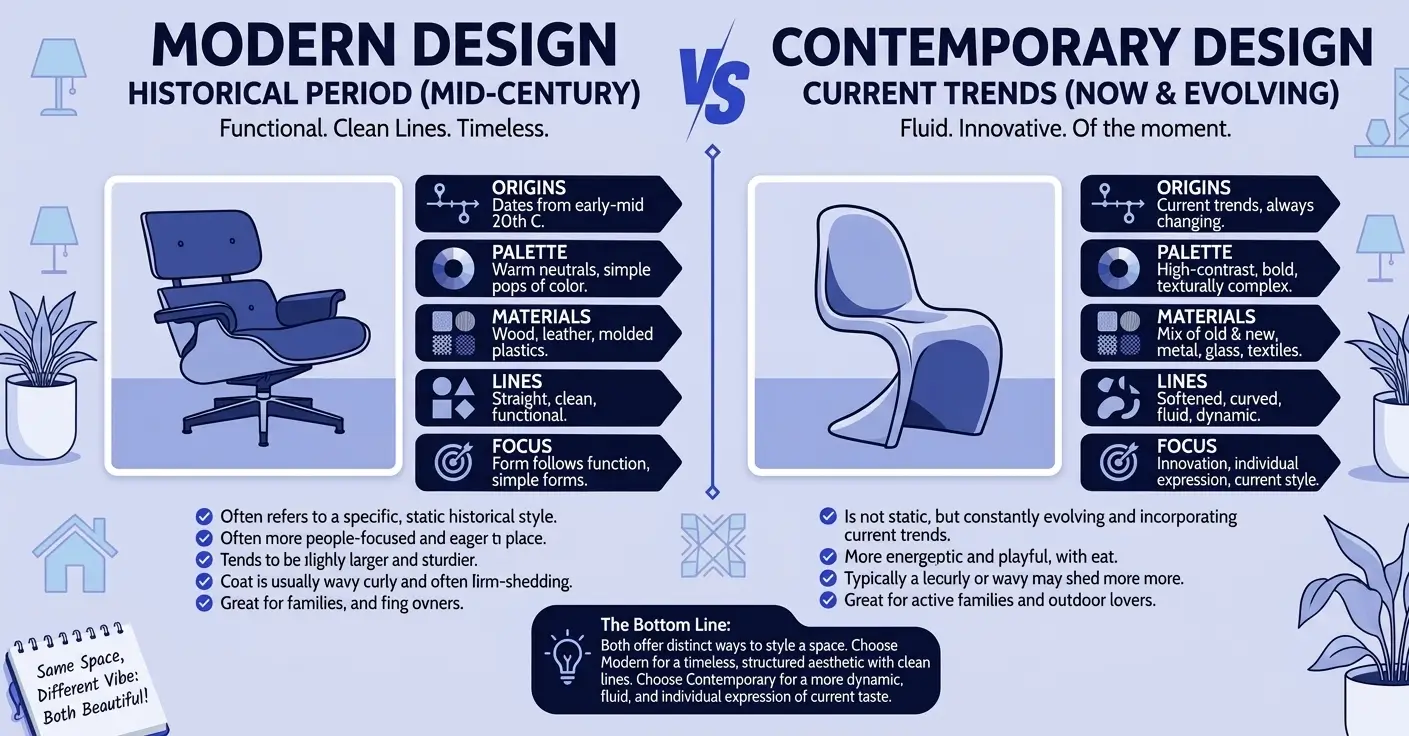
In everyday English, modern and contemporary can overlap. But in art, architecture, and design, Modern can have a specialized historical meaning.
Search results for the comparison are heavily populated by design and architecture pages, which commonly distinguish modern design as a historically rooted movement from contemporary design as current and evolving.
Modern design
In design contexts, modern may refer to Modernism and related twentieth-century design traditions.
Typical characteristics associated with modern design include:
- clean lines
- functional forms
- limited ornament
- geometric shapes
- emphasis on function
- materials such as wood, glass, steel, and concrete
Contemporary design
Contemporary design generally describes design associated with the present period.
Because the present keeps changing, contemporary design is not a fixed historical style. Current examples can incorporate:
- newer materials
- changing technology
- varied shapes
- sustainability
- mixed influences
- evolving color and texture trends
Current design sources consistently make this historical-versus-current distinction.
Why the terms overlap
Contemporary design can borrow heavily from modernist principles.
That means something can look both modern and contemporary in casual conversation, even though the technical meanings differ.
Common Collocations With Modern and Contemporary
Collocations with modern
- modern technology
- modern society
- modern life
- modern medicine
- modern science
- modern methods
- modern equipment
- modern architecture
- modern design
- modern art
- modern ideas
- modern world
Collocations with contemporary
- contemporary art
- contemporary music
- contemporary literature
- contemporary culture
- contemporary society
- contemporary architecture
- contemporary design
- contemporary artists
- contemporary issues
- contemporary politics
- contemporary writers
- contemporary accounts
These patterns reflect the words’ common usage rather than a rule that one word can never occur in the other’s contexts. Oxford, for example, lists both modern architecture and contemporary architecture.
Common Mistakes With Modern and Contemporary
Mistake 1
Incorrect:
Shakespeare was a modern of Ben Jonson.
Correct:
Shakespeare was a contemporary of Ben Jonson.
Why:
The noun contemporary can mean a person who lived during the same period as another person.
Mistake 2
Incorrect assumption:
Contemporary always means “new.”
Better understanding:
Contemporary can mean “current,” but it can also mean “from the same period.”
Why:
The second meaning can apply to historical events and documents.
Mistake 3
Incorrect assumption:
Modern always means “from the present day.”
Better understanding:
Modern can mean present/recent, but it also has specialized historical and stylistic meanings.
For example, Modern art can refer to a historical artistic category rather than whatever art happens to be newest.
Mistake 4
Modern and contemporary are always interchangeable.
They are interchangeable in some contexts, particularly when both mean current or present-day. But they are not interchangeable when contemporary means existing at the same time as something else.
Pronunciation
The words are pronounced differently.
Modern
UK: /ˈmɒdn/
US: /ˈmɑːdərn/
Contemporary
UK: /kənˈtemprəri/
US: /kənˈtempəreri/
Oxford provides both UK and US pronunciations for modern and contemporary.
They are not homophones.
Can Modern and Contemporary Be Used Interchangeably?
Sometimes, but not always.
Usually interchangeable when:
Both simply mean current or present-day.
modern society
contemporary society
modern music
contemporary music
The exact nuance can still vary by field or context.
Not interchangeable when:
Contemporary means existing at the same time as someone or something else.
Shakespeare was a contemporary of Ben Jonson.
Here, modern cannot replace contemporary.
Also be careful with specialized terminology
In art, architecture, and design, modern may refer to a historical movement or established style, while contemporary often describes work associated with the present.
How to Remember the Difference
Use this simple rule:
Modern = current or recent.
Contemporary = current OR from the same time.
An even easier memory trick:
Modern → “new/current”
Contemporary → “same time”
If you are talking about two people, events, or things that existed during the same period, contemporary is the word to remember.
Which One Should I Use?
Use modern when you mean:
“current, recent, new, or based on newer ideas/methods.”
modern technology
modern medicine
modern society
Use contemporary when you mean:
“current/present-day.”
contemporary art
contemporary literature
contemporary culture
Use contemporary when you mean:
“from the same period as something else.”
a contemporary account of the event
Shakespeare’s contemporaries
Quick decision rule
Do you mean current or up-to-date? → Modern
Do you mean current/present-day in a cultural or artistic context? → Contemporary often fits naturally
Do you mean existing during the same period as something else? → Contemporary
X or Y? Practice Examples
Choose modern or contemporary.
- The hospital has ______ medical equipment.
- Shakespeare and Marlowe were ______.
- The museum features ______ art.
- We need ______ methods for analyzing the data.
- Historians examined ______ accounts of the battle.
- She writes about ______ social issues.
- The company invested in ______ technology.
- The gallery specializes in ______ painting.
Answers
- modern — current/up-to-date equipment
- contemporaries — people living during the same period
- contemporary — art associated with the present period
- modern — newer/current methods
- contemporary — accounts from the time of the battle
- contemporary — issues of the present period
- modern — current technology
- contemporary — art associated with the current period
Frequently Asked Questions
What is the main difference between modern and contemporary?
Modern generally means current, recent, or based on newer ideas, methods, or technology. Contemporary can also mean current, but it additionally means existing or happening during the same period as something else.
Are modern and contemporary synonyms?
Sometimes. Dictionaries recognize overlap between the words when they mean current or present-day. But contemporary has the additional meaning of belonging to the same time period.
Is contemporary the same as modern?
Not always. In ordinary contexts, they may be interchangeable. In historical contexts, contemporary can mean “from the same period,” while modern generally does not carry that meaning.
What does contemporary mean in history?
In historical writing, contemporary can mean existing or happening during the same period being discussed. A “contemporary account” of an event is an account produced around the time of that event.
What does modern mean in art?
In art, modern can refer to a historical artistic movement or period rather than simply meaning “made recently.” This specialized use is one reason modern and contemporary art are often treated as distinct categories.
What does contemporary mean in art?
In general art terminology, contemporary art refers broadly to art associated with the present or recent period. The exact boundaries of “contemporary” can vary by institution and context.
Which word should I use for “current”?
Both modern and contemporary can express the idea of current or present-day. Choose according to context and the nuance you need.
Is contemporary more formal than modern?
Not necessarily. Contemporary often sounds more specialized or formal in contexts such as art, literature, architecture, and academic writing, but it is also an ordinary English word.
What is the difference between contemporary and contemporaneous?
Both can mean existing or happening at the same time. Contemporary can additionally mean “present-day” and can be used as a noun for a person from the same period. Contemporaneous is an adjective specifically associated with happening or existing at the same time.
Conclusion
Modern and contemporary overlap when they mean current or present-day, so they can sometimes be used interchangeably. The important difference is that contemporary has another meaning: existing or happening during the same period as someone or something else. Modern more often emphasizes what is current, recent, up-to-date, or based on newer ideas. In art, architecture, and design, modern can also identify a historical movement, while contemporary generally refers to current work.

Sajid Ali is an English language educator and content specialist with 7+ years of teaching experience. He holds master’s degrees in Information Technology and Education from the Virtual University of Pakistan and writes SEO-optimized, learner-friendly vocabulary content for diffari.com.