
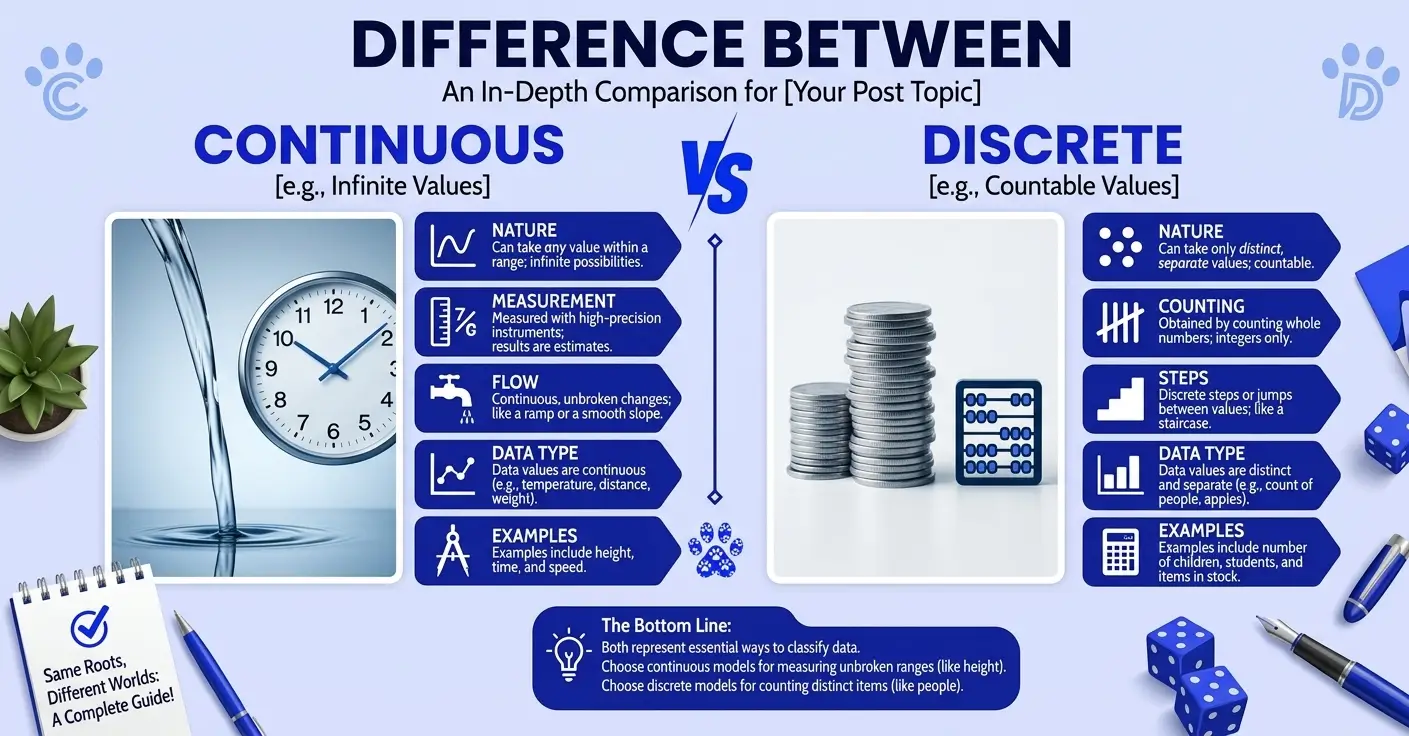
Continuous and discrete are two ways of describing how values can occur. The distinction is especially important in mathematics, statistics, data analysis, and science. Continuous refers to values that can vary anywhere within a range, while discrete refers to separate, distinct possible values.
The easiest way to tell them apart is not simply to look for decimals. Instead, ask whether values between two possible observations can exist. Height, weight, and temperature are commonly treated as continuous because they can be measured to increasingly fine levels. The number of students, cars, or books is discrete because these quantities are counted in separate units.
Quick Answer
Continuous describes values that can theoretically take any value within a range, including values between two observations.
Discrete describes separate, distinct values that can be counted or listed.
The key difference is that continuous variables have possible values throughout a range, while discrete variables have separate possible values with gaps or fixed steps between them.
For example:
- A person’s height can be 170 cm, 170.1 cm, 170.12 cm, and so on, so it is continuous.
- The number of students in a classroom can be 20 or 21, but not 20.5, so it is discrete.
Continuous vs. Discrete at a Glance
| Feature | Continuous | Discrete |
|---|---|---|
| Basic idea | Values can vary across a range | Values are separate and distinct |
| Usually obtained by | Measuring | Counting |
| Intermediate values | Possible | Not necessarily possible |
| Typical examples | Height, weight, temperature, time | Number of students, cars, books |
| Possible values | Can be uncountably many within an interval | Finite or countably infinite |
| Common visualization | Histogram or other distribution plots | Bar chart, dot plot, or other discrete displays |
The distinction is about the possible values of the variable, not merely how the values happen to be written.
What Does Continuous Mean?
Continuous means something that can vary smoothly without being restricted to separate steps.
In statistics, a continuous variable can theoretically take any value within a specified interval. Between two possible values, another value can also be possible.
For example, suppose a runner completes a race in 20 seconds. That time could theoretically be:
- 20 seconds
- 20.1 seconds
- 20.01 seconds
- 20.001 seconds
The precision of the measurement may be limited by the measuring instrument, but the underlying quantity can be represented at increasingly fine levels. Response time, height, weight, temperature, and distance are common examples.
Examples of Continuous Variables
- Height
- Weight
- Distance
- Temperature
- Time
- Speed
- Length
- Volume
A useful way to think about continuous values is as points along a range or spectrum rather than separate boxes.
What Does Discrete Mean?
Discrete means separate, distinct, or individually distinguishable.
A discrete variable has possible values that are separate rather than filling every point within a range. Many discrete variables result from counting.
For example, the number of customers entering a store could be:
- 0
- 1
- 2
- 3
- 4
There cannot be 3.6 customers in the store if the variable means the number of individual customers.
Discrete values do not have to be limited to ordinary whole numbers. They can also follow fixed increments or categories. For example, Canadian currency can be discrete when considered at the cent level, and shoe sizes can be discrete because only certain sizes are available.
Examples of Discrete Variables
- Number of students
- Number of employees
- Number of cars
- Number of books
- Number of tickets sold
- Number of children
- Shoe size
- Number of goals scored
What Is the Difference Between Continuous and Discrete?
The fundamental difference is how the possible values are distributed.
A continuous variable can have another possible value between any two values within its range. A discrete variable has separate possible values, so intermediate values may not be meaningful or allowed.
Consider these examples:
Height:
A person can be 170 cm, 170.5 cm, 170.55 cm, or another value within the measurement range. Height is therefore treated as continuous.
Number of people:
A room can contain 20 people or 21 people, but not 20.5 people. The count is discrete.
This leads to a useful rule:
If the quantity is fundamentally measured along a range, think continuous. If it consists of separate countable units or fixed possible values, think discrete.
Continuous and Discrete Examples
| Variable | Type | Why? |
|---|---|---|
| Height | Continuous | Can be measured at increasingly fine precision |
| Weight | Continuous | Intermediate values are possible |
| Temperature | Continuous | Can vary across a range |
| Time | Continuous | Smaller intervals can be measured |
| Distance | Continuous | Values between measurements are possible |
| Number of students | Discrete | Students are counted individually |
| Number of cars | Discrete | Cars are separate units |
| Number of books | Discrete | Books are counted |
| Number of goals | Discrete | Goals occur as separate events |
| Shoe size | Discrete | Only specific sizes are available |
The Decimal Myth: Continuous Does Not Simply Mean “Has Decimals”
One of the most common mistakes is assuming:
Decimal = continuous
Whole number = discrete
That shortcut is useful for beginners, but it is not the actual definition.
A discrete variable can sometimes contain decimal values when its possible values occur in fixed increments.
For example, shoe sizes can include:
- 8
- 8.5
- 9
- 9.5
The presence of .5 does not make shoe size continuous because you cannot normally choose every possible value such as 8.27 or 9.13. The available values are discrete.
Likewise, money can be discrete when the smallest permitted unit is fixed. If an amount is restricted to cents, possible values occur in steps such as $10.00, $10.01, $10.02, and so forth.
So the better question is:
Can the variable take values anywhere within the relevant range, or only at specific possible points?
Tricky Examples: Age, Money, Shoe Size and Time
Some variables are not as straightforward as they first appear.
Is Age Continuous or Discrete?
Age can be continuous or recorded discretely depending on how it is defined and measured.
A person’s actual age changes continuously. Someone who is exactly 20 years old today is also 20 years and several seconds old a moment later.
However, if a dataset records age only as completed years, then its recorded values are discrete:
- 18
- 19
- 20
- 21
The underlying quantity and the way it is recorded are not always the same thing. G2 also highlights this distinction when discussing age.
Is Money Continuous or Discrete?
Money can be treated as discrete when the smallest unit is fixed.
For example, if a system records dollars and cents, possible recorded amounts occur in increments of one cent.
A theoretical economic quantity such as income may sometimes be modeled differently for statistical purposes, but the actual monetary unit used for recording transactions imposes discrete steps.
Is Shoe Size Continuous or Discrete?
Shoe size is generally discrete because manufacturers offer specific sizes rather than every mathematically possible measurement.
A system might offer:
- 8
- 8.5
- 9
- 9.5
There is no ordinary shoe size of 8.37 in the same scale.
Is Time Continuous or Discrete?
Time is generally treated as continuous because between two moments there can always be another moment.
However, a digital system may record time at discrete intervals such as:
- every second
- every minute
- every hour
This illustrates an important distinction between the underlying phenomenon and the way data is recorded.
Continuous vs. Discrete Data
In statistics, continuous and discrete commonly describe types of quantitative data.
Discrete data consists of separate values, often produced by counting.
Continuous data consists of measured values that can vary within a range.
For example:
Number of customers = discrete data
Customer waiting time = continuous data
The number of customers is counted. Waiting time is measured.
This distinction can affect how data is summarized, visualized, and modeled.
Continuous vs. Discrete Variables
A continuous variable can theoretically take values throughout a range.
A discrete variable has separate possible values.
For example:
- Height → continuous variable
- Weight → continuous variable
- Temperature → continuous variable
- Number of children → discrete variable
- Number of employees → discrete variable
- Number of products sold → discrete variable
LibreTexts describes the distinction in terms of possible values between observations: if another value can logically occur between two values, the variable is continuous; if possible values are separate, it is discrete.
How Are Continuous and Discrete Data Visualized?
The type of data can influence which visualization is appropriate.
Discrete categories or values are often displayed with bar charts or dot plots, while continuous distributions are commonly represented using histograms and other distribution plots.
For example:
Discrete:
Number of books owned:
- 0
- 1
- 2
- 3
- 4
A bar chart can compare the frequency associated with each value.
Continuous:
Heights of 1,000 people:
- 160–165 cm
- 165–170 cm
- 170–175 cm
- 175–180 cm
A histogram can group measurements into intervals and show the distribution.
The graph is not what makes a variable continuous or discrete. The nature of the underlying data determines the appropriate representation.
Common Mistakes With Continuous and Discrete
Mistake 1: Assuming every whole number is discrete
Incorrect idea:
“The data contains whole numbers, so it must be discrete.”
Correct principle:
Look at the underlying possible values.
A continuous measurement can be rounded and recorded as a whole number without becoming conceptually discrete.
Why:
Recording precision and the nature of the variable are different things.
Mistake 2: Assuming every decimal is continuous
Incorrect idea:
“Because shoe size can be 8.5, shoe size is continuous.”
Correct principle:
Shoe sizes are still separate permitted values.
Why:
The values do not fill the entire range.
Mistake 3: Confusing measurement with recording
A continuous quantity can be recorded using discrete steps.
For example, temperature might be recorded only to the nearest whole degree even though the underlying temperature varies continuously.
Mistake 4: Assuming discrete means finite
A discrete variable does not necessarily have to have only a finite number of possible values.
The important property is that the possible values are countable and separate, even when the set can continue indefinitely.
Can a Variable Be Treated Differently?
Yes.
In real statistical work, the distinction is sometimes influenced by how accurately a variable is measured, recorded, or modeled.
For example, age may be conceptually continuous but recorded as completed years. Researchers may also use statistical methods that approximate certain discrete measurements as continuous when the approximation is appropriate.
This is one reason the distinction should not be reduced to a simple decimal test. The Berkeley statistics material notes that practical measurement always has limits of precision, which can make the distinction less absolute in applied work.
Can Continuous and Discrete Mean Something Other Than Data?
Yes.
The words are also used in other mathematical contexts.
For example:
- A continuous function has a graph without breaks or jumps over its domain.
- A discrete function may have separate input values.
- A continuous probability distribution assigns probabilities across intervals.
- A discrete probability distribution assigns probabilities to separate possible outcomes.
For probability distributions, the distinction becomes particularly important because continuous probability is calculated over intervals, while a discrete distribution assigns probabilities to individual possible values.
So when someone asks about “continuous and discrete,” the surrounding subject matters.
How to Remember the Difference
Use this simple memory rule:
Continuous = connected range.
Discrete = distinct values.
Think of a ruler for continuous data. You can measure a length at increasingly fine points.
Think of people in a room for discrete data. You count separate individuals.
Another useful question is:
Could there logically be another valid value between these two values?
If yes, the variable may be continuous.
If the possible values are separate and intermediate values are not valid, it is discrete.
Which One Should I Use?
Use this decision guide:
If you are measuring something along a range → Continuous
Examples:
- height
- weight
- distance
- temperature
- time
If you are counting separate units or selecting from fixed possible values → Discrete
Examples:
- number of people
- number of cars
- number of books
- number of goals
- shoe size
If you are unsure → Ask what the possible values actually are.
Do not decide based only on whether the recorded number contains a decimal.
Continuous or Discrete? Practice Examples
Classify each variable as continuous or discrete.
- Number of students in a classroom
- Height of a student
- Number of goals scored in a game
- Temperature outside
- Weight of a package
- Number of computers in an office
- Shoe size
- Time required to finish an exam
- Number of books on a shelf
- Distance traveled by a car
Answers
- Discrete — students are counted.
- Continuous — height is measured across a range.
- Discrete — goals are separate countable events.
- Continuous — temperature can vary across a range.
- Continuous — weight is measured.
- Discrete — computers are counted individually.
- Discrete — shoe sizes occur at specific available increments.
- Continuous — time can be measured at increasingly fine precision.
- Discrete — books are counted.
- Continuous — distance can take intermediate values.
Frequently Asked Questions
What is the difference between continuous and discrete?
Continuous variables can take values throughout a range, while discrete variables have separate, distinct possible values. Continuous variables are commonly measured, while discrete variables are commonly counted.
Is continuous the same as decimal?
No. Decimals do not automatically make a variable continuous. A discrete variable can contain decimal values when its possible values occur at fixed increments, such as some measurements of money or shoe sizes.
Is discrete always a whole number?
No. Discrete values can include decimals if only certain decimal values are possible. What matters is whether the possible values are separate and countable.
Is age continuous or discrete?
Age is conceptually continuous when measured precisely because time passes continuously. However, age recorded only in completed years is discrete in that dataset.
Is time continuous or discrete?
Time is generally treated as continuous because there can always be another moment between two moments. However, a system may record time at discrete intervals.
Is shoe size continuous or discrete?
Shoe size is generally discrete because only specific sizes are available. The existence of half sizes does not make every value between sizes possible.
Are continuous and discrete variables the same as continuous and discrete data?
They are closely related terms. A variable describes the characteristic being measured or counted, while data are the observed values collected for that variable.
What is the easiest way to identify a continuous variable?
Ask whether another valid value could exist between two possible values. If values can theoretically occur throughout a range, the variable is likely continuous.
What is the easiest way to identify a discrete variable?
Ask whether the possible values are separate and countable. If intermediate values are not possible or meaningful, the variable is likely discrete.
Conclusion
The main difference between continuous and discrete is the structure of their possible values. Continuous variables can vary throughout a range, while discrete variables consist of separate, countable, or otherwise distinct values.
The most useful rule is not “decimals are continuous and whole numbers are discrete.” Instead, ask whether values between two observations can logically exist. Height, weight, temperature, and time are commonly continuous, while numbers of people, books, cars, and goals are discrete.
Remember: continuous means values across a range; discrete means distinct possible values.