
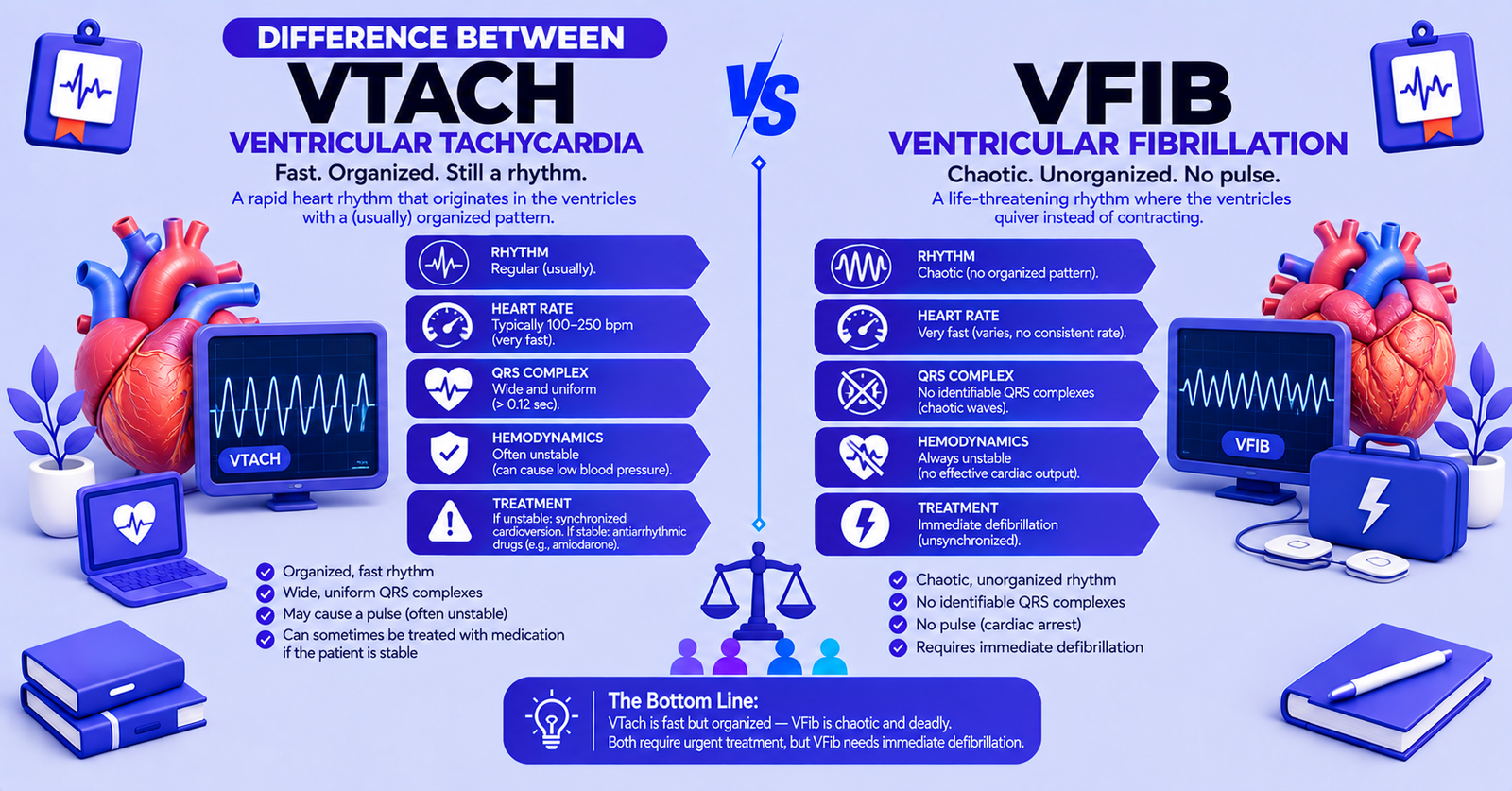
VTach and VFib are both dangerous abnormal heart rhythms that begin in the ventricles, the heart’s lower chambers. However, they are not the same condition. The most important difference is that ventricular tachycardia (VTach) is a very fast ventricular rhythm that can still be electrically organized and may produce a pulse, while ventricular fibrillation (VFib) is chaotic electrical activity that prevents the ventricles from pumping blood effectively.
Understanding this distinction matters because VTach can range from a brief episode to a life-threatening rhythm, while VFib is a cardiac-arrest emergency. VTach can also deteriorate into VFib.
Quick Answer
VTach (ventricular tachycardia) is a very fast rhythm that starts in the ventricles. The electrical activity is generally more organized than VFib, and a person with VTach may still have a pulse.
VFib (ventricular fibrillation) is chaotic electrical activity in the ventricles. The ventricles quiver rather than contract effectively, so there is no effective cardiac output and the person becomes pulseless. VFib requires immediate CPR and defibrillation.
The simplest way to remember the difference:
VTach is a very fast ventricular rhythm; VFib is a chaotic ventricular rhythm that stops effective pumping.
VTach vs VFib at a Glance
| Feature | VTach | VFib |
| Full name | Ventricular tachycardia | Ventricular fibrillation |
| Origin | Ventricles | Ventricles |
| Electrical pattern | Fast and generally organized | Chaotic and disorganized |
| Effective pumping | May be reduced but can persist | No effective ventricular pumping |
| Pulse | May be present or absent | Absent |
| Consciousness | May be preserved or lost | Usually rapidly lost |
| ECG appearance | Rapid ventricular rhythm with recognizable wide complexes in typical VT | Chaotic waveform without organized QRS complexes |
| Cardiac arrest | Can cause it, especially if pulseless | Causes cardiac arrest |
| Can progress to the other? | Can deteriorate into VFib | — |
| Emergency treatment | Depends on pulse and stability | Immediate CPR and defibrillation |
VTach can be clinically stable, unstable, or pulseless, so its management depends heavily on the patient’s condition. VFib is a shockable cardiac-arrest rhythm.
What Is VTach?
Ventricular tachycardia, commonly called VTach, V-tach, or VT, is a rapid heart rhythm that originates in the ventricles.
The rapid ventricular rhythm can prevent the heart chambers from filling normally between contractions. As a result, the heart may pump less blood to the brain and other organs. Symptoms can include palpitations, dizziness, shortness of breath, chest discomfort, fainting, or loss of consciousness.
VTach is not always identical from one episode to another. It can be:
- Nonsustained, meaning it stops within 30 seconds.
- Sustained, meaning it continues for more than 30 seconds.
- Monomorphic, where the ventricular complexes have a similar appearance.
- Polymorphic, where their appearance changes from beat to beat.
Sustained VT can be dangerous and may progress to cardiac arrest or VFib.
What Is VFib?
Ventricular fibrillation, commonly called VFib, V-fib, or VF, is a severely disorganized ventricular rhythm.
Instead of contracting in a coordinated way, the ventricles quiver because of chaotic electrical activity. This prevents them from pumping blood effectively. As a result, VFib causes cardiac arrest and requires immediate emergency treatment.
A person experiencing VFib typically becomes unresponsive and has no effective pulse. Without rapid CPR and defibrillation, VFib can be fatal.
What Is the Difference Between VTach and VFib?
The central difference is how organized the ventricular electrical activity is and whether the heart can still produce effective circulation.
In VTach, the ventricles are beating extremely rapidly because abnormal electrical signals are driving them. Although this can severely reduce cardiac output, some VTach episodes still produce enough circulation for the person to have a pulse and remain conscious.
In VFib, the electrical activity is so disorganized that the ventricles cannot contract effectively. Instead, they quiver, resulting in essentially no effective cardiac output.
So the distinction can be simplified as:
VTach = fast ventricular rhythm that may still produce a pulse.
VFib = chaotic ventricular activity with no effective pulse.
There is an important qualification: VTach without a pulse is also a cardiac-arrest rhythm and is treated as a shockable rhythm.
VTach vs VFib on an ECG
The ECG is one of the main ways clinicians distinguish the two rhythms.
VTach on an ECG
Typical VTach appears as a rapid ventricular rhythm with wide QRS complexes and an organized repeating pattern. Depending on the type of VT, the complexes may look similar or may change shape.
VFib on an ECG
VFib has no organized QRS complexes. Instead, the ECG shows rapidly changing, chaotic electrical activity. There is no stable repeating ventricular pattern.
Simple ECG memory rule
VTach: fast + organized enough to recognize ventricular complexes.
VFib: chaotic + no recognizable organized QRS pattern.
ECG interpretation should always be combined with assessment of the patient, including pulse and clinical condition.
Pulse and Cardiac Output: The Key Clinical Difference
One of the most important distinctions is whether a pulse is present.
VTach
VTach can occur with a pulse or without a pulse.
If the rhythm still produces enough blood flow, the person may have:
- a measurable pulse
- blood pressure
- consciousness
- palpitations
- dizziness or other symptoms
If VTach becomes pulseless, it is a cardiac-arrest rhythm.
VFib
VFib causes ineffective ventricular contractions and therefore no effective pulse.
The person usually becomes unresponsive rapidly because the brain and other organs are no longer receiving adequate blood flow.
This is why pulse assessment is so important when distinguishing the clinical significance of ventricular rhythms.
VTach Symptoms vs VFib Symptoms
Common VTach symptoms
Depending on how severe and sustained the rhythm is, VTach may cause:
- Palpitations
- Dizziness
- Lightheadedness
- Chest discomfort
- Shortness of breath
- Weakness
- Fainting
- Loss of consciousness
Some short episodes may produce few or no symptoms, while sustained VT can cause severe instability.
Typical VFib presentation
VFib is much more dramatic because it prevents effective circulation.
A person may:
- Suddenly collapse
- Become unresponsive
- Have no pulse
- Stop breathing normally or only gasp
- Experience cardiac arrest
VFib is an immediate medical emergency.
Can VTach Turn Into VFib?
Yes.
VTach can deteriorate into ventricular fibrillation, particularly when the ventricular rhythm becomes increasingly unstable. The American Heart Association notes that prolonged polymorphic VT can degenerate into VF, and Mayo Clinic identifies VFib as a potentially life-threatening complication of VTach.
This is one reason sustained VTach should never be dismissed simply because it initially appears more organized than VFib.
The progression can be thought of as:
VTach → worsening ventricular instability → VFib → cardiac arrest
This sequence does not occur in every case, but it explains why clinicians take dangerous ventricular tachycardia seriously.
Are VTach and VFib Shockable?
Both can be associated with shockable rhythms, but the exact situation matters.
VFib
Yes. VFib is a shockable cardiac-arrest rhythm.
Emergency treatment includes high-quality CPR and rapid defibrillation.
Pulseless VTach
Yes. Pulseless VTach is also a shockable cardiac-arrest rhythm.
The American Heart Association specifically includes VF and pulseless VT among the rhythms for which early defibrillation is critical.
VTach with a pulse
This is different.
If a person has VTach with a pulse, treatment depends on whether the patient is stable or unstable. An unstable patient may require synchronized cardioversion, while other situations may be managed differently by trained clinicians.
Therefore:
Do not assume every VTach episode is treated exactly like VFib. Pulse and clinical stability matter.
Cardioversion vs Defibrillation
These terms are often confused.
Cardioversion
Synchronized cardioversion delivers an electrical shock timed with the heart’s electrical cycle. It may be used for certain unstable tachyarrhythmias when a pulse is present.
Defibrillation
Defibrillation is an unsynchronized electrical shock used during cardiac arrest for shockable rhythms such as:
- VFib
- Pulseless VTach
The American Heart Association’s current resuscitation guidance specifically distinguishes these cardiac-arrest rhythms and emphasizes rapid defibrillation alongside CPR.
A simple way to remember it:
Unstable tachyarrhythmia with a pulse → synchronized cardioversion may be appropriate.
VFib or pulseless VTach → defibrillation during cardiac arrest.
Actual treatment decisions belong to trained emergency professionals following the applicable resuscitation protocol.
Causes and Risk Factors
VTach and VFib can share many underlying causes because both involve abnormal electrical activity in the ventricles.
Potential causes and risk factors include:
- Coronary artery disease
- Previous heart attack
- Structural heart disease
- Cardiomyopathy
- Heart failure
- Electrolyte abnormalities
- Hypoxia
- Certain medications or toxic exposures
- Inherited electrical disorders
Scar tissue from previous heart damage can create an abnormal electrical pathway that contributes to ventricular arrhythmias.
VFib can also occur during an acute disruption of the heart’s electrical system or blood supply.
The underlying cause matters because treating the rhythm alone may not address the reason it occurred.
Common Mistakes With VTach and VFib
Mistake 1: Thinking VTach and VFib are the same
Incorrect idea:
“Both are just different names for a dangerous fast heartbeat.”
Correct:
VTach is a rapid ventricular rhythm; VFib is chaotic ventricular electrical activity that prevents effective pumping.
Why:
They have different ECG patterns and clinical consequences.
Mistake 2: Assuming VTach always means cardiac arrest
Incorrect idea:
“Anyone with VTach automatically has no pulse.”
Correct:
VTach can occur with a pulse or without one.
Why:
Pulse status changes the clinical situation and treatment approach.
Mistake 3: Thinking VFib still produces a normal heartbeat
Incorrect idea:
“VFib is simply a very fast heartbeat.”
Correct:
VFib is chaotic electrical activity that causes the ventricles to quiver rather than pump effectively.
Why:
The problem is not merely speed; it is the loss of coordinated ventricular contraction.
Mistake 4: Treating all VTach the same way
Incorrect idea:
“Every VTach case receives the same treatment.”
Correct:
Treatment depends on factors including pulse status, stability, rhythm characteristics, and the underlying cause.
Common Collocations and Medical Phrases
These combinations are useful when reading clinical material:
VTach
- sustained VTach
- nonsustained VTach
- monomorphic VT
- polymorphic VT
- VT with a pulse
- pulseless VT
- ventricular tachycardia
- ventricular tachycardia ECG
VFib
- ventricular fibrillation
- VFib arrest
- shockable VF
- VF rhythm
- ventricular fibrillation ECG
- refractory VF
- VF cardiac arrest
Related terms
- ventricular arrhythmia
- cardiac arrest
- cardiac output
- defibrillation
- synchronized cardioversion
- automated external defibrillator
- CPR
How to Remember the Difference
Use this simple memory rule:
Tachycardia = Too Fast
Think:
VTach → the ventricles are going too fast.
Fibrillation = Flickering/Chaotic
Think:
VFib → the ventricles are electrically chaotic and quivering instead of pumping effectively.
Then add the most important clinical rule:
VTach may have a pulse. VFib does not produce an effective pulse.
For cardiac-arrest purposes, remember:
VFib + pulseless VT = shockable rhythms.
Which One Should I Use?
Since VTach and VFib are medical diagnoses rather than interchangeable vocabulary choices, the practical decision depends on which rhythm is being described.
Think VTach when the ventricles are beating very rapidly in an organized ventricular rhythm.
With VFib, the ventricular electrical activity is chaotic, and the ventricles are not effectively pumping blood.
For VTach, determine whether the patient has a pulse and whether they are hemodynamically stable.
VFib, by contrast, is a cardiac-arrest emergency that requires immediate resuscitation and defibrillation.
VTach or VFib? Practice Examples
Choose VTach or VFib.
1.
A patient has a very rapid ventricular rhythm with recognizable, repetitive wide complexes on an ECG.
Answer: VTach
2.
A patient suddenly collapses and has no pulse. The ECG shows chaotic electrical activity without recognizable QRS complexes.
Answer: VFib
3.
A patient has ventricular tachycardia but still has a measurable pulse.
Answer: VTach
4.
A cardiac-arrest patient has a shockable rhythm characterized by chaotic ventricular activity.
Answer: VFib
5.
A ventricular rhythm deteriorates from an organized rapid rhythm into chaotic electrical activity.
Answer: VTach progressing to VFib
6.
A rhythm has no effective ventricular contractions and produces no cardiac output.
Answer: VFib
7.
A patient has a rapid ventricular rhythm, but the appropriate treatment depends on whether the patient is stable and whether a pulse is present.
Answer: VTach
8.
A patient in cardiac arrest has a shockable rhythm requiring immediate defibrillation.
Answer: VFib or pulseless VTach
Frequently Asked Questions
What is the main difference between VTach and VFib?
VTach is a very fast ventricular rhythm that can remain organized enough to produce some cardiac output and may occur with a pulse. VFib is chaotic ventricular electrical activity that prevents effective pumping and causes cardiac arrest.
Is VTach worse than VFib?
VFib is generally the more immediately catastrophic rhythm because it causes loss of effective cardiac output and cardiac arrest. However, VTach can also be life-threatening, particularly when sustained, unstable, or pulseless, and it can deteriorate into VFib.
Does VTach have a pulse?
It can. VTach may occur with a pulse or without a pulse. Pulseless VTach is a cardiac-arrest rhythm and is treated as a shockable rhythm.
Does VFib have a pulse?
No effective pulse is present in VFib because the ventricles are not contracting effectively enough to circulate blood. VFib is therefore a cardiac-arrest emergency.
Can VTach turn into VFib?
Yes. VTach can deteriorate into VFib, particularly when the ventricular rhythm becomes unstable or persists.
Which is more organized, VTach or VFib?
VTach is generally more organized. VFib is characterized by chaotic, disorganized ventricular electrical activity without an organized repeating ventricular pattern.
What does VTach look like on an ECG?
Typical VTach appears as a rapid ventricular rhythm with wide QRS complexes. The exact appearance varies depending on whether the VT is monomorphic or polymorphic.
What does VFib look like on an ECG?
VFib appears as chaotic, rapidly changing electrical activity without recognizable organized QRS complexes.
Are VTach and VFib both shockable?
VFib and pulseless VTach are shockable cardiac-arrest rhythms. VTach with a pulse is a different clinical situation and may require synchronized cardioversion or other treatment depending on stability and the specific rhythm.
What is the difference between cardioversion and defibrillation?
Cardioversion is generally a synchronized shock used for certain tachyarrhythmias, while defibrillation is an unsynchronized shock used for cardiac-arrest rhythms such as VFib and pulseless VTach.
Is VFib the same as a heart attack?
No. VFib is an abnormal heart rhythm, while a heart attack results from inadequate blood flow to heart muscle, usually because of a blocked coronary artery. A heart attack can, however, trigger VFib.
What should someone do if they witness a possible VFib cardiac arrest?
If someone suddenly becomes unresponsive and is not breathing normally, emergency services should be contacted immediately, CPR should be started according to local emergency guidance, and an AED should be used as soon as one is available.
Conclusion
The difference between VTach and VFib comes down to the organization of ventricular electrical activity and the heart’s ability to maintain circulation. VTach is a very fast ventricular rhythm that may still produce a pulse, while VFib is chaotic ventricular activity that prevents effective pumping and causes cardiac arrest. VTach can be stable, unstable, or pulseless, whereas VFib is a pulseless emergency. Both can be dangerous, and pulseless VTach and VFib are shockable cardiac-arrest rhythms.