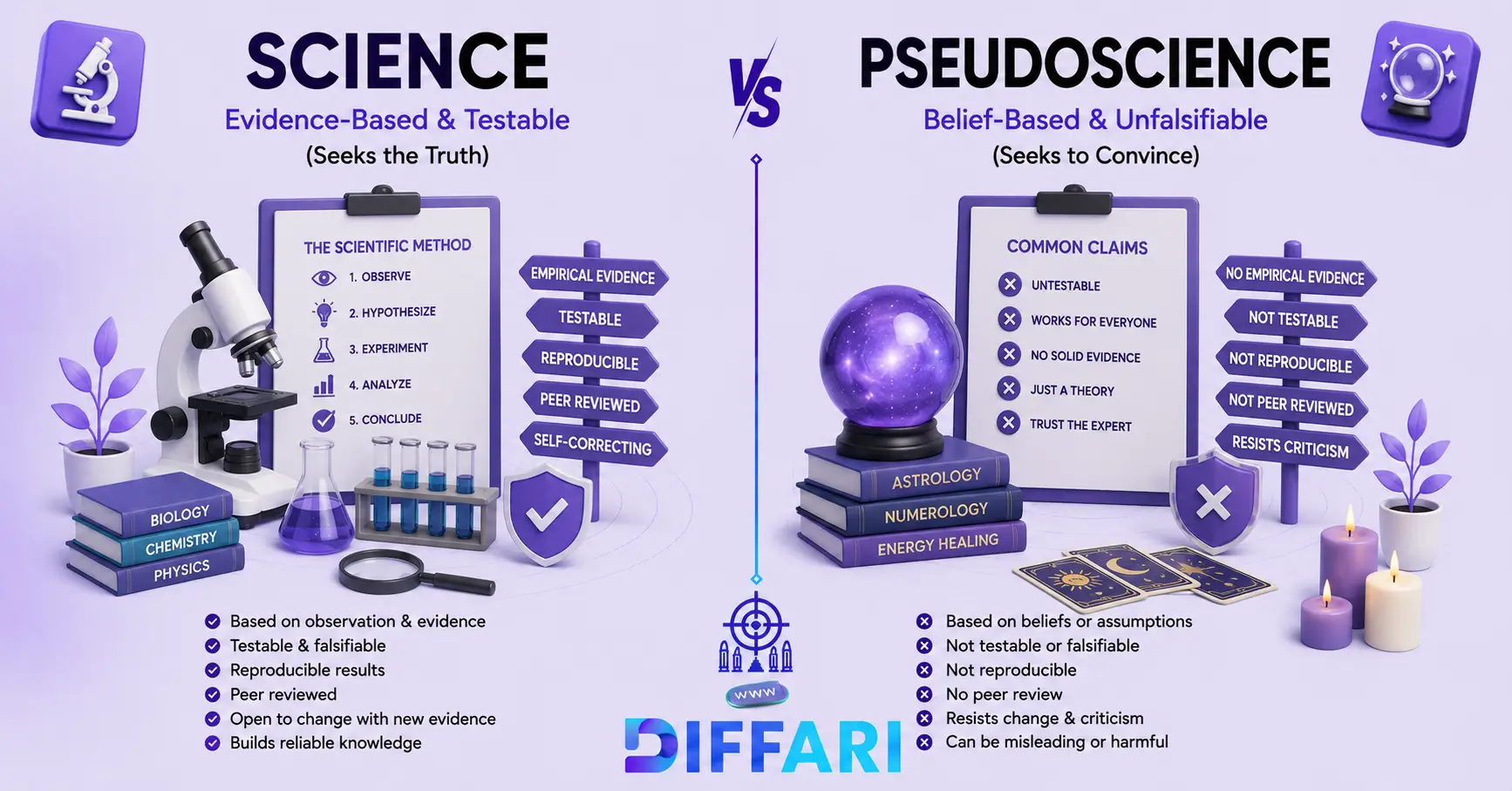

Science and pseudoscience can sometimes look surprisingly similar. Both may use technical vocabulary, make claims about how the world works, and present observations or experiments as support. The important difference is not simply whether something uses scientific-sounding words or mentions evidence. It is how claims are investigated, tested, criticized, and revised.
Science is a systematic way of developing and testing knowledge through empirical evidence, critical evaluation, and methods that allow claims to be challenged. Pseudoscience, by contrast, refers to claims or systems that present themselves as scientific but do not adequately meet scientific standards. The boundary is not always defined by one universal rule; philosophers of science continue to debate the best criteria for drawing it.
This distinction matters because a claim can sound scientific without actually being supported by reliable scientific methods.
Quick Answer
Science uses systematic observation, measurement, testing, evidence, criticism, and revision to investigate questions about the world.
Pseudoscience presents ideas as scientific or scientifically authoritative without adequately following the standards that make scientific investigation reliable.
The key difference is how knowledge claims are tested and handled when evidence challenges them. Science is designed to expose ideas to criticism and possible revision, while pseudoscientific systems often rely on selective evidence, weak methodology, unfalsifiable claims, or strategies that protect a belief from meaningful counterevidence.
Science vs Pseudoscience at a Glance
| Feature | Science | Pseudoscience |
|---|---|---|
| Main purpose | Investigate and explain phenomena | Present claims as reliable knowledge without adequate scientific support |
| Evidence | Uses systematic empirical evidence | May rely heavily on anecdotes, selective evidence, or weak evidence |
| Testing | Claims are exposed to meaningful tests | Claims may be difficult or impossible to test properly |
| Falsifiability | Important claims can potentially be challenged by evidence | Claims may be structured to resist refutation |
| Replication | Independent testing is valued | Independent confirmation may be weak or absent |
| Criticism | Criticism is part of the process | Counterevidence may be dismissed or avoided |
| Revision | Conclusions can change with better evidence | Core beliefs may remain fixed despite contrary evidence |
| Methodology | Methods are expected to be explicit and scrutinizable | Methods may be vague, selective, or inadequately justified |
| Scientific appearance | Follows scientific practices | May imitate the language or appearance of science |
This table describes general tendencies rather than an infallible checklist. Philosophical research shows that the science–pseudoscience boundary is complex and cannot always be reduced to one criterion.
What Is Science?
Science is a systematic approach to learning about the natural and social world through observation, evidence, reasoning, testing, and critical evaluation.
Scientists formulate questions and hypotheses, collect relevant evidence, conduct observations or experiments when appropriate, analyze results, compare findings with existing knowledge, and communicate their methods and conclusions to other researchers.
An important characteristic of science is that its conclusions are open to correction. A scientific explanation is not protected simply because it is popular or because an influential person supports it. If strong new evidence conflicts with an established explanation, scientists can investigate the discrepancy and revise the explanation.
Science therefore should not be understood as a collection of facts that can never change. It is better understood as an ongoing process of inquiry and error correction. The Stanford Encyclopedia of Philosophy specifically emphasizes empirical testing, criticism, and the capacity of scientific knowledge to improve over time.
Example of scientific reasoning
Suppose researchers propose that a particular drug reduces a certain symptom.
They might:
- State a clear hypothesis.
- Design a study capable of testing it.
- Collect measurements.
- Analyze the results.
- Compare the results with the prediction.
- Allow other researchers to examine or repeat the work.
- Modify the conclusion if the evidence does not support the original claim.
The result may support the hypothesis, weaken it, or show that the hypothesis needs modification.
That possibility of being wrong is not a weakness of science. It is one of the reasons scientific inquiry can correct itself.
What Is Pseudoscience?
Pseudoscience refers to a claim, doctrine, or practice that presents itself as scientific or as providing scientifically reliable knowledge without adequately meeting relevant scientific standards.
The term is more specific than simply saying something is “wrong” or “not scientific.” The Stanford Encyclopedia of Philosophy notes that not everything that is non-scientific is pseudoscience. Pseudoscience typically involves some form of scientific pretension or an attempt to present a non-scientific doctrine as having scientific status.
For example, an idea can be mistaken without being pseudoscientific. A scientist may conduct a flawed experiment, misunderstand a result, or make a calculation error. That is normally treated as bad or erroneous science, not automatically as pseudoscience.
The distinction becomes more significant when a system persistently presents unsupported or inadequately tested claims as scientific knowledge while resisting the methods of critical evaluation used by science.
What Is the Difference Between Science and Pseudoscience?
The biggest difference is methodological accountability.
Science does not merely ask whether evidence supporting a claim exists. It also asks:
- How was the evidence obtained?
- Can the claim be tested?
- What observations would count against it?
- Can other researchers examine the methods?
- Can the findings be independently tested?
- Are alternative explanations considered?
- Is contradictory evidence taken seriously?
- Can the conclusion change when better evidence appears?
Pseudoscience can imitate some of the outward appearance of this process while failing to maintain the underlying standards.
For example, a pseudoscientific claim might use scientific terminology, cite isolated studies, show impressive-looking charts, or refer to “research.” Those features alone do not establish that the claim is scientifically reliable.
Scientific credibility depends on the quality and transparency of the investigative process, not merely on scientific vocabulary.
How Science Tests Claims
Testing is central to scientific reasoning.
A strong scientific hypothesis makes predictions that can be compared with observations or measurements. A useful scientific claim must expose itself to the possibility of failure.
This connects to falsifiability, a concept strongly associated with philosopher Karl Popper. In simplified terms, a claim is falsifiable when there is some conceivable observation or result that could show it to be false. Popper’s approach has been highly influential, although contemporary philosophy of science does not treat falsifiability as a complete solution to every demarcation problem.
Example
Consider:
“This treatment improves recovery time under these specified conditions.”
That claim can potentially be tested.
Now consider:
“This treatment always works, but whenever it appears not to work, an invisible factor prevented its effectiveness.”
The second claim is much harder to challenge because almost any outcome can be explained away.
That kind of protective reasoning can make a claim resistant to meaningful testing.
Why Replication Matters
A single experiment rarely settles an important scientific question.
Other researchers may attempt to reproduce or independently investigate a result. If similar findings emerge under appropriate conditions, confidence in the result can increase. If repeated investigations fail to support the original result, scientists have reason to reconsider it.
Replication is therefore part of the broader scientific culture of independent scrutiny and error correction.
A scientific claim does not become true simply because one experiment produced a desired result.
Why Peer Review and Openness Matter
Scientific research is normally communicated to other researchers so that its methods, evidence, reasoning, and conclusions can be examined.
This does not mean peer review guarantees that every published study is correct. Scientific publications can contain errors, weak methods, disputed interpretations, or results that later fail to hold up.
The important distinction is that science has institutional mechanisms through which researchers can criticize, test, reproduce, challenge, and revise claims.
By contrast, pseudoscientific systems may place greater emphasis on authority, selective evidence, inaccessible methods, or explanations that insulate the central claim from criticism. Research on pseudoscience identifies lack of openness, selective confirmation, and resistance to counterevidence among important warning signs.
How Pseudoscience Can Look Scientific
Pseudoscience is often persuasive precisely because it can resemble science on the surface.
It may contain:
- Technical vocabulary
- Charts and statistics
- References to experiments
- Scientific-looking equipment
- Claims about “energy,” “quantum” effects, or biological mechanisms
- Testimonials
- People described as experts
- References to research papers
None of these features proves that a claim is scientifically established.
A useful question is:
Does the underlying method actually support the scientific conclusion being claimed?
Scientific terminology without sound methodology is not enough.
Science vs Pseudoscience Examples
Example 1: A testable medical hypothesis
Researchers hypothesize that a treatment lowers blood pressure.
They define the outcome, establish appropriate comparison groups, collect measurements, analyze the results, and report limitations.
This is consistent with scientific inquiry.
Example 2: Selective testimonials
A product is promoted because several customers say it worked for them, while unsuccessful experiences are ignored.
Testimonials alone are not strong evidence of scientific effectiveness.
Example 3: A prediction that can never fail
A person claims a method can predict an event but explains every failed prediction by saying that an unknown force interfered.
The claim becomes difficult to falsify and therefore difficult to evaluate scientifically.
Example 4: A scientific theory changes
Researchers obtain strong evidence that conflicts with an established explanation and gradually develop a better model.
Changing a scientific conclusion is a normal part of science, not evidence that science has failed.
Science is expected to improve when evidence reveals weaknesses in existing explanations.
Common Warning Signs of Pseudoscience
No single warning sign proves that a claim is pseudoscientific. However, several warning signs together should encourage careful scrutiny.
1. Unfalsifiable claims
If no possible observation could show that the claim is wrong, testing becomes difficult.
2. Cherry-picking
Only favorable studies, observations, or examples are presented while contradictory evidence is ignored.
3. Reliance on anecdotes
Personal stories can be meaningful experiences, but they cannot by themselves establish that a treatment, product, or theory works generally.
4. Vague methodology
A claim is described as “scientifically proven” without explaining how the evidence was collected or analyzed.
5. Conspiracy-based protection
Criticism is dismissed by claiming that scientists, institutions, governments, or experts are deliberately hiding the truth.
The National Academies identifies conspiracy claims, fake experts, cherry-picked data, logical fallacies, and unrealistic research expectations among recognized warning signs discussed in science communication.
6. Resistance to counterevidence
Instead of treating contrary results as information that might require reconsideration, every negative result is reinterpreted as confirmation.
7. Scientific-sounding language without scientific support
Words such as “quantum,” “energy,” “frequency,” or “biological” can make an explanation sound technical without establishing that its underlying claim is scientifically supported.
What Does Not Automatically Make Something Pseudoscience?
This is an important distinction.
A claim should not automatically be called pseudoscience simply because:
- It is new.
- Scientists disagree about it.
- Evidence is currently incomplete.
- An experiment failed.
- A study was later shown to be wrong.
- It is outside mainstream opinion.
- Researchers are still investigating it.
Science itself contains uncertainty, disagreement, mistakes, and competing hypotheses.
The Stanford Encyclopedia of Philosophy explicitly distinguishes pseudoscience from ordinary bad science and emphasizes that established science is itself not free from error.
The better question is not:
“Is everyone already convinced?”
Instead ask:
“Are the claim and its supporting methods open to appropriate testing and critical evaluation?”
Can Science Be Wrong?
Yes.
Individual scientific studies, hypotheses, measurements, interpretations, and even widely accepted theories can be wrong or incomplete.
That does not make science equivalent to pseudoscience.
The difference is how errors are treated.
Science has mechanisms for identifying and correcting errors through further evidence, criticism, replication, and improved explanations. Scientific knowledge changes because researchers continue testing claims against observations.
The fact that scientific conclusions can change is therefore a feature of scientific inquiry.
Can Science and Pseudoscience Overlap?
The boundary is not always perfectly sharp.
Philosophers have proposed different criteria for distinguishing science from pseudoscience, and the general demarcation problem remains debated. Research on the subject increasingly considers multiple characteristics rather than relying on one universal test.
This means it is better to evaluate a claim using several questions rather than applying a simplistic “one strike and you’re pseudoscience” rule.
Consider:
- Evidence quality
- Testability
- Falsifiability
- Methodological transparency
- Replication
- Logical consistency
- Treatment of contradictory evidence
- Relationship to established knowledge
- Willingness to revise conclusions
The more a claim systematically fails these standards while continuing to present itself as scientific, the stronger the reason for skepticism.
Common Mistakes About Science and Pseudoscience
Mistake 1: “Anything not proven is pseudoscience.”
Why it is wrong:
Many legitimate scientific hypotheses are still being investigated. Lack of sufficient evidence means a claim may be unproven, not necessarily pseudoscientific.
Mistake 2: “Science never changes.”
Why it is wrong:
Scientific knowledge can change as new evidence becomes available.
Mistake 3: “Something is scientific because it uses statistics.”
Why it is wrong:
Statistics can be misused. The quality of the data, study design, analysis, and interpretation matters.
Mistake 4: “One study proves a claim.”
Why it is wrong:
Important findings generally require broader scrutiny and, where appropriate, independent confirmation.
Mistake 5: “Anything alternative to mainstream science is pseudoscience.”
Why it is wrong:
Being unconventional is not enough. A claim should be evaluated according to its evidence and methods.
How to Evaluate a Scientific-Sounding Claim
When you encounter a claim that is presented as scientific, use this practical checklist:
1. What exactly is being claimed?
A vague claim is difficult to evaluate.
2. What evidence supports it?
Look for actual evidence rather than testimonials or authority alone.
3. How was the evidence collected?
Consider the study design, measurements, sample, controls, and methodology.
4. Could the claim be shown to be wrong?
If nothing could possibly count against it, be cautious.
5. Can independent researchers test it?
Independent scrutiny is important.
6. Does the claim address contradictory evidence?
Ignoring inconvenient evidence is a major warning sign.
7. Does the explanation change when evidence changes?
Scientific reasoning allows conclusions to be revised.
8. Is scientific terminology doing more work than evidence?
Technical language does not substitute for a sound method.
How to Remember the Difference
Use this simple rule:
Science tests its ideas; pseudoscience protects its ideas.
That is not a complete philosophical definition, but it is a useful practical memory aid.
A slightly more precise version is:
Science asks, “What evidence could change our conclusion?”
Pseudoscience often asks, “How can we explain away evidence that challenges our conclusion?”
Which One Should I Trust?
When evaluating a claim:
A clearly testable claim → examine how it can be tested.
Evidence that could prove the claim wrong → examine its falsification conditions.
Independent investigation → look for evidence that other researchers can replicate.
Contradictory evidence → examine whether it is openly discussed and addressed.
Only favorable evidence → be cautious about the strength of the claim.
A claim that cannot possibly be challenged → approach it with particular caution.
Scientific terminology without supporting evidence → do not confuse technical language with genuine scientific support.
The goal is not to automatically trust something because it is called “science.” The goal is to evaluate how well the evidence and methodology justify the conclusion.
Science vs Pseudoscience: Practice Examples
Choose science or pseudoscience based on the description.
- Researchers publish a hypothesis, describe their methods, and invite other researchers to test the findings.
- A claim is said to be true regardless of what observations are made.
- Researchers change their conclusion after repeated evidence contradicts the original hypothesis.
- A product is promoted mainly through testimonials from satisfied customers.
- A theory makes specific predictions that can be tested.
- Critics are dismissed as part of a conspiracy whenever they produce contrary evidence.
- Researchers report limitations and discuss results that do not support their hypothesis.
- A claim uses complex scientific vocabulary but provides no clear method for testing it.
Answers
- Science
- Pseudoscience
- Science
- Pseudoscience warning sign
- Science
- Pseudoscience warning sign
- Science
- Pseudoscience warning sign
These answers describe methodological tendencies, not a single universal philosophical test.
Frequently Asked Questions
What is the difference between science and pseudoscience?
Science uses systematic methods of observation, testing, evidence, criticism, and revision. Pseudoscience presents claims as scientific without adequately satisfying the standards used for reliable scientific investigation.
Is pseudoscience the same as bad science?
Not necessarily. A scientist can make mistakes or conduct a poor study without practicing pseudoscience. Pseudoscience generally involves a broader pattern in which unsupported or inadequately scientific claims are presented as scientific.
Is everything that is not science pseudoscience?
No. The Stanford Encyclopedia of Philosophy explicitly distinguishes pseudoscience from other forms of non-scientific activity, including areas that are not intended to function as science.
Is falsifiability the only difference between science and pseudoscience?
No. Falsifiability is an important concept, but contemporary discussions of scientific demarcation use multiple criteria. These can include empirical support, logical consistency, methodological quality, critical scrutiny, and responsiveness to evidence.
Can scientists be wrong?
Yes. Individual scientists and scientific studies can be wrong. Science is designed to allow errors to be identified and conclusions to be revised.
Does changing a scientific theory make it unreliable?
No. Revision in response to better evidence is a normal part of scientific progress. A willingness to change is fundamentally different from protecting a belief against counterevidence.
Can pseudoscience use real scientific evidence?
Yes. A pseudoscientific argument may cite genuine studies while selecting only evidence that supports its preferred conclusion or interpreting research beyond what it actually demonstrates. The important issue is how evidence is selected and interpreted.
How can I recognize pseudoscience?
Look for multiple warning signs: unfalsifiable claims, selective evidence, weak methodology, reliance on anecdotes, conspiracy explanations, resistance to criticism, lack of independent testing, and scientific-sounding terminology without adequate scientific support.
Conclusion
The difference between science and pseudoscience is deeper than whether a claim uses experiments, statistics, or scientific terminology. Science is an open process of investigating claims through evidence, testing, criticism, independent scrutiny, and revision. Pseudoscience presents itself as scientific while failing to adequately meet those standards.

Sajid Ali is an English language educator and content specialist with 7+ years of teaching experience. He holds master’s degrees in Information Technology and Education from the Virtual University of Pakistan and writes SEO-optimized, learner-friendly vocabulary content for diffari.com.