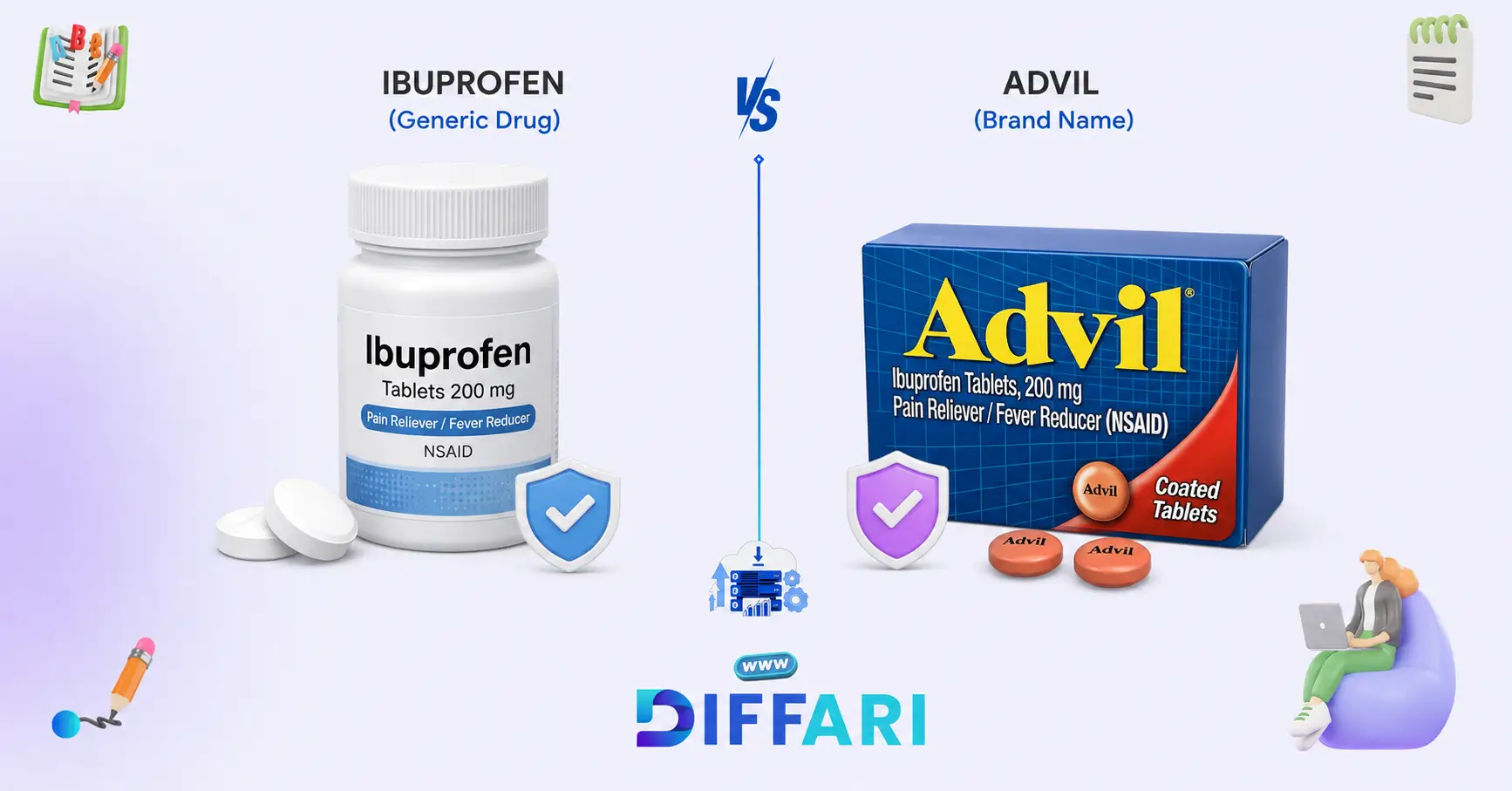

If you have ever compared a bottle labeled ibuprofen with one labeled Advil, you may wonder whether you are choosing between two different medicines. In most cases, you are not. Ibuprofen is the active drug, while Advil is a brand name used for products containing ibuprofen. Standard Advil Tablets, for example, contain 200 mg of ibuprofen as the active ingredient.
The important distinction is therefore not simply “ibuprofen vs. Advil.” It is generic drug vs. brand name, plus the specific formulation you are buying. Some Advil products contain ibuprofen alone, while combination products such as Advil PM or Advil Cold and Sinus contain ibuprofen together with other active ingredients.
Quick Answer
Ibuprofen is the name of the drug, while Advil is a brand name for products containing ibuprofen.
For a standard Advil product containing the same amount and formulation of ibuprofen as a generic ibuprofen product, the active medicine is the same. FDA-approved generic medicines are required to contain the same active ingredient and meet standards for strength, dosage form, quality, and therapeutic performance.
The main practical differences may be the brand, price, inactive ingredients, formulation, and whether the product contains additional active ingredients.
Ibuprofen vs. Advil at a Glance
| Feature | Ibuprofen | Advil |
| What is it? | Generic drug/active ingredient | Brand name |
| Active ingredient | Ibuprofen | Usually ibuprofen in standard products |
| Drug class | NSAID | Contains an NSAID when ibuprofen is the active ingredient |
| Main uses | Pain and fever; also inflammation | Depends on the specific Advil product |
| Generic or brand? | Generic drug name | Brand |
| Can formulations differ? | Yes | Yes |
| Can inactive ingredients differ? | Yes, by manufacturer/product | Yes, by product |
| Can it contain other active ingredients? | Yes, in combination products | Yes, in combination products |
| Is one automatically stronger? | No | No |
What Is Ibuprofen?
Ibuprofen is a nonsteroidal anti-inflammatory drug, commonly abbreviated NSAID. It is used to relieve pain and reduce fever, and it also has anti-inflammatory effects. MedlinePlus lists uses including headaches, muscle aches, menstrual pain, toothaches, backaches, arthritis-related pain, and fever.
You can find ibuprofen as:
- tablets
- chewable tablets
- capsules
- gel capsules
- liquid suspensions
- concentrated liquid drops
- prescription-strength products
Ibuprofen can also appear as the active ingredient in combination medicines.
So when a package says “ibuprofen”, it is identifying the medicine itself rather than necessarily identifying a particular brand.
Example
A store-brand bottle might say:
Ibuprofen 200 mg
That tells you the active drug and strength.
What Is Advil?
Advil is a brand name associated with ibuprofen-containing pain-relief products.
For example, standard Advil Tablets list ibuprofen 200 mg as the active ingredient and identify it as an NSAID and pain reliever/fever reducer.
That means the relationship is similar to:
Ibuprofen = drug
Advil = brand
This distinction is the key to understanding the comparison.
However, it is important not to assume that every product carrying the Advil name contains only ibuprofen. Some Advil products combine ibuprofen with other medicines for additional purposes. For example, Advil PM contains ibuprofen and diphenhydramine, while Advil Cold and Sinus products can contain ibuprofen plus a decongestant.
What Is the Difference Between Ibuprofen and Advil?
The simplest answer is that they are different kinds of names for the same underlying medicine in standard products.
Ibuprofen identifies the drug’s active ingredient. Advil identifies a brand and its products.
Think of it this way:
Ibuprofen is what is in the medicine. Advil is one brand that sells medicine containing ibuprofen.
This is why a bottle of generic ibuprofen and a standard bottle of Advil can both list ibuprofen as the active ingredient.
Brand name vs. generic name
A brand-name product is marketed under a particular commercial name.
A generic medicine uses the established drug name and is manufactured as a generic version.
The FDA says approved generic drugs contain the same active ingredient as their brand-name counterparts and must meet requirements relating to strength, dosage form, quality, safety, effectiveness, and performance.
Do Ibuprofen and Advil Work the Same?
When you are comparing plain ibuprofen and a standard Advil product with the same strength and comparable dosage form, the active medicine is the same: ibuprofen.
Therefore, you should not assume that Advil is inherently stronger simply because it is a brand-name product.
The FDA explains that therapeutically equivalent products containing the same active ingredient, dosage form, route, and strength are expected to produce the same clinical effect and safety profile when the applicable equivalence requirements are met.
The more useful question is therefore:
Does this specific product contain the same active ingredient, strength, and formulation?
That question is more informative than simply asking whether the package says “Advil” or “ibuprofen.”
Why Does Advil Sometimes Cost More Than Ibuprofen?
One practical difference is price.
A brand-name product can cost more because of branding, marketing, packaging, and other commercial factors. FDA notes that generic drugs often cost less because generic manufacturers do not have to repeat the original brand drug’s costly development program.
So if you see:
- Brand-name Advil
- Store-brand ibuprofen
and both contain the same active ingredient and strength in comparable formulations, the higher price of Advil does not automatically mean that it contains a stronger or better form of ibuprofen.
For many consumers, the decision comes down to:
- price
- preferred tablet or capsule format
- inactive ingredients
- familiarity with the brand
- availability
Can Inactive Ingredients Be Different?
Yes.
The active ingredient is the part of the medicine responsible for its therapeutic effect. Inactive ingredients can include substances used for coating, coloring, binding, preservation, flavoring, or manufacturing.
FDA explains that generic drugs can have allowable differences in inactive ingredients while still meeting the requirements for generic approval. In some people, those differences may matter because of sensitivities or tolerability.
This means two products can both contain ibuprofen but look, taste, or feel different.
For example:
Product A: ibuprofen 200 mg + one set of inactive ingredients
Product B: ibuprofen 200 mg + a different set of inactive ingredients
The active medicine can still be the same.
Why Formulation Matters
Not every ibuprofen product is identical in physical formulation.
Ibuprofen can be sold as tablets, capsules, gel capsules, liquids, and other dosage forms.
This matters because comparing:
Advil 200 mg tablet
with:
another 200 mg ibuprofen product
is different from comparing a standard tablet with a product that has a different formulation or additional active ingredients.
The brand name alone does not tell you everything about the product.
Always check the Drug Facts label for:
- Active ingredient
- Strength
- Purpose
- Directions
- Warnings
- Other active ingredients, if present
Are All Advil Products Just Ibuprofen?
No.
This is one of the most important details to understand.
Many standard Advil products use ibuprofen as their active ingredient. However, some products under the Advil brand contain additional active ingredients.
For example:
- Standard Advil contains ibuprofen.
- Advil PM contains ibuprofen plus diphenhydramine.
- Advil Cold and Sinus products can contain ibuprofen plus pseudoephedrine.
- Advil Dual Action combines ibuprofen with acetaminophen.
Therefore, saying “Advil is ibuprofen” is useful as a basic explanation, but it is not precise enough for every product.
A better rule is:
Check the active ingredients on the exact Advil product you are considering.
Common Mistakes With Ibuprofen and Advil
Mistake 1: Thinking they are two different pain medicines
Incorrect idea:
“I already took ibuprofen, so Advil would be a different pain reliever.”
Better understanding:
Standard Advil contains ibuprofen, so taking both may mean taking the same active drug twice.
Always check the active ingredients of medicines before combining them.
Mistake 2: Assuming brand-name means stronger
Incorrect idea:
“Advil must be stronger because it is a famous brand.”
Correct understanding:
The brand name itself does not make ibuprofen pharmacologically stronger.
The strength depends on the product’s active ingredient and labeled amount, along with the formulation.
Mistake 3: Ignoring combination products
Incorrect idea:
“Every Advil product contains only ibuprofen.”
Correct understanding:
Some Advil products contain additional active ingredients, so the complete product label matters.
Mistake 4: Comparing only the front of the package
Two packages can look similar while having different formulations.
Before comparing products, check the Active Ingredients section rather than relying only on the brand name.
Can Ibuprofen and Advil Be Used Interchangeably?
Often, but only when the products are equivalent for the purpose you are considering.
If you are comparing a standard Advil product containing ibuprofen with a generic ibuprofen product containing the same strength and comparable dosage form, they contain the same active medicine.
However, do not treat every product labeled “Advil” as interchangeable with plain ibuprofen because some Advil products contain additional active ingredients.
The safest practical approach is to compare:
- active ingredient
- strength
- dosage form
- additional active ingredients
- directions and warnings
If you take other medicines or have a medical condition, ask a pharmacist or healthcare professional before switching or combining products.
Safety: Ibuprofen and Advil Have the Same NSAID Concerns
Because standard Advil contains ibuprofen, the major safety considerations associated with ibuprofen also apply to that product.
Ibuprofen is an NSAID, and NSAIDs can cause stomach problems and, particularly with higher doses or longer use, serious gastrointestinal bleeding. Ibuprofen also carries cardiovascular and kidney-related risks that should be considered according to the product labeling and individual health circumstances.
MedlinePlus specifically warns that NSAIDs such as ibuprofen can increase the risk of heart attack or stroke, with risk potentially increasing with longer treatment or higher doses.
Do not assume that a brand-name product is safer simply because it has a familiar label.
Likewise, do not assume that generic ibuprofen is less safe because it costs less. FDA-approved generics are required to meet established standards for quality, strength, safety, and effectiveness.
Which One Should I Use?
Use this simple decision guide:
If you mean the drug itself → Ibuprofen
If you mean a brand-name ibuprofen product → Advil
If you are comparing standard Advil with generic ibuprofen → Compare the active ingredient, strength, and formulation
If the Advil product contains additional active ingredients → Do not treat it as plain ibuprofen
If you are unsure whether two medicines contain the same drug → Check the Active Ingredients section or ask a pharmacist
Ibuprofen or Advil? Practice Examples
Choose the better description for each situation.
- The medicine label says “ibuprofen 200 mg.” Is this a drug name or a brand name?
- A package says “Advil Tablets.” What does Advil represent?
- A standard Advil tablet lists ibuprofen 200 mg as its active ingredient. Are Advil and ibuprofen completely unrelated medicines?
- A product contains ibuprofen plus another active ingredient. Should you automatically treat it as plain ibuprofen?
- A generic ibuprofen product and standard Advil have the same labeled ibuprofen strength. Does the brand name alone make Advil stronger?
Answers
- Ibuprofen is the drug/active ingredient.
- Advil is a brand name.
- No. Standard Advil contains ibuprofen.
- No. Check the complete list of active ingredients.
- No. Brand recognition does not by itself make ibuprofen stronger.
Frequently Asked Questions
What is the main difference between ibuprofen and Advil?
Ibuprofen is the drug name, while Advil is a brand name for ibuprofen-containing products. Standard Advil products contain ibuprofen as the active ingredient.
Is Advil the same as ibuprofen?
For standard Advil products whose active ingredient is ibuprofen, the underlying active medicine is the same. However, some Advil-branded products contain additional active ingredients, so always check the exact product label.
Is generic ibuprofen as good as Advil?
FDA-approved generic medicines must meet requirements designed to ensure they have the same active ingredient and provide the same clinical effect and safety profile as the corresponding brand product when the products are therapeutically equivalent.
Is Advil stronger than ibuprofen?
Not simply because it is a brand. If you compare equivalent products with the same ibuprofen strength and appropriate formulation, the brand name itself does not make the medicine stronger.
Can I take Advil and ibuprofen together?
You should not assume they are different medicines. Standard Advil contains ibuprofen, so taking both can result in taking the same active drug more than once. Check the active ingredients and follow the product directions. Ask a pharmacist or healthcare professional if you are uncertain.
Does Advil always contain only ibuprofen?
No. Some Advil products contain ibuprofen plus another active ingredient, such as diphenhydramine or a decongestant.
Why is generic ibuprofen often cheaper?
Generic medicines can cost less because manufacturers do not have to repeat the original brand drug’s entire development program. FDA-approved generics still have to meet regulatory requirements for quality and therapeutic performance.
Are Advil and ibuprofen both NSAIDs?
Ibuprofen is an NSAID. Standard Advil products use ibuprofen as their active ingredient, so they are also products containing an NSAID.
Conclusion
The difference between ibuprofen and Advil is primarily a difference between a drug name and a brand name. Ibuprofen is the active medicine, while Advil is a brand that sells products containing ibuprofen.

Sajid Ali is an English language educator and content specialist with 7+ years of teaching experience. He holds master’s degrees in Information Technology and Education from the Virtual University of Pakistan and writes SEO-optimized, learner-friendly vocabulary content for diffari.com.