
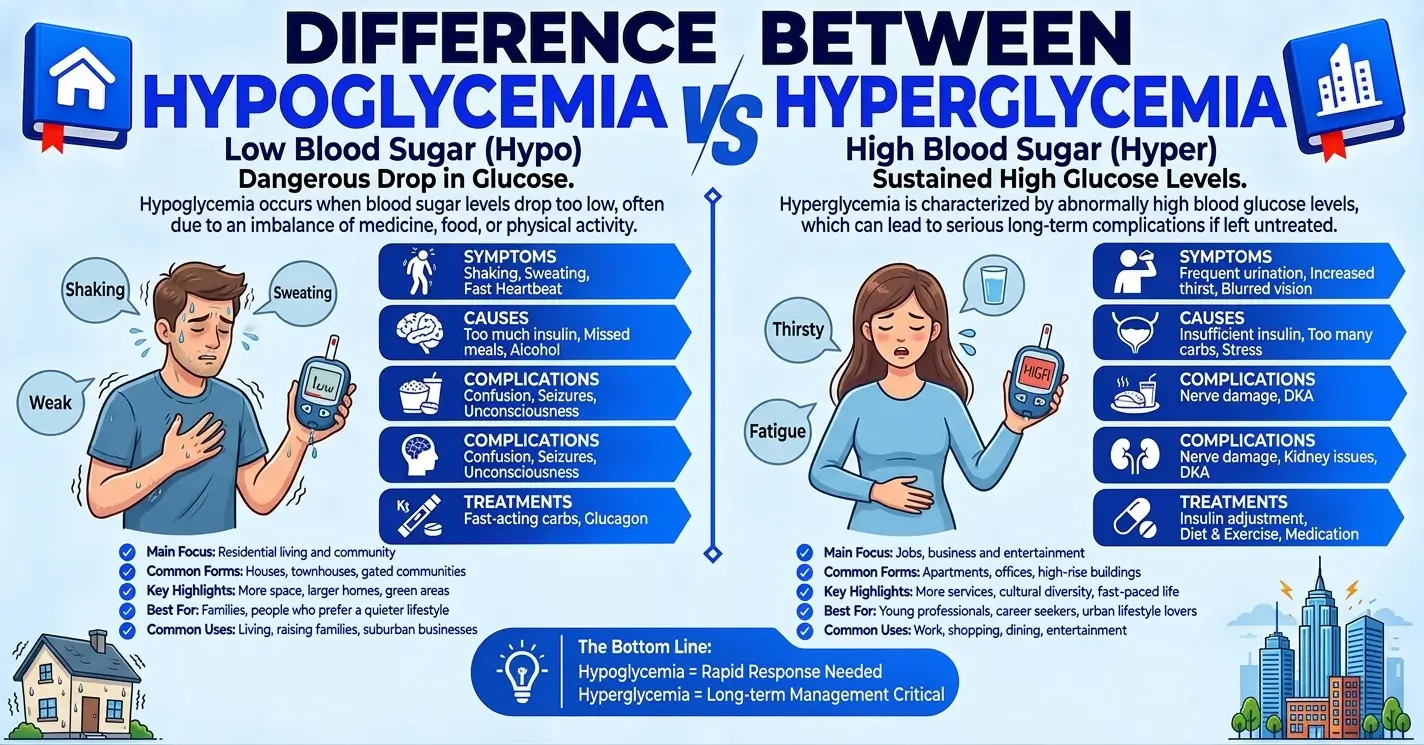

Hypoglycemia and hyperglycemia are opposite blood-glucose problems. Hypoglycemia means blood glucose is too low, while hyperglycemia means blood glucose is too high. Although both can occur in people with diabetes, they have different symptoms, causes and immediate concerns.
For many people with diabetes, blood glucose below 70 mg/dL (3.9 mmol/L) is considered hypoglycemia. Hyperglycemia is more context-dependent: what counts as high depends on whether glucose is being measured before or after eating, whether someone has diabetes, and the clinical situation.
Understanding the difference can help you recognize what the terms mean and why the appropriate response to low blood sugar is different from the response to persistent high blood sugar.
Quick Answer
Hypoglycemia means low blood glucose, while hyperglycemia means high blood glucose.
The easiest way to remember the difference is:
- Hypo = low → hypoglycemia = blood sugar is too low.
- Hyper = high → hyperglycemia = blood sugar is too high.
Hypoglycemia commonly causes symptoms such as shakiness, sweating, hunger, dizziness and confusion. Hyperglycemia commonly causes increased thirst, frequent urination, weakness or fatigue and blurred vision.
Hypoglycemia vs. Hyperglycemia at a Glance
| Feature | Hypoglycemia | Hyperglycemia |
|---|---|---|
| Basic meaning | Low blood glucose | High blood glucose |
| Common term | Low blood sugar | High blood sugar |
| Common clinical threshold | Below 70 mg/dL is clinically important for many people with diabetes | No single threshold applies to every situation |
| Typical symptoms | Shaking, sweating, hunger, dizziness, confusion | Thirst, frequent urination, fatigue, blurred vision |
| Common diabetes-related causes | Too much insulin/medicine, missed meals, increased activity | Too little insulin, insulin resistance, illness or other factors |
| Onset | Can become symptomatic relatively quickly | Often develops more gradually, although severe hyperglycemia can become an emergency |
| Immediate concern | Severe episodes can cause seizures or loss of consciousness | Severe cases can contribute to DKA or other hyperglycemic emergencies |
| Typical response | Rapidly raise glucose when appropriate | Identify the cause, monitor glucose and follow the person’s medical treatment plan |
The exact interpretation of a glucose reading depends on the individual and the circumstances. ADA’s 2026 standards classify glucose below 70 mg/dL as hypoglycemia and distinguish levels below 54 mg/dL as more severe; hyperglycemia ranges and diabetes diagnostic thresholds are defined differently.
What Is Hypoglycemia?
Hypoglycemia is low blood glucose.
For many people with diabetes, a blood glucose reading below 70 mg/dL (3.9 mmol/L) is considered low. ADA classifies:
- Level 1: below 70 but at least 54 mg/dL
- Level 2: below 54 mg/dL
- Level 3: a severe event involving altered mental or physical function that requires assistance, regardless of the measured glucose value.
Common symptoms include:
- Shaking or trembling
- Sweating
- Hunger
- Weakness
- Dizziness
- Irritability
- Headache
- Rapid heartbeat
- Confusion
- Blurred vision
- Slurred speech
Severe hypoglycemia can lead to seizures, loss of consciousness and other serious consequences.
Common Causes of Hypoglycemia
In people with diabetes, common causes include:
- Taking too much insulin
- Taking certain glucose-lowering medicines
- Missing or delaying a meal
- Exercising more than usual without adjusting food or medication
- Alcohol use, particularly without enough food
The CDC identifies missed meals, too much insulin, certain diabetes medicines, increased physical activity and alcohol among causes of low blood sugar.
Hypoglycemia can also occur in people without diabetes, although it is less common and may have different causes.
What Is Hyperglycemia?
Hyperglycemia is high blood glucose.
It occurs when there is too much glucose in the bloodstream. A common underlying problem is that the body does not have enough effective insulin to move glucose from the blood into cells. Insulin resistance can also contribute.
Common symptoms include:
- Increased thirst
- Dry mouth
- Frequent urination
- Fatigue or weakness
- Blurred vision
- Headache
- Dry skin
MedlinePlus lists thirst, tiredness or weakness, headaches, frequent urination and blurred vision among symptoms of high blood glucose.
Common Causes of Hyperglycemia
Hyperglycemia can be associated with:
- Diabetes
- Insufficient insulin
- Insulin resistance
- Illness or infection
- Physical stress
- Certain medicines
- Problems affecting insulin or glucose regulation
MedlinePlus notes that illness, infection, surgery, trauma and certain medicines can contribute to high blood glucose.
What Is the Difference Between Hypoglycemia and Hyperglycemia?
The fundamental difference is the direction of the blood-glucose problem.
Hypoglycemia = glucose is too low
The body and brain need glucose for energy. When glucose falls too low, the body can produce warning symptoms such as sweating, shaking, hunger and a rapid heartbeat. If severe, low glucose can impair brain function and lead to confusion, seizures or loss of consciousness.
Hyperglycemia = glucose is too high
When there is too much glucose in the bloodstream, common symptoms include thirst, frequent urination, fatigue and blurred vision. Persistent or severe hyperglycemia can cause serious complications, including diabetic ketoacidosis in appropriate clinical settings.
So the simplest distinction is:
Hypoglycemia means “too little glucose.” Hyperglycemia means “too much glucose.”
Hypoglycemia vs. Hyperglycemia Symptoms
The symptoms can help distinguish the two, although symptoms alone cannot reliably determine a person’s glucose level.
| Hypoglycemia | Hyperglycemia |
|---|---|
| Shaking | Increased thirst |
| Sweating | Frequent urination |
| Hunger | Dry mouth |
| Dizziness | Fatigue |
| Irritability | Weakness |
| Rapid heartbeat | Blurred vision |
| Confusion | Headache |
| Slurred speech | Dry skin |
Hypoglycemia tends to produce a cluster of warning symptoms associated with the body’s response to falling glucose, whereas hyperglycemia commonly produces symptoms related to excess glucose and fluid loss.
Important: symptoms are not a substitute for checking blood glucose when testing is available and appropriate.
What Blood Sugar Number Is Low or High?
This is one area where oversimplification can cause confusion.
Low blood sugar
For many people with diabetes:
Below 70 mg/dL (3.9 mmol/L) = hypoglycemia.
ADA further identifies glucose below 54 mg/dL (3.0 mmol/L) as level 2 hypoglycemia.
High blood sugar
There is not one universal “hyperglycemia number” that applies to every situation.
For people with diabetes, ADA’s 2026 CGM framework identifies glucose above 180 mg/dL (10.0 mmol/L) as level 1 hyperglycemia and above 250 mg/dL (13.9 mmol/L) as level 2 hyperglycemia. These are monitoring classifications, not the same thing as a diabetes diagnosis.
Diabetes diagnosis uses different criteria. For example, ADA lists a fasting plasma glucose of 126 mg/dL (7.0 mmol/L) or higher, a 2-hour OGTT glucose of 200 mg/dL (11.1 mmol/L) or higher, or other qualifying criteria.
Therefore:
Do not use one blood-glucose number out of context to diagnose hyperglycemia or diabetes.
What Should You Do for Hypoglycemia?
If a person with diabetes has a blood glucose below 70 mg/dL and is conscious and able to swallow, NIDDK recommends taking 15–20 grams of glucose or carbohydrate, waiting about 15 minutes and checking the glucose again. The treatment can be repeated if the level remains low.
Examples include glucose tablets or an appropriate amount of regular fruit juice or non-diet soda.
Severe hypoglycemia is different. If someone is confused, unconscious, having a seizure or unable to treat themselves, do not try to give food or drink by mouth. Emergency medical assistance may be required. ADA identifies severe hypoglycemia as an event requiring assistance from another person.
What Should You Do for Hyperglycemia?
The appropriate response depends on the person’s diabetes treatment plan, glucose level, symptoms and underlying cause.
For someone who has diabetes, persistent high glucose should be managed according to the treatment plan provided by their healthcare professional. Monitoring glucose and identifying factors such as illness, medication issues or insufficient insulin can be important.
Very high glucose accompanied by symptoms such as vomiting, abdominal symptoms, difficulty breathing, severe dehydration or altered consciousness can indicate a medical emergency. Diabetic ketoacidosis requires prompt medical treatment.
Common Mistakes With Hypoglycemia and Hyperglycemia
Incorrect:
Hypoglycemia means diabetes.
Correct: Hypoglycemia means low blood glucose. It can occur with diabetes but is not synonymous with diabetes.
Incorrect:
Hyperglycemia always means someone has diabetes.
Correct: Diabetes is a major cause of hyperglycemia, but high blood glucose can also occur because of illness, physical stress, certain medicines or other conditions.
Incorrect:
Any blood sugar over 126 mg/dL automatically means hyperglycemia and diabetes.
Correct: Blood-glucose interpretation depends on the test and circumstances. A fasting plasma glucose of ≥126 mg/dL is one criterion used for diagnosing diabetes, but diagnosis generally requires appropriate confirmation unless there is unequivocal hyperglycemia.
Incorrect:
Shaking always means low blood sugar.
Correct: Shaking can be a symptom of hypoglycemia, but symptoms alone cannot establish the glucose level. When possible, confirm with a glucose measurement.
Common Collocations With Hypoglycemia and Hyperglycemia
Hypoglycemia
- severe hypoglycemia
- mild hypoglycemia
- recurrent hypoglycemia
- hypoglycemia symptoms
- hypoglycemia treatment
- hypoglycemia risk
- hypoglycemic episode
Hyperglycemia
- severe hyperglycemia
- persistent hyperglycemia
- hyperglycemia symptoms
- hyperglycemia management
- hyperglycemic crisis
- hyperglycemic episode
- chronic hyperglycemia
These combinations reflect the way the terms are commonly used in medical and diabetes-related writing.
Can Hypoglycemia and Hyperglycemia Be Used Interchangeably?
No.
They describe opposite glucose abnormalities.
- Hypoglycemia → low blood glucose
- Hyperglycemia → high blood glucose
They should not be substituted for one another.
A person can experience both at different times, particularly when managing diabetes. The causes and appropriate responses can be very different.
How to Remember the Difference
Use the prefixes:
Hypo = low
Think:
Hypo → low → hypoglycemia → low blood sugar
Hyper = high
Think:
Hyper → high → hyperglycemia → high blood sugar
A simple memory rule is:
Hypo goes down; hyper goes up.
Which One Should I Think About?
Use this as a quick recognition guide, not as a diagnosis:
Shaking, sweating, sudden hunger, dizziness, or confusion may indicate low blood sugar (hypoglycemia).
On the other hand, unusual thirst, frequent urination, fatigue, or blurred vision may be associated with high blood sugar (hyperglycemia).
When you have diabetes and experience symptoms that could indicate either condition, checking your blood glucose when possible is more reliable than trying to identify the cause from symptoms alone.
X or Y? Practice Examples
Choose hypoglycemia or hyperglycemia.
- A person with diabetes becomes sweaty, shaky and very hungry.
- Someone is unusually thirsty and urinating much more frequently.
- A glucose reading is below 70 mg/dL.
- A person has persistent high blood glucose and increasing thirst.
- Someone develops confusion during a severe low-glucose episode.
- A person with diabetes has very high glucose accompanied by vomiting and breathing difficulty.
Answers
- Hypoglycemia
- Hyperglycemia
- Hypoglycemia
- Hyperglycemia
- Hypoglycemia
- Hyperglycemia
The symptoms in these examples are characteristic patterns, but actual diagnosis and treatment should be based on glucose measurements and clinical assessment where appropriate.
Frequently Asked Questions
What is the difference between hypoglycemia and hyperglycemia?
Hypoglycemia means blood glucose is too low, while hyperglycemia means blood glucose is too high. Hypoglycemia commonly causes shakiness, sweating, hunger and confusion, while hyperglycemia commonly causes thirst, frequent urination, fatigue and blurred vision.
Is hypoglycemia low blood sugar?
Yes. Hypoglycemia is the medical term for low blood glucose. For many people with diabetes, glucose below 70 mg/dL is considered clinically important hypoglycemia.
Is hyperglycemia high blood sugar?
Yes. Hyperglycemia is the medical term for high blood glucose. However, there is no single number that defines high blood sugar for every clinical situation.
Which is more dangerous, hypoglycemia or hyperglycemia?
Both can become dangerous when severe. Severe hypoglycemia can cause altered mental function, seizures or loss of consciousness, while severe hyperglycemia can contribute to acute emergencies such as diabetic ketoacidosis. The immediate risk depends on the person’s glucose level, symptoms and clinical circumstances.
Can someone have both hypoglycemia and hyperglycemia?
Yes. A person, particularly someone managing diabetes, can experience both low and high blood glucose at different times. Diabetes management aims to keep glucose within an individualized target range while minimizing both extremes.
Can people without diabetes have hypoglycemia?
Yes. Although hypoglycemia is commonly associated with glucose-lowering treatment in diabetes, it can occur in people without diabetes for other reasons.
How can I remember hypoglycemia vs. hyperglycemia?
Remember the prefixes: hypo means low, while hyper means high. Therefore, hypoglycemia is low blood sugar and hyperglycemia is high blood sugar.
What should I do if someone has severe hypoglycemia?
If the person is unable to safely treat themselves, is unconscious, has a seizure or has severe altered mental status, they need emergency assistance. Food or liquid should not be given to an unconscious person.
Conclusion
The difference between hypoglycemia and hyperglycemia is straightforward: hypoglycemia means blood glucose is too low, while hyperglycemia means it is too high. Low blood sugar commonly produces symptoms such as sweating, shaking, hunger and confusion, while high blood sugar is commonly associated with thirst, frequent urination, fatigue and blurred vision.

Sajid Ali is an English language educator and content specialist with 7+ years of teaching experience. He holds master’s degrees in Information Technology and Education from the Virtual University of Pakistan and writes SEO-optimized, learner-friendly vocabulary content for diffari.com.