
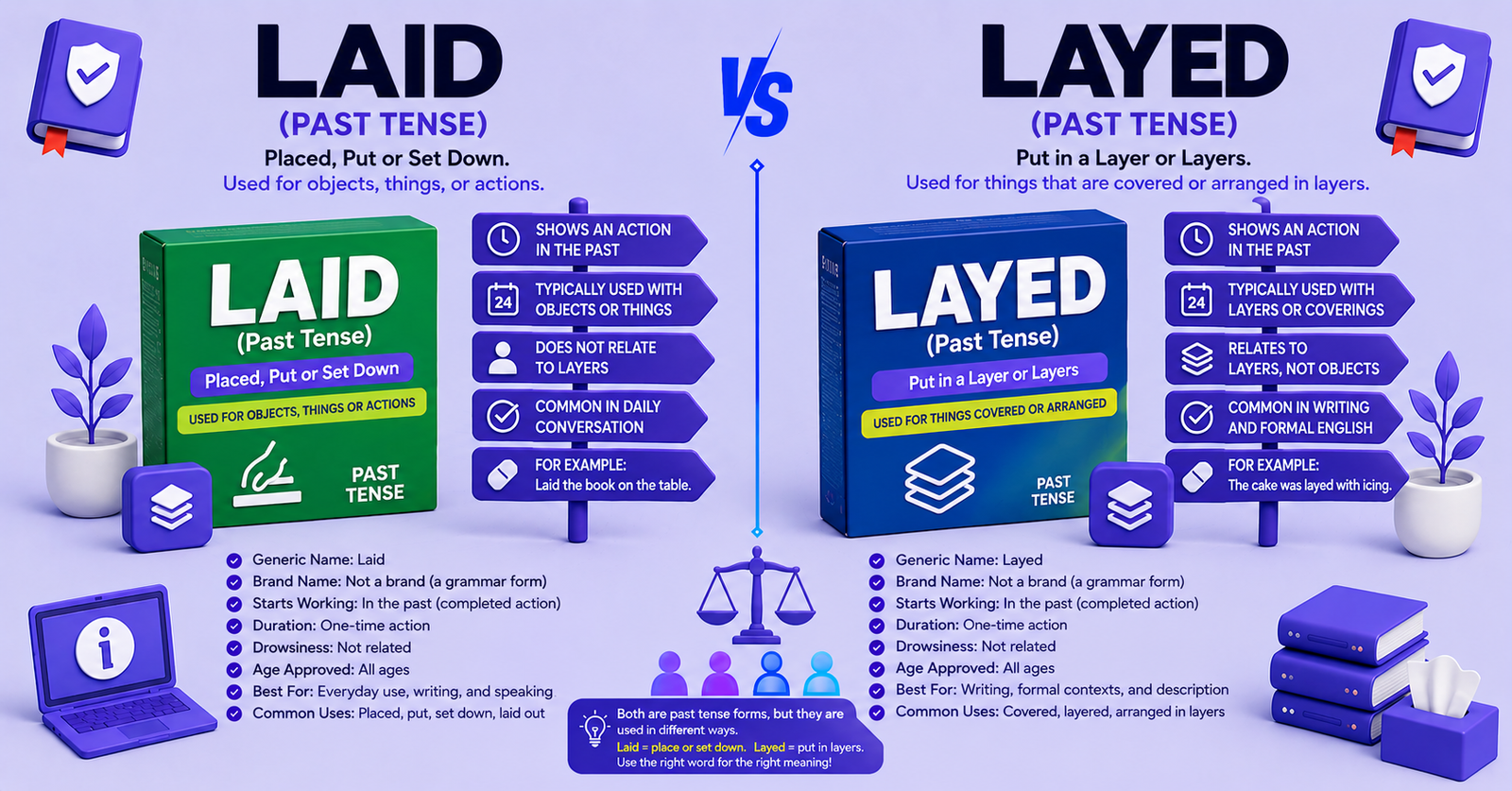

If you are unsure whether to write laid or layed, the standard English choice is laid. The verb lay, meaning to put or place something somewhere, has the irregular past tense and past participle laid. Layed is not the standard past-tense form of this verb.
The confusion is understandable because many English verbs form their past tense by adding -ed. However, lay does not follow that pattern. There is also a second source of confusion: lay is the past tense of another verb, lie. Once these forms are separated, the difference becomes much easier to remember.
Quick Answer
Laid is the correct standard form when it is the past tense or past participle of lay.
- Correct: She laid the book on the table.
- Incorrect in standard English: She layed the book on the table.
The basic verb pattern is:
lay → laid → laid
The confusion becomes greater because lie has a different pattern:
lie → lay → lain
So, if you mean “put or place something,” use laid for the past tense—not layed.
Laid vs. Layed at a Glance
| Feature | Laid | Layed |
|---|---|---|
| Standard English form | Yes | No |
| Related base verb | lay | — |
| Past tense of lay | Yes | No |
| Past participle of lay | Yes | No |
| Meaning | Put or placed something | Not the standard form |
| Example | She laid the keys down. | She layed the keys down. |
| Recommended in formal writing | Yes | No |
Cambridge lists laid as the past simple and past participle of lay, while Merriam-Webster gives the same forms.
What Does “Laid” Mean?
Laid is the past tense and past participle of lay when lay means to put, place, position, or set something down.
For example:
- She laid the papers on the desk.
- He laid his phone beside the computer.
- They laid the foundation for the building.
- The hen has laid three eggs.
The verb lay normally takes an object. Something or someone is being placed somewhere.
She laid the baby in the crib.
Here, baby is the object being placed.
Cambridge defines lay as putting something into a particular position, especially a flat or horizontal position, and gives laid as its past form.
What Does “Layed” Mean?
In ordinary modern standard English, layed is not the correct past-tense or past-participle form of lay.
The standard form is:
lay → laid
not:
lay → layed
Therefore, in normal writing, use laid:
She laid the folder on my desk.
Not:
She layed the folder on my desk.
The spelling layed looks reasonable because English frequently creates past-tense forms with -ed, but lay is an irregular verb. Major dictionary references list laid, not layed, as the past form.
What Is the Difference Between Laid and Layed?
The main difference is simple:
Laid is the standard past tense and past participle of lay. Layed is not the standard form of that verb.
For example:
Present: I lay the book on the desk.
Past: I laid the book on the desk.
Past participle: I have laid the book on the desk.
There is no standard form:
I layed the book on the desk.
The important thing is that laid and layed are not two interchangeable spellings.
Why Does “Layed” Look Correct?
The mistake comes from a perfectly understandable English pattern.
Many verbs form the past tense by adding -ed:
- play → played
- clean → cleaned
- walk → walked
- open → opened
So it may seem logical to form:
- lay → layed
But English contains many irregular verbs whose past forms do not follow the regular -ed pattern.
For example:
- say → said
- pay → paid
- teach → taught
- bring → brought
- lay → laid
So the safest rule is not to build the past form of lay yourself. Remember its irregular form:
Lay → Laid → Laid
Lay, Laid, Lie, and Lain: The Bigger Confusion
This is where many people actually get confused.
There are two different verbs involved:
Lay
Lay means to put or place something.
Its forms are:
lay → laid → laid
Example:
I lay the book on the table every morning.
Yesterday, I laid the book on the table.
I have laid the book there before.
Lie
Lie means to rest or be in a horizontal position.
Its forms are:
lie → lay → lain
Example:
I lie on the sofa when I am tired.
Yesterday, I lay on the sofa.
I have lain on this sofa for hours.
Cambridge specifically distinguishes lay as a verb that takes an object from lie, which does not take an object in this meaning.
Merriam-Webster likewise explains that lay becomes laid, while lie becomes lay, lain, and lying.
Compare These Sentences
I laid the book on the table.
Here, I put the book somewhere.
I lay on the sofa yesterday.
Here, I rested on the sofa.
The first sentence uses lay → laid.
The second uses lie → lay.
That is why the word lay can be particularly confusing.
When to Use Laid
Use laid when the base verb is lay and you are talking about putting or placing something.
Examples
She laid the keys on the counter.
He laid the baby in the crib.
They laid new carpet in the hallway.
The workers laid the foundation.
The company has laid the groundwork for expansion.
The hen has laid an egg.
These uses are consistent with the standard meanings of lay documented by Cambridge and Merriam-Webster.
Laid in Real Sentences
Here are some natural examples:
1. She laid her phone on the desk.
The phone was placed on the desk.
2. He laid the documents beside the printer.
The documents were deliberately placed there.
3. The workers laid the bricks carefully.
The bricks were positioned as part of construction.
4. The company laid the groundwork for the project.
Here, laid is used figuratively to mean established or prepared.
5. The hen has laid two eggs.
Here, lay means to produce and deposit eggs.
Common Collocations With Laid
Some common expressions containing laid include:
- laid down
- laid out
- laid aside
- laid off
- laid the groundwork
- laid the foundation
- laid the blame
- laid an egg
- laid to rest
For example:
She laid out the documents for review.
The negotiations laid the groundwork for the agreement.
The company laid off several employees.
These are established uses rather than separate spellings of layed. Cambridge and Merriam-Webster document several of these constructions.
Common Mistakes With Laid and Layed
Mistake 1
Incorrect:
She layed the book on the table.
Correct:
She laid the book on the table.
Why: The past tense of lay is laid, not layed.
Mistake 2
Incorrect:
I laid on the sofa yesterday.
Better standard form:
I lay on the sofa yesterday.
Why: Here, you mean that you rested or reclined. The verb is lie, whose past tense is lay.
Mistake 3
Incorrect:
I have layed the documents on the desk.
Correct:
I have laid the documents on the desk.
Why: The past participle of lay is also laid.
Mistake 4
Incorrect:
I have lain the book on the table.
Correct:
I have laid the book on the table.
Why: Lain belongs to the verb lie, not lay.
Pronunciation
Laid is pronounced /leɪd/ in both British and American English.
It sounds like “lade.”
Layed is not the standard form you should substitute for laid in ordinary writing.
The pronunciation therefore does not provide a useful reason to choose layed. The important distinction is grammatical and spelling-based.
Are Laid and Layed Interchangeable?
No.
In standard modern English, use laid when you need the past tense or past participle of lay.
She laid the coat on the chair.
Not:
She layed the coat on the chair.
If you encounter layed somewhere, that does not make it an accepted alternative spelling for standard uses of laid.
For normal academic, professional, educational, and general-purpose writing, laid is the appropriate choice.
How to Remember the Difference
Use this simple three-word pattern:
Lay → Laid → Laid
You can also connect it with another irregular verb:
Pay → Paid
Lay → Laid
The important point is that lay does not become layed.
For the separate verb lie, remember:
Lie → Lay → Lain
So:
- Put something somewhere? → lay / laid
- Rest or recline? → lie / lay / lain
Which One Should I Use?
Use this quick decision guide:
For “put or place something” → use lay or laid.
She laid the book on the table.
When you mean “rest or recline” → use lie or one of its forms.
She lay on the bed yesterday.
Between “laid” and “layed” → choose laid.
They laid the foundation.
For the past participle of “lay” → use laid.
They have laid the foundation.
X or Y? Practice Examples
Choose laid, layed, lay, lie, lain, or another appropriate form.
- She ___ the keys on the kitchen counter yesterday.
- I ___ on the beach all afternoon.
- The workers have ___ new flooring.
- He ___ the baby in the crib.
- I want to ___ down for a few minutes.
- The dog had ___ on the floor for hours.
- They ___ the documents on the table.
- The company has ___ the groundwork for the project.
Answers
- laid
- lay
- laid
- laid
- lie
- lain
- laid
- laid
The key is to identify the base verb before choosing its tense.
Frequently Asked Questions
Is “laid” or “layed” correct?
Laid is correct when you mean the past tense or past participle of lay. Layed is not the standard form.
Is “layed” a word?
Layed is not the standard past-tense or past-participle form of the verb lay in modern standard English. In ordinary writing, use laid.
What is the past tense of lay?
The past tense of lay is laid.
Present: I lay the book down.
Past: I laid the book down.
What is the past participle of lay?
The past participle is also laid.
I have laid the book down.
What is the difference between lay and lie?
Lay means to put or place something and normally takes an object.
Lie means to rest or be in a horizontal position and does not take an object in that meaning.
Is it “laid down” or “layed down”?
The standard form is laid down when lay is the verb.
She laid down the papers.
However, if someone is reclining, the verb may be lie:
She lay down for a nap yesterday.
The difference depends on which verb you mean.
Is it “laid in bed” or “layed in bed”?
If you mean someone placed another person in bed, use laid:
She laid the baby in bed.
If you mean someone rested in bed, the verb may be lay as the past tense of lie:
I lay in bed yesterday.
Are laid and layed pronounced differently?
The standard word laid is pronounced /leɪd/.
The important issue is not pronunciation but choosing the correct standard spelling and verb form.
Conclusion
The difference between laid and layed is straightforward: laid is the standard past tense and past participle of lay, while layed should not be used as the ordinary past form of that verb. The bigger source of confusion is the relationship between lay and lie. Remember lay → laid → laid for putting or placing something, and lie → lay → lain for resting or reclining. When you mean “put or place,” choose laid, not layed.

Sajid Ali is an English language educator and content specialist with 7+ years of teaching experience. He holds master’s degrees in Information Technology and Education from the Virtual University of Pakistan and writes SEO-optimized, learner-friendly vocabulary content for diffari.com.