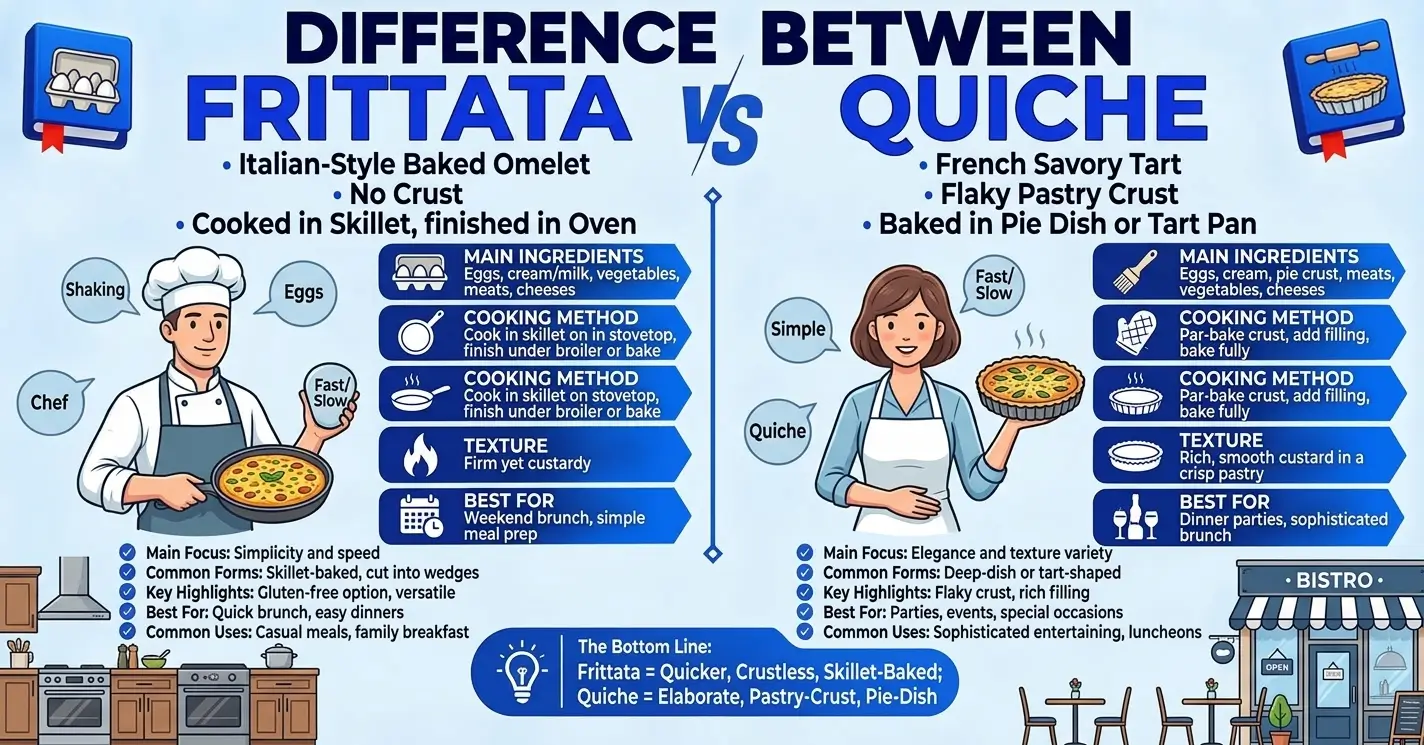

Frittata and quiche are both egg-based dishes that can contain vegetables, cheese, meat, or seafood, so it is easy to confuse them. The main difference is how they are built and cooked. A traditional quiche has a pastry crust and a richer egg custard, while a frittata is crustless, more egg-forward, and commonly starts in a skillet before finishing in the oven or under a broiler. There are exceptions, particularly crustless quiche, but the distinction becomes clear when you look at the crust, dairy, texture, and cooking method.
Quick Answer
A frittata is a crustless Italian egg dish that is usually cooked in a skillet and often finished in the oven or under a broiler.
A quiche is a savory tart made with an egg custard, traditionally baked inside a pastry crust.
The easiest way to remember the difference is:
Frittata = crustless, egg-forward, skillet-cooked.
Quiche = pastry crust, custardy filling, baked like a tart.
Both can contain similar fillings, but their structure, texture, and preparation are different.
Frittata vs Quiche at a Glance
| Feature | Frittata | Quiche |
|---|---|---|
| Basic form | Crustless egg dish | Savory egg custard tart |
| Traditional crust | No | Yes |
| Main base | Eggs | Eggs plus milk or cream |
| Dairy | Usually less | Usually more |
| Texture | Firm, tender, and egg-forward | Soft, rich, and custardy |
| Typical pan | Oven-safe skillet | Pie dish or tart pan |
| Cooking | Often starts on stovetop, then finishes in oven/broiler | Generally baked in the oven |
| Fillings | Vegetables, cheese, meat, seafood | Vegetables, cheese, meat, seafood |
| Traditional association | Italian | French |
| Preparation | Generally simpler | Usually more involved because of the pastry |
What Is a Frittata?
A frittata is an Italian egg dish that resembles a thick, open-faced omelet. Eggs are combined with fillings such as vegetables, cheese, herbs, meat, or seafood and cooked directly in a pan. Many versions begin on the stovetop and are then transferred to an oven or placed under a broiler to finish cooking.
Frittatas are especially flexible because they can accommodate ingredients that are already available in the kitchen. Cooked vegetables, leftover meat, cheese, and herbs can all become part of the filling.
Unlike an omelet, a frittata is generally thicker and is not folded around its filling. The ingredients are incorporated throughout the egg mixture, and the finished dish is commonly cut into wedges.
Frittatas can contain dairy, such as cream, yogurt, sour cream, or cheese, but dairy is not what defines the dish. Some recipes use very little dairy, while others include more.
What Is a Quiche?
A quiche is a savory tart made from an egg-based custard and various fillings. Traditional quiche is baked in a pastry shell, usually in a pie dish or tart pan.
The custard commonly contains eggs combined with milk, cream, or another liquid dairy ingredient. Fillings can include vegetables, cheese, bacon, ham, seafood, herbs, and other savory ingredients.
Because quiche contains more liquid dairy relative to the eggs than a typical frittata, its interior tends to be softer, richer, and more custard-like.
A classic example is quiche Lorraine, which is associated with a filling of eggs, dairy, bacon, and cheese in a pastry crust.
What Is the Difference Between Frittata and Quiche?
The most important differences are crust, dairy, texture, cooking method, and cooking vessel.
1. Crust
The easiest distinction is the crust.
A traditional quiche has a pastry crust surrounding the egg filling. The crust gives the quiche its characteristic pie- or tart-like structure.
A traditional frittata has no pastry crust. The egg mixture cooks directly in the pan.
There is one important exception: crustless quiche. Crustless quiche recipes are common, so the presence or absence of pastry alone cannot identify every possible quiche.
2. Eggs and Dairy
Both dishes use eggs, but the balance is different.
Quiche generally contains considerably more milk or cream relative to its eggs. This creates an egg custard with a soft, creamy consistency.
Frittata is generally more egg-forward. It can contain milk, cream, or other dairy, but usually in a smaller proportion.
So it is better to remember:
Quiche is more custard-focused; frittata is more egg-focused.
Exact ratios vary by recipe, so there is no single universal egg-to-dairy formula that applies to every frittata or quiche.
3. Texture
The difference in ingredients affects the final texture.
A well-made quiche usually has a soft, creamy, custardy interior combined with a crisp or flaky pastry crust.
A frittata generally has a firmer, more substantial egg texture. It can still be tender and fluffy, but it usually holds its shape more firmly than a custard-style quiche.
4. Cooking Method
A traditional frittata commonly begins on the stovetop. The fillings may be cooked in an oven-safe skillet before the egg mixture is added. The partially set frittata can then be transferred to the oven or finished under a broiler.
A traditional quiche is assembled in its crust and baked in the oven until the custard is set.
This difference in cooking method also affects preparation time and equipment.
5. Cooking Vessel
Frittatas are commonly associated with a skillet, especially a cast-iron or other oven-safe skillet.
Quiche is usually prepared in a pie dish or tart pan because the pastry crust needs support.
This makes the cooking vessel another useful clue when distinguishing the two.
6. Origin
Frittata is an Italian dish, while quiche is strongly associated with French cuisine.
The history of quiche is more complicated than simply calling it a French invention. The dish is closely associated with Lorraine, a region with German historical connections, and the name is related to the German Kuchen, meaning “cake.” For the practical food comparison, however, it is enough to recognize frittata as Italian and quiche as traditionally associated with France.
When to Use a Frittata
Choose a frittata when you want a relatively simple, flexible egg dish without pastry.
A frittata is particularly useful when:
- You have leftover cooked vegetables or meat.
- You want a crustless breakfast or brunch dish.
- You need a meal that can be prepared in a skillet.
- You prefer a firmer egg texture.
- You want to minimize pastry preparation.
- You want an easy dish that can be served warm or at room temperature.
For example, leftover spinach, roasted peppers, onions, potatoes, and cheese can all be incorporated into a frittata.
When to Use a Quiche
Choose a quiche when you want a richer, custard-like filling and the structure of a savory tart.
Quiche works particularly well when:
- You want a pastry crust.
- You prefer a soft, creamy egg filling.
- You are preparing a brunch centerpiece.
- You want a dish that can hold substantial fillings.
- You enjoy the combination of flaky pastry and savory custard.
- You are willing to spend more time preparing the dish.
Quiche can also be prepared ahead of time and served warm or at room temperature.
Frittata and Quiche in Sentences
Frittata
We made a spinach and feta frittata for brunch.
The dish is crustless and primarily egg-based, with spinach and cheese incorporated into the mixture.
She cooked the vegetables in a skillet before adding the eggs for the frittata.
The skillet-based preparation is characteristic of many frittata recipes.
Quiche
I made a mushroom and cheese quiche with a flaky pastry crust.
The pastry shell and custard filling make this a traditional quiche.
The quiche had a creamy center and a crisp crust.
The description emphasizes two characteristic features of traditional quiche: custard-like filling and pastry.
Common Collocations With Frittata and Quiche
Frittata combinations
- vegetable frittata
- spinach frittata
- potato frittata
- cheese frittata
- breakfast frittata
- baked frittata
- egg frittata
- skillet frittata
- mushroom frittata
- herb frittata
Quiche combinations
- quiche Lorraine
- spinach quiche
- mushroom quiche
- cheese quiche
- bacon quiche
- vegetable quiche
- crustless quiche
- savory quiche
- homemade quiche
- mini quiche
These combinations reflect common ways the dishes are described rather than strict ingredient requirements.
Common Mistakes With Frittata and Quiche
Mistake 1: Saying a frittata is always dairy-free
Incorrect:
A frittata never contains milk or cream.
Correct:
A frittata can contain dairy, although it generally uses less dairy than quiche.
Why:
Dairy is common in some frittata recipes, but it is not what defines the dish.
Mistake 2: Saying every quiche must have a crust
Incorrect:
If there is no crust, it cannot be quiche.
Correct:
Traditional quiche has a pastry crust, but crustless quiche is also made.
Why:
Crust is the most useful traditional distinction, but crustless versions exist.
Mistake 3: Treating quiche and frittata as identical
Incorrect:
A frittata and quiche are the same dish with different names.
Correct:
Frittata and quiche are related egg-based dishes with different traditional structures and preparation methods.
Why:
They share eggs and many possible fillings, but their crust, dairy balance, texture, and cooking methods differ.
Mistake 4: Assuming the filling determines the dish
Bacon, spinach, mushrooms, cheese, onions, and other ingredients can appear in either dish.
The filling alone does not tell you whether something is a frittata or a quiche.
Look at the structure and preparation instead.
Are Frittata and Quiche Interchangeable?
Not completely.
They can sometimes serve a similar purpose because both work well for breakfast, brunch, lunch, or a light dinner. Both can also contain similar fillings and can be served warm or at room temperature.
However, they are not interchangeable when the structure matters.
If a recipe specifically calls for a pastry crust and a custard-style filling, replacing it with a frittata changes the dish substantially.
Likewise, replacing a firm, skillet-cooked frittata with a rich custard quiche changes the texture and preparation method.
A crustless quiche can make the distinction less obvious, but the two dishes can still differ in their egg-to-dairy balance and resulting texture.
How to Remember the Difference
Use this simple rule:
Frittata = eggs first. Quiche = custard plus crust.
Think about what supports the dish.
- Frittata: the eggs themselves form the structure.
- Quiche: pastry supports a softer egg custard.
If you see a thick egg dish cooked directly in a skillet, think frittata.
If you see a savory egg custard inside a pastry shell, think quiche.
Which One Should I Use?
Use this quick decision guide:
Want a crustless egg dish?
→ Frittata
Want a flaky pastry crust?
→ Quiche
Want a firmer, egg-forward texture?
→ Frittata
Want a soft, creamy custard texture?
→ Quiche
Want to cook the dish primarily in a skillet?
→ Frittata
Want a savory tart baked in a pie or tart pan?
→ Quiche
Want something quick and flexible for using leftovers?
→ Frittata
Want a richer pastry-based brunch dish?
→ Quiche
Remember that these are practical rules, not absolute recipe laws. Crustless quiche and variations in frittata recipes mean there is some overlap.
Frittata or Quiche? Practice Examples
Choose frittata or quiche for each situation.
- The dish has a flaky pastry shell and a creamy egg filling.
- You want to use leftover roasted vegetables in a skillet-based egg dish.
- The recipe calls for eggs, cream, bacon, and a pastry crust.
- You want a firm, crustless dish that can be cut into wedges.
- The recipe begins by cooking vegetables in an oven-safe skillet before adding eggs.
- You want a savory tart with a custard-like center.
Answers
- Quiche — the pastry shell and custard filling are characteristic of traditional quiche.
- Frittata — a frittata is particularly adaptable to cooked leftover ingredients.
- Quiche — the pastry crust and custard-style filling point to quiche.
- Frittata — a crustless, firm egg dish fits the traditional frittata format.
- Frittata — starting the cooking process in a skillet is typical of frittata preparation.
- Quiche — a savory tart with an egg custard is the traditional quiche structure.
Frequently Asked Questions
What is the main difference between frittata and quiche?
The main traditional difference is structure: quiche is an egg custard tart traditionally made with pastry, while frittata is a crustless egg dish commonly cooked in a skillet. Quiche also generally contains more dairy, giving it a softer, custard-like texture.
Is frittata healthier than quiche?
Neither is automatically healthier. Nutrition depends on the recipe, portion size, cheese, meat, dairy, vegetables, pastry, and cooking fat used. A frittata can avoid the calories associated with pastry, but its nutritional profile still depends on its ingredients.
Does a frittata have a crust?
Traditional frittata does not have a pastry crust. The egg mixture cooks directly in a pan.
Does quiche always have a crust?
Traditional quiche has a pastry crust, but crustless quiche is also a recognized preparation. Therefore, the presence of a crust is the easiest traditional distinction, but not an absolute rule.
Is quiche more custardy than frittata?
Generally, yes. Quiche typically contains more liquid dairy relative to its eggs, producing a softer and more custard-like filling. Frittata is generally firmer and more egg-forward.
Can you make a frittata without dairy?
Yes. Dairy is not essential to the definition of frittata. Some recipes use a small amount of milk, cream, yogurt, or another dairy product, while others rely primarily on eggs.
Can you make quiche without milk?
Yes, depending on the recipe. Quiche recipes can use different dairy combinations, and some variations use alternatives. The defining concept is an egg-based custard tart rather than one mandatory type of milk.
Are frittata and quiche both Italian?
No. Frittata is Italian, while quiche is traditionally associated with France, particularly Lorraine. The historical background of quiche is more complicated, but the modern culinary association is French.
Can a crustless quiche be called a frittata?
Not necessarily. Removing the crust does not automatically turn a quiche into a frittata. The recipes can still differ in their dairy-to-egg balance, texture, and preparation method.
Conclusion
The difference between a frittata and quiche comes down mainly to structure and preparation. A traditional frittata is a crustless, egg-forward dish usually cooked in a skillet, while a traditional quiche is a savory custard tart baked with a pastry crust. Quiche generally contains more dairy and has a softer, creamier texture, whereas frittata tends to be firmer and more substantial. The simplest memory rule is: frittata is the crustless egg dish; quiche is the custard tart. Just remember that crustless quiche exists, so texture and cooking method can help when the distinction is less obvious.

Sajid Ali is an English language educator and content specialist with 7+ years of teaching experience. He holds master’s degrees in Information Technology and Education from the Virtual University of Pakistan and writes SEO-optimized, learner-friendly vocabulary content for diffari.com.