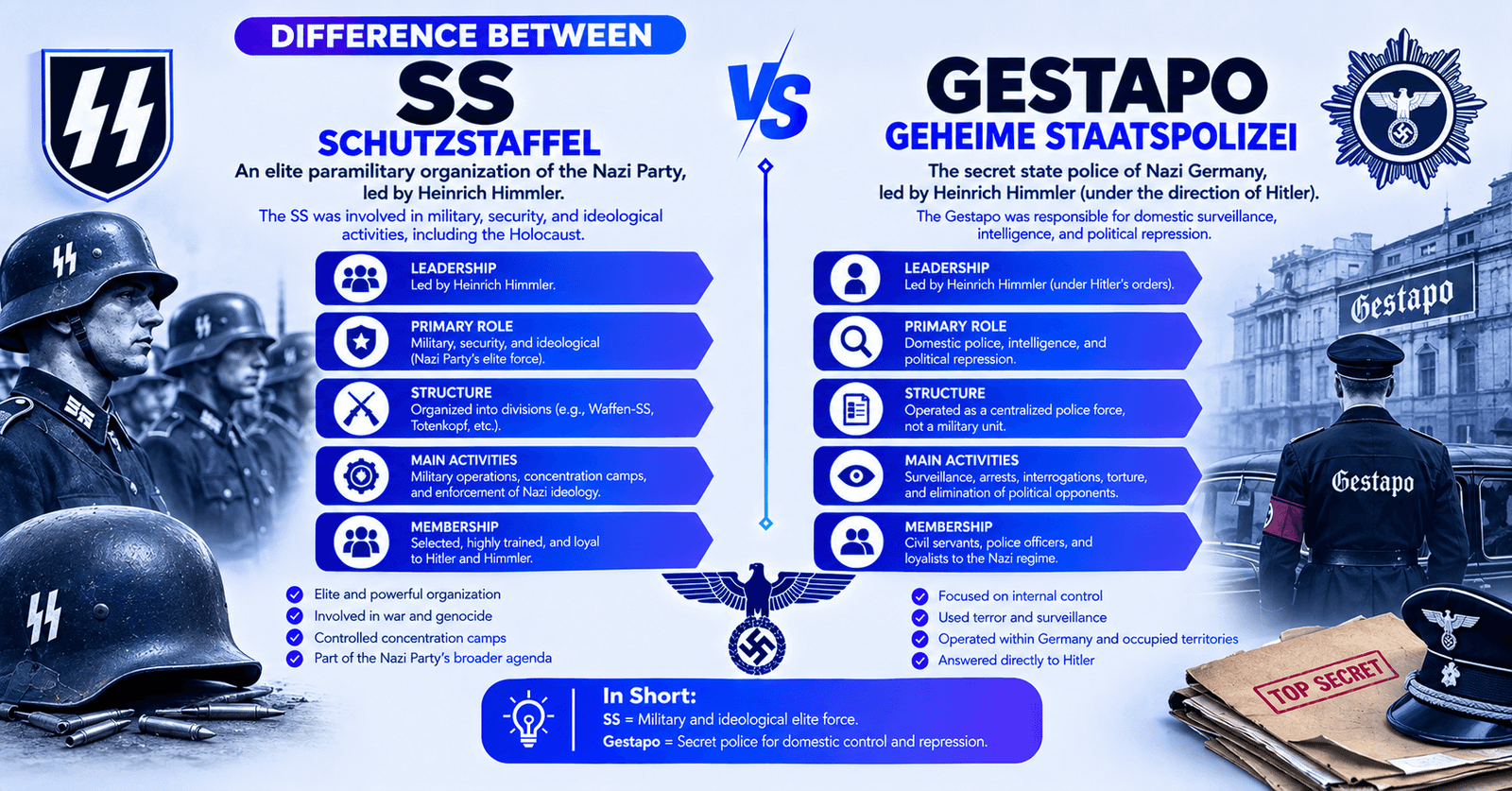

The SS and Gestapo were both major instruments of Nazi persecution, but they were not the same organization. The SS (Schutzstaffel) developed from Hitler’s personal guard into a vast Nazi organization involved in security, policing, concentration camps, intelligence, military operations, and racial policies. The Gestapo (Geheime Staatspolizei) was specifically the Nazi regime’s political police, responsible for investigating and suppressing perceived threats to the state.
The relationship became increasingly close as Heinrich Himmler consolidated control over Germany’s police organizations. By 1939, the Gestapo had become Office IV of the Reich Security Main Office (RSHA), an organization that also incorporated the SS intelligence service, the SD, and the Criminal Police.
Quick Answer
The SS was a broad Nazi organization with military, security, police, concentration-camp, and ideological functions, while the Gestapo was the Nazi regime’s political police force.
The SS grew from Hitler’s personal guard into one of the most powerful organizations in Nazi Germany. The Gestapo focused specifically on political policing: surveillance, investigations, arrests, interrogations, and suppression of people the Nazi regime considered enemies.
So, SS and Gestapo were connected, but they were not simply two names for the same organization.
SS vs Gestapo at a Glance
| SS | Gestapo | |
| Full name | Schutzstaffel | Geheime Staatspolizei |
| English meaning | Protection Squads | Secret State Police |
| Basic type | Broad Nazi organization | Political police |
| Origin | Established as Hitler’s personal guard | Created from political-police organizations in 1933 |
| Main role | Security, policing, camps, military and ideological functions | Investigating and suppressing perceived threats to the Nazi regime |
| Leadership connection | Led by Heinrich Himmler | Came under Himmler’s control |
| Concentration camps | Controlled and administered the camp system through SS units | Investigated/arrested people and could send detainees to camps |
| Later structure | Large SS organization with multiple branches | Office IV of the RSHA from 1939 |
The table simplifies a complicated institutional history, but the central distinction is well established by the USHMM: the SS was much broader, while the Gestapo was specifically the political police.
What Was the SS?
SS stands for Schutzstaffel, usually translated as “Protection Squads.”
The SS was originally established in 1925 as a small organization responsible for protecting Adolf Hitler and other Nazi leaders and providing security at Nazi Party events. It later developed into a powerful organization under Heinrich Himmler.
Its responsibilities expanded dramatically.
The SS became involved in:
- security and policing
- intelligence
- concentration camps
- racial and population policies
- settlement policies
- persecution of people classified by the Nazis as racial or political enemies
- military operations through the Waffen-SS
- coordination of major aspects of the Holocaust
The SS eventually became so powerful that the USHMM describes it as a “state within a state.” It controlled the German police forces and the concentration-camp system and played a leading role in the Nazi regime’s genocidal policies.
The SS was not simply the Nazi army
This is an important distinction.
The SS included different branches and functions. The Waffen-SS, for example, was its military branch, while other SS units were involved in policing, administration, intelligence, and concentration camps.
Therefore:
SS = a broad Nazi organization with many functions
rather than:
SS = one specific police force
What Was the Gestapo?
Gestapo is the shortened name for Geheime Staatspolizei, meaning Secret State Police.
The Gestapo was the Nazi regime’s political police force. Its central task was to investigate and suppress people whom the regime considered threats to the state.
Its activities included:
- surveillance
- gathering information
- investigating political opposition
- searching homes
- arresting suspects
- interrogating detainees
- using informants and denunciations
- persecuting people targeted by Nazi racial and political policies
- organizing or assisting deportations
The Gestapo was given extraordinary powers and operated with little meaningful legal oversight. It could use “protective custody” to send people to concentration camps without normal judicial protections.
Importantly, the Gestapo was not simply a generic name for all Nazi perpetrators. The USHMM specifically notes that it was one institution among several involved in Nazi crimes.
What Is the Difference Between the SS and Gestapo?
The easiest way to understand the difference is to look at scope and function.
1. The SS was much broader
The SS developed into a huge organization with responsibilities extending far beyond ordinary policing.
It was involved in:
- security
- intelligence
- concentration camps
- military operations
- policing
- racial policies
- population policies
- the Holocaust
The Gestapo had a much more specific institutional function: political policing.
2. The Gestapo investigated perceived threats
The Gestapo focused on finding and suppressing people the Nazi regime regarded as enemies.
It used surveillance, informants, searches, interrogations, and arrests.
3. The SS controlled the concentration-camp system
SS units known as the SS Death’s-Head Units (SS-Totenkopfverbände) guarded and administered the concentration camps.
The Gestapo could arrest people and send them to concentration camps, but the daily administration and guarding of the camps were handled by SS camp personnel.
4. The organizations became institutionally connected
By 1936, Heinrich Himmler had become Chief of the German Police while also leading the SS. This helped bring Germany’s police organizations under an increasingly SS-dominated structure.
In 1939, the RSHA was created. It brought together the Security Police—which included the Gestapo and Kripo—with the SS intelligence service, the SD. The Gestapo became RSHA Office IV.
How Were the SS and Gestapo Connected?
The relationship can be confusing because the SS increasingly controlled Germany’s police apparatus.
A simplified organizational picture is:
SS
↓
SS leadership under Heinrich Himmler
↓
German police organizations increasingly brought under SS control
↓
Security Police (SiPo)
→ Gestapo
→ Kripo
And in 1939:
RSHA
→ Security Police
→ Gestapo
→ Kripo
→ SD
→ other offices
The RSHA therefore provides an important explanation for why the SS and Gestapo are so often discussed together.
SS and Gestapo Roles in Nazi Persecution
Both organizations played major roles in the Nazi regime’s system of persecution.
The Gestapo investigated and arrested people considered political or racial enemies and helped enforce Nazi policies. It also played a major role in deportations of Jews to ghettos, concentration camps, and killing centers.
The SS had an even broader role. SS and police organizations under Himmler’s authority played a leading and coordinating role in the Holocaust, including mass shootings, deportations, concentration camps, and other forms of persecution and mass murder.
This is why it is inaccurate to describe the Gestapo as though it alone carried out Nazi persecution.
Did the Gestapo Run the Concentration Camps?
Not exactly.
The distinction is important.
The SS controlled the concentration-camp system, and SS Death’s-Head Units guarded and administered the camps.
The Gestapo, however, had the authority to arrest people and place them in “protective custody,” including sending them to concentration camps without normal judicial proceedings.
So:
Gestapo = could investigate and send people to camps
SS camp units = guarded and administered the camps
That distinction helps prevent the two organizations from being treated as interchangeable.
Common Misunderstandings About the SS and Gestapo
Mistake 1: “The SS and Gestapo were the same organization.”
Incorrect:
The SS and Gestapo were just two names for the same organization.
Correct:
They were distinct organizations with different institutional roles, although they became closely connected through the SS-controlled police system.
Why:
The SS was a broad Nazi organization, while the Gestapo was specifically the political police.
Mistake 2: “The SS was only a military organization.”
Incorrect:
The SS was simply Hitler’s military force.
Correct:
The SS had military, security, police, intelligence, concentration-camp, and ideological functions.
Why:
The Waffen-SS was a military branch, but the overall SS organization was much broader.
Mistake 3: “Every Nazi police officer was Gestapo.”
Incorrect:
All Nazi police were Gestapo.
Correct:
The Gestapo was one specific political-police organization among several Nazi security and police institutions.
Why:
The Nazi security apparatus also included organizations such as the Kripo, SD, and various SS and police units.
Mistake 4: “The Gestapo was an ordinary secret police agency.”
Incorrect:
The Gestapo was simply a normal intelligence organization.
Correct:
The Gestapo was a political police force operating under the Nazi dictatorship and used surveillance, arrest, interrogation, and coercion to enforce the regime’s policies.
Why:
Its powers were largely freed from ordinary legal constraints, and it was heavily involved in persecution.
SS, Gestapo, SD, and RSHA: What’s the Difference?
These four terms are often confused.
| Organization | Basic role |
| SS | Broad Nazi organization with security, military, police, camp, and ideological functions |
| Gestapo | Political police |
| SD | SS intelligence service |
| RSHA | Central organization created in 1939 that brought together the Security Police and SD |
The RSHA incorporated the Gestapo as Office IV, while the SD was another component of the RSHA.
This is why an article about the SS and Gestapo benefits from mentioning the RSHA: it explains how the two organizations became institutionally connected without incorrectly treating them as identical.
Can SS and Gestapo Be Used Interchangeably?
No.
The terms should not normally be used interchangeably.
Use SS when referring to the broader Nazi organization and its various branches and functions.
Use Gestapo when specifically referring to the Nazi political police.
For example:
The SS controlled the concentration-camp system.
This is appropriate when discussing the SS’s institutional control of the camp system.
The Gestapo investigated political opponents.
This describes the Gestapo’s political-policing function.
How to Remember the Difference
Use this simple rule:
SS = the larger organization
Gestapo = the political police
Think of the Gestapo as one important component within the much larger Nazi security system that increasingly came under SS control, rather than as another word for the SS itself.
Which One Should I Use?
For the broad Nazi organization, use SS.
When referring specifically to the Nazi political police, use Gestapo.
The SD refers to the SS intelligence service.
For the central security organization created in 1939, use RSHA.
The term Kripo refers to the Nazi criminal police.
This distinction helps keep the historical terminology accurate.
SS or Gestapo? Practice Examples
Choose SS or Gestapo.
- The organization that began as Hitler’s personal guard was the ______.
- The Nazi political police was the ______.
- The organization responsible for the administration and guarding of concentration camps included specialized ______ units.
- The ______ used surveillance and interrogations to investigate perceived threats to the regime.
- The Waffen-SS was a branch of the ______.
- The ______ became Office IV of the RSHA in 1939.
- Heinrich Himmler was the leader of the ______.
- The ______ was much broader in scope than the political police.
Answers
- SS
- Gestapo
- SS
- Gestapo
- SS
- Gestapo
- SS
- SS
Frequently Asked Questions
What does SS stand for?
SS stands for Schutzstaffel, commonly translated as Protection Squads. It began as Hitler’s personal guard and developed into a powerful Nazi organization with numerous security, military, police, and ideological functions.
What does Gestapo stand for?
Gestapo is short for Geheime Staatspolizei, meaning Secret State Police. It was the political police force of Nazi Germany.
Were the SS and Gestapo the same?
No. They were distinct organizations. The SS was much broader, while the Gestapo was specifically the Nazi political police. They became closely connected as Himmler consolidated control of the police and later through the RSHA.
Was the Gestapo part of the SS?
The relationship changed over time and is best described institutionally rather than simply saying the Gestapo was “the SS.” By 1939, the Gestapo was Office IV of the RSHA, an organization created under Heinrich Himmler that combined the Security Police and SS intelligence service.
Which organization controlled the concentration camps?
The SS controlled the concentration-camp system. SS Death’s-Head Units guarded and administered the camps, while the Gestapo had authority to incarcerate people and send them to camps through protective custody.
What was the main job of the Gestapo?
Its primary role was political policing: investigating and suppressing people whom the Nazi regime considered threats. Its methods included surveillance, informants, searches, arrests, and brutal interrogations.
Did both organizations participate in the Holocaust?
Yes, but their roles were not identical. The SS and police system played a leading coordinating role in the Holocaust, while the Gestapo was involved in persecution, arrests, deportations, and other operations.
Conclusion
The SS and Gestapo were closely connected but not identical. The SS (Schutzstaffel) was a broad Nazi organization that eventually controlled or participated in security, policing, military operations, intelligence, concentration camps, and genocidal policies. The Gestapo (Geheime Staatspolizei) was specifically the Nazi regime’s political police, responsible for investigating and suppressing perceived enemies.
The easiest rule to remember is:
SS = broad Nazi organization; Gestapo = political police.

Sajid Ali is an English language educator and content specialist with 7+ years of teaching experience. He holds master’s degrees in Information Technology and Education from the Virtual University of Pakistan and writes SEO-optimized, learner-friendly vocabulary content for diffari.com.