
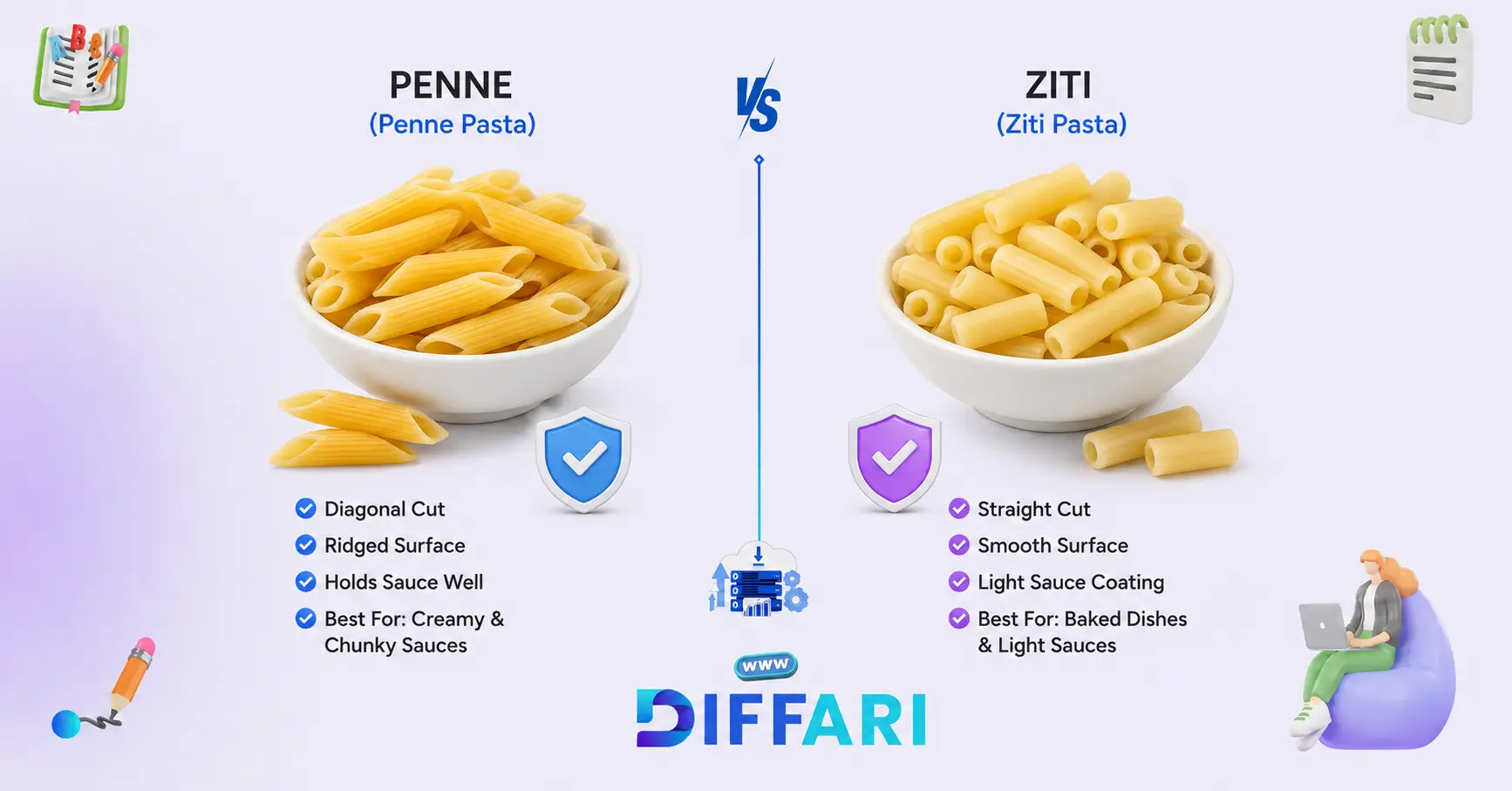

Penne and ziti are both hollow, tube-shaped Italian pastas, so they can look almost identical at first glance. However, their ends, surface texture, and typical culinary uses make them distinct pasta shapes.
The easiest way to tell them apart is to look at the ends: penne is cut diagonally, giving it pointed, quill-like ends, while ziti is cut straight across, creating blunt, tube-like ends. Penne is also commonly ridged, while ziti is generally smooth.
These differences matter because pasta shape affects texture and how sauce interacts with each piece. The good news is that penne and ziti can usually substitute for each other, especially when a recipe calls for a short tubular pasta.
Quick Answer
Penne and ziti are both tubular pastas, but their shapes are different. Penne has diagonally cut ends and is often ridged, while ziti has straight-cut ends and is usually smooth.
It is particularly useful for saucy stovetop dishes because ridged penne can grip sauce well. Ziti is especially associated with baked pasta dishes, where its smooth tubes become tender as they cook with sauce and cheese.
Penne vs. Ziti at a Glance
| Feature | Penne | Ziti |
| Shape | Short, hollow tube | Hollow tube |
| End cut | Diagonal | Straight |
| Surface | Smooth or ridged | Usually smooth |
| Common variety | Penne rigate | Smooth ziti |
| Texture | Often firmer, especially when ridged | Generally smoother and softer when baked |
| Common uses | Saucy pasta dishes, salads, stovetop recipes | Baked pasta and casseroles |
| Can they substitute? | Yes, in many recipes | Yes, in many recipes |
The defining difference is the cut of the ends, rather than simply the overall size.
What Is Penne?
Penne is a short, hollow, cylindrical pasta with ends cut diagonally. That angled cut gives it the pointed appearance associated with a quill or pen, which explains the name.
Penne comes in two main surface styles:
- Penne rigate — ridged on the outside
- Penne lisce — smooth on the outside
In North American cooking, penne rigate is particularly familiar and is often used with substantial sauces because its ridges provide additional surface texture for the sauce to cling to.
Common Uses for Penne
Penne works well in:
- Penne alla vodka
- Penne all’Arrabbiata
- Marinara-based pasta
- Tomato sauces
- Creamy sauces
- Pasta salads
- Vegetable and meat sauces
Its hollow center also allows sauce to enter the pasta rather than remaining only on the outside.
What Is Ziti?
Ziti is a hollow, tubular pasta with straight-cut ends. Unlike the familiar ridged version of penne, ziti is generally smooth on the outside.
Ziti is strongly associated with Southern Italian cooking and is particularly well known in the United States through baked ziti, a casserole-style dish combining pasta, sauce, cheese, and other ingredients.
The straight, smooth tube gives ziti a different eating texture from ridged penne, particularly when the pasta is baked.
Common Uses for Ziti
Ziti is commonly used in:
- Baked ziti
- Pasta al forno
- Cheesy pasta casseroles
- Tomato-based baked pasta
- Ricotta-based pasta dishes
- Other oven-baked pasta recipes
What Is the Difference Between Penne and Ziti?
The biggest difference is how the pasta is cut.
1. End Shape
Penne: The ends are cut diagonally, creating an angled or pointed appearance.
Ziti: The ends are cut straight across at roughly a right angle.
This is the easiest visual test when you’re trying to identify the pasta.
2. Surface Texture
Penne can be either smooth or ridged, although penne rigate is particularly common.
Ziti is traditionally smooth.
The ridges on penne rigate can help sauce cling to the pasta, giving it a more textured bite.
3. Cooking Texture
Penne, especially thicker-walled or ridged varieties, tends to retain a firm al dente texture well.
Ziti is particularly suited to baking, where the pasta continues cooking while surrounded by sauce and cheese. This can produce a softer, more uniform texture.
4. Typical Use
Penne is highly versatile and frequently appears in stovetop pasta dishes.
Ziti has a stronger association with baked pasta and casseroles.
That doesn’t mean you cannot bake penne or use ziti with a stovetop sauce. Pasta shapes are guidelines rather than rigid rules.
Penne vs. Ziti: Which Holds Sauce Better?
If you’re comparing ridged penne with smooth ziti, penne generally has an advantage when the goal is to give sauce more textured surface area to cling to.
The ridges of penne rigate can catch thicker sauces and small ingredients.
However, ziti’s hollow center still makes it effective for carrying sauce inside the tube. Its smooth exterior simply creates a different overall texture.
So the better choice depends on the dish:
Thick or chunky stovetop sauce → Penne rigate
Cheesy baked casserole → Ziti
When to Use Penne
Choose penne when you want:
- A firm, substantial bite
- Ridged pasta for thicker sauces
- A versatile pasta for stovetop recipes
- Pasta for salads
- A shape that works well with tomato, meat, or creamy sauces
For example:
Penne alla vodka is a natural choice for penne because the sauce coats the short, hollow pasta and works especially well with the ridged variety.
When to Use Ziti
Choose ziti when you’re preparing:
- Baked pasta
- Cheesy casseroles
- Pasta with ricotta
- Oven-baked tomato sauces
- Recipes where a softer, cohesive pasta texture is desirable
The classic example is baked ziti, where the pasta cooks together with sauce and cheese in the oven.
Can You Substitute Penne for Ziti?
Yes. In most recipes, you can substitute penne for ziti.
The Kitchn specifically notes that the two are similar enough to be used interchangeably in many situations, with texture being one of the most noticeable differences.
For example, if a baked ziti recipe calls for ziti and your grocery store doesn’t have it, penne is a practical substitute. This is also supported by recipe sources that specifically recommend penne as an alternative.
The final dish may have:
- More surface texture
- A firmer bite
- More sauce adhesion if you use penne rigate
- A slightly different appearance
So substitution is usually fine, but it isn’t always completely identical.
Penne Rigate vs. Ziti
This is an especially useful comparison.
Penne rigate has:
- Diagonal ends
- Exterior ridges
- A textured surface
- A firm, substantial bite
Ziti has:
- Straight-cut ends
- A smooth surface
- A simpler tubular shape
- A softer texture when used in baked dishes
This distinction is more accurate than simply saying “penne is ridged and ziti is smooth,” because smooth penne also exists.
Common Mistakes With Penne and Ziti
Mistake 1: Assuming all penne is ridged
Incorrect:
Penne always has ridges.
Correct:
Penne can be smooth or ridged.
Why:
Penne comes in both lisce and rigate forms.
Mistake 2: Thinking the names refer to the same shape
Incorrect:
Penne and ziti are exactly the same pasta.
Correct:
Penne and ziti are similar tubular pastas with different cuts and typical surface characteristics.
Why:
Penne has diagonal ends, while ziti has straight-cut ends.
Mistake 3: Thinking ziti can never replace penne
Incorrect:
Ziti cannot be used in a penne recipe.
Correct:
Ziti can replace penne in many recipes, although the texture and appearance may change.
Why:
Both are short tubular pastas, making them practical substitutes in many dishes.
Common Collocations With Penne and Ziti
Penne
- penne pasta
- penne rigate
- penne alla vodka
- penne Arrabbiata
- penne with marinara
- penne pasta salad
- creamy penne
Ziti
- baked ziti
- ziti pasta
- baked ziti casserole
- cheesy baked ziti
- ziti with tomato sauce
- baked ziti with ricotta
“Baked ziti” is particularly established as a dish name, which makes ziti more strongly associated with oven-baked pasta than penne.
How to Remember the Difference
Use this simple rule:
Penne = pointy ends.
Ziti = straight ends.
Think of penne as resembling the tip of a pen or quill.
Think of ziti as a simple hollow tube with the ends cut straight.
If you’re standing in a grocery aisle, look at the ends first. You don’t need to measure the pasta to identify the basic difference.
Which One Should I Use?
Choose penne if:
- You want ridged pasta.
- You’re making a saucy stovetop dish.
- You want a firmer, textured bite.
- You’re making pasta salad.
- You’re using a thick or chunky sauce.
Choose ziti if:
- You’re making baked ziti.
- You’re preparing a cheesy casserole.
- You prefer a smooth pasta surface.
- You want a softer, more uniform baked texture.
If the recipe calls for one but you only have the other:
Use the available pasta.
The substitution will usually work, although the final texture and appearance may differ.
Penne or Ziti? Practice Examples
Choose penne or ziti.
- I am making a classic baked pasta casserole. → ______
- I want ridged pasta for a thick tomato sauce. → ______
- My recipe specifically calls for baked ziti, but the store is out of ziti. → ______
- I am making penne alla vodka. → ______
- I want pasta for a cold pasta salad. → ______
- I need a smooth tubular pasta for a cheesy oven-baked dish. → ______
Answers
- Ziti
- Penne rigate
- Penne
- Penne
- Penne
- Ziti
These are recommendations rather than absolute rules; both shapes are versatile and can often be substituted.
Frequently Asked Questions
What is the main difference between penne and ziti?
The easiest difference to see is the end cut. Penne is cut diagonally, while ziti is cut straight across. Penne is also commonly ridged, whereas ziti is generally smooth.
Are penne and ziti the same?
No. They are similar tubular pastas, but their shapes differ. Penne has angled ends, while ziti has straight ends.
Can I use penne instead of ziti?
Yes. Penne is a common substitute for ziti, particularly when ziti is unavailable. The resulting dish may have a firmer or more textured bite.
Can I use ziti instead of penne?
Yes, in many recipes. Ziti can replace penne when the exact pasta shape is not essential. Expect a smoother texture and somewhat different appearance.
Which is better for baked pasta?
Ziti is the traditional choice, particularly for dishes such as baked ziti. However, penne also works well in baked pasta recipes.
Which holds sauce better: penne or ziti?
Ridged penne generally provides more surface texture for sauce to cling to, while ziti relies more on its hollow center and smooth surface.
What is penne rigate?
Penne rigate is the ridged version of penne. Its exterior grooves increase surface texture and can help sauces cling to the pasta.
Is ziti always smooth?
Traditional ziti is generally smooth, but pasta manufacturers can produce variations. Therefore, “usually smooth” is safer and more accurate than claiming that every product labeled ziti must be smooth.
Which one is longer?
Size varies by manufacturer and specific pasta product, so length should not be treated as the primary way to distinguish them. The end cut is much more reliable.
Conclusion
The difference between penne and ziti is mainly shape and surface. Penne has diagonally cut ends and may be smooth or ridged, while ziti has straight-cut ends and is typically smooth. Penne is especially useful for saucy stovetop dishes, while ziti is strongly associated with baked pasta and casseroles.

Sajid Ali is an English language educator and content specialist with 7+ years of teaching experience. He holds master’s degrees in Information Technology and Education from the Virtual University of Pakistan and writes SEO-optimized, learner-friendly vocabulary content for diffari.com.