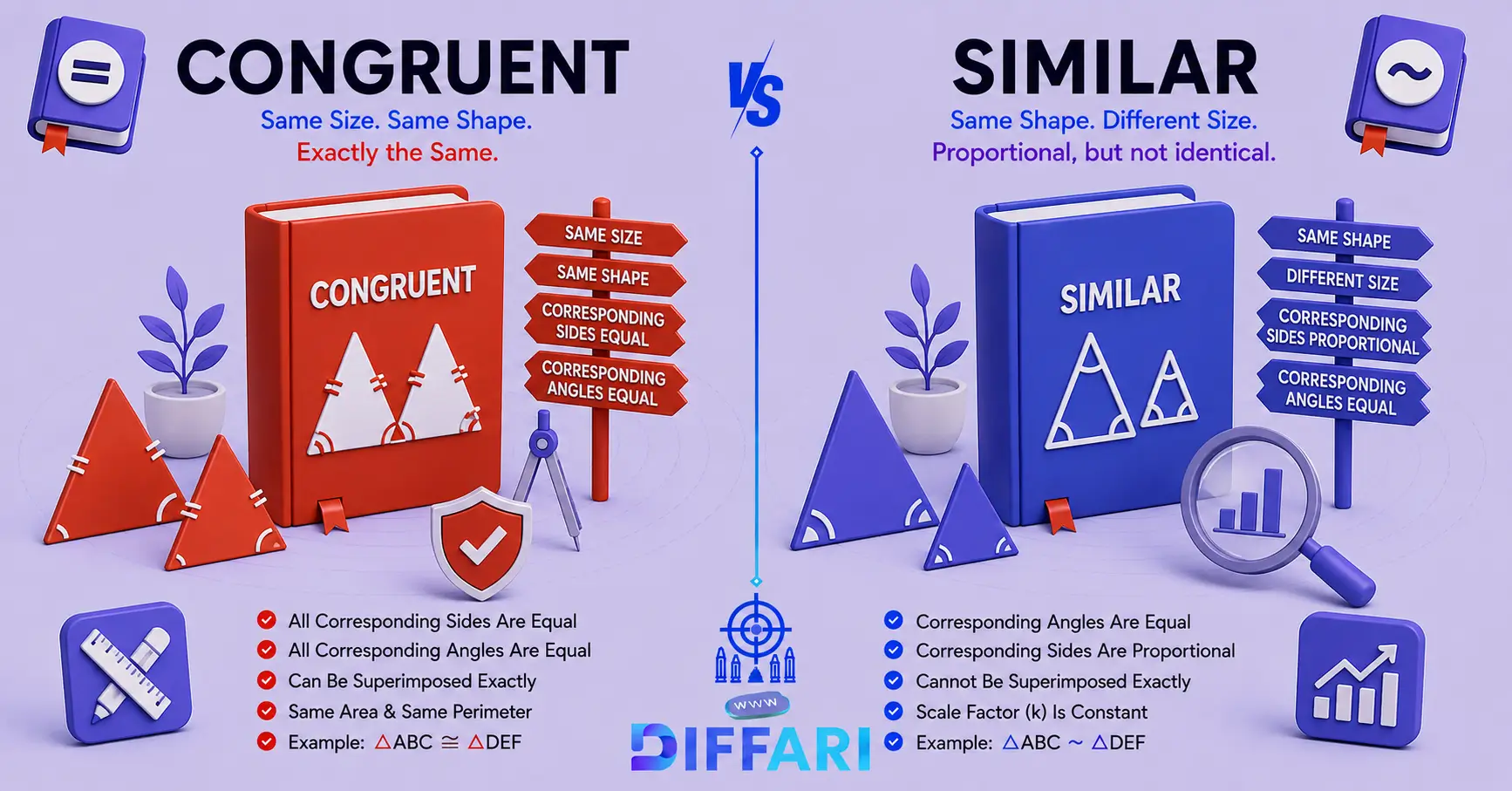

When comparing geometric figures, congruent and similar both describe shapes that have the same basic form. The important difference is size. Congruent figures have the same shape and the same size, while similar figures have the same shape and proportional measurements but may be different sizes.
That distinction becomes especially important when comparing triangles, finding missing side lengths, working with scale drawings, or deciding which geometry rule applies.
Quick Answer
Congruent figures have the same shape and the same size. Similar figures have the same shape but may have different sizes.
For congruent figures, corresponding side lengths are equal and corresponding angles are equal.
For similar figures, corresponding angles are equal and corresponding side lengths are proportional.
The easiest rule to remember is:
Congruent = exact same shape and size.
Similar = same shape, possibly different size.
Congruent vs Similar at a Glance
| Feature | Congruent | Similar |
| Same shape | Yes | Yes |
| Same size | Yes | Not necessarily |
| Corresponding angles | Equal | Equal |
| Corresponding sides | Equal | Proportional |
| Scale factor | 1 | May be different from 1 |
| Can be rotated? | Yes | Yes |
| Can be reflected? | Yes | Yes |
| Can be enlarged or reduced? | No resizing needed | Yes |
| Symbol | ≅ | ~ |
The transformation distinction is useful: congruent figures can be matched using rigid transformations such as rotations, reflections, and translations, while similar figures can additionally involve dilation.
What Does Congruent Mean?
In geometry, two figures are congruent when they have exactly the same shape and size.
One figure may be moved, rotated, or flipped, but its dimensions do not change. If you can place one figure over the other and make them match exactly, they are congruent.
Example
Imagine two triangles with side lengths:
- 3 cm
- 4 cm
- 5 cm
If both triangles have the same corresponding side lengths and angles, they are congruent.
They might face different directions, but that does not matter. Rotation or reflection does not change their size.
Symbol
Congruence is represented by:
≅
For example:
△ABC ≅ △DEF
means the two triangles are congruent.
What Does Similar Mean?
Two figures are similar when they have the same shape but do not necessarily have the same size.
Their corresponding angles have equal measures, and their corresponding side lengths have the same ratio. One figure can therefore be an enlargement or reduction of the other.
Example
Suppose one triangle has sides:
3, 4, 5
and another has sides:
6, 8, 10
The second triangle is twice as large:
- 6 ÷ 3 = 2
- 8 ÷ 4 = 2
- 10 ÷ 5 = 2
Because all corresponding sides have the same ratio, the triangles are similar.
Symbol
Similarity is represented by:
~
For example:
△ABC ~ △DEF
means the triangles are similar.
What Is the Difference Between Congruent and Similar?
The fundamental difference is whether the size must remain exactly the same.
Congruent
The figures must have:
- the same shape
- the same size
- equal corresponding side lengths
- equal corresponding angle measures
Similar
The figures must have:
- the same shape
- equal corresponding angle measures
- proportional corresponding side lengths
- potentially different sizes
Think of a photograph.
If you move the same photograph without changing its dimensions, the two representations are analogous to congruent figures.
If you enlarge the photograph while keeping its proportions unchanged, the original and enlarged versions are analogous to similar figures.
Similarity is commonly used in scale drawings, maps, enlarged photographs, and other proportional models.
Congruent and Similar Transformations
Transformations provide another easy way to understand the distinction.
Congruent Figures
You can use:
- translation — slide
- rotation — turn
- reflection — flip
These transformations preserve the figure’s size.
Similar Figures
You can use the same rigid transformations plus dilation.
A dilation enlarges or reduces the figure while preserving its proportions. Khan Academy describes similar figures through rigid transformations combined with dilations.
Simple rule
No resizing needed → congruent
Resizing is needed while proportions stay the same → similar
Congruent vs Similar Triangles
The distinction is particularly important with triangles.
Congruent Triangles
Two triangles are congruent when their corresponding sides and angles match exactly.
For example:
Triangle A: 3, 4, 5
Triangle B: 3, 4, 5
If the corresponding parts match, the triangles are congruent.
Common triangle congruence criteria include:
- SSS — Side-Side-Side
- SAS — Side-Angle-Side
- ASA — Angle-Side-Angle
- AAS — Angle-Angle-Side
These criteria are used to establish congruence from sufficient measurements.
Similar Triangles
Similar triangles have the same shape but can have different sizes.
For example:
Triangle A: 3, 4, 5
Triangle B: 6, 8, 10
Every side in Triangle B is twice the corresponding side in Triangle A.
The scale factor is therefore 2.
Common triangle similarity criteria include:
- AA — Angle-Angle
- SSS — proportional corresponding sides
- SAS — proportional two sides with the included angle equal
Khan Academy specifically teaches AA, SSS, and SAS as triangle similarity criteria.
Corresponding Sides and Angles
The word corresponding is important in both congruence and similarity.
Corresponding parts are the parts that occupy matching positions in two figures.
For example, if:
△ABC ~ △DEF
then:
- A corresponds to D
- B corresponds to E
- C corresponds to F
Therefore:
- AB corresponds to DE
- BC corresponds to EF
- AC corresponds to DF
For congruent figures, corresponding side lengths are equal.
For similar figures, corresponding side lengths have equal ratios.
Scale Factor: The Key to Similarity
A scale factor tells you how much one figure has been enlarged or reduced compared with another.
Suppose a side of one triangle is 5 cm and its corresponding side in a similar triangle is 15 cm.
The scale factor is:
15 ÷ 5 = 3
So the second triangle is three times as large in its corresponding linear dimensions.
For similar figures, the scale factor is central to solving missing-length problems.
For congruent figures, the scale factor is effectively:
1
because corresponding lengths do not change.
Common Mistakes With Congruent and Similar
Mistake 1: Thinking Similar Means Exactly the Same Size
Incorrect idea:
“Similar shapes must have identical measurements.”
Correct idea:
Similar shapes have the same shape and proportional measurements, but their sizes can differ.
Why:
Similarity permits a scale change.
Mistake 2: Thinking Different Orientation Means Different Shapes
A triangle can be rotated or reflected and still be congruent to another triangle.
Why:
Rotation and reflection do not change the figure’s dimensions.
Mistake 3: Assuming Equal Angles Automatically Mean Congruent
Two triangles can have all corresponding angles equal while having different side lengths.
That can establish similarity, but not necessarily congruence.
Example:
- 3-4-5 triangle
- 6-8-10 triangle
The triangles have the same shape but different sizes.
Therefore, they are similar, not congruent.
Mistake 4: Copying Side Lengths From Similar Figures
If two figures are similar, do not assume corresponding sides have equal lengths.
Instead, check their ratio.
For example:
4/6 = 6/9 = 8/12
The ratios are equal, so the corresponding sides are proportional.
Common Geometry Relationships
| Relationship | Congruent | Similar |
| Same shape | Yes | Yes |
| Same size | Yes | Not required |
| Equal corresponding angles | Yes | Yes |
| Equal corresponding sides | Yes | No |
| Proportional corresponding sides | Yes, with ratio 1 | Yes |
| Dilation required | No | Sometimes |
| Scale factor | 1 | Any positive factor appropriate to the figures |
A useful way to see the relationship is that congruence is a special case of similarity with a scale factor of 1.
Can Congruent Figures Also Be Similar?
Yes.
This is one of the most important details to understand.
If two figures are congruent, they have the same shape and size. Their corresponding side lengths are therefore proportional with a ratio of 1:1.
So congruent figures satisfy the conditions for similarity when similarity includes the scale-factor-1 case.
However:
Not every pair of similar figures is congruent.
A 3-4-5 triangle and a 6-8-10 triangle are similar, but they are not congruent because their sizes differ.
Which One Should I Use?
Use this quick decision guide:
Figures with exactly the same shape and size are “congruent.”
By comparison, figures with the same shape but different sizes are “similar.”
Equal corresponding sides are a key sign of congruence.
Proportional corresponding sides, on the other hand, indicate similarity.
When one figure can be resized to match another using a scale factor, think “similar.”
A simple memory rule is: Congruent = same shape + same size; Similar = same shape, different size.
Congruent = copy.
Similar = scaled copy.
X or Y? Practice Examples
1. Two triangles have sides 5, 12, and 13 in both figures.
Answer: Congruent
Their corresponding side lengths are the same.
2. One triangle has sides 3, 4, and 5. Another has sides 6, 8, and 10.
Answer: Similar
Every corresponding side is multiplied by 2.
3. Two squares have side lengths 4 cm and 9 cm.
Answer: Similar
Both are squares, so their shape is the same, even though their sizes differ.
4. One triangle is rotated 180° but has exactly the same dimensions as another triangle.
Answer: Congruent
Rotation does not change the size or shape.
5. One rectangle is 2 × 4 and another is 3 × 6.
Answer: Similar
The corresponding side ratios are:
2:3
and
4:6 = 2:3
So the dimensions are proportional.
6. Two figures have equal corresponding angles but their corresponding side ratios are not consistent.
Answer: Neither, in general
Equal angles alone do not guarantee that arbitrary figures are similar unless the necessary similarity conditions are satisfied.
Frequently Asked Questions
What is the main difference between congruent and similar?
Congruent figures have the same shape and size, while similar figures have the same shape but may have different sizes.
Are congruent figures similar?
Yes. Congruent figures can be considered similar with a scale factor of 1.
Are all similar figures congruent?
No. Similar figures can have different sizes.
For example, 3-4-5 and 6-8-10 triangles are similar but not congruent.
What happens to corresponding sides?
For congruent figures, corresponding side lengths are equal.
For similar figures, corresponding side lengths are proportional.
What happens to corresponding angles?
Corresponding angles have equal measures in both congruent and similar figures.
What is the easiest way to remember congruent vs similar?
Remember:
Congruent = same shape + same size
Similar = same shape + possibly different size
Can similar figures be different sizes?
Yes. In fact, different sizes are one of the most common ways to recognize similarity. A figure can be enlarged or reduced while preserving its proportions.
What is the difference between congruent and similar triangles?
Congruent triangles have exactly the same shape and size. Similar triangles have the same shape, but their corresponding side lengths may differ by a common scale factor.
Conclusion
The difference between congruent and similar comes down mainly to size. Congruent figures have the same shape and exactly the same size, while similar figures have the same shape and proportional measurements but can be larger or smaller. Corresponding sides are equal for congruent figures and proportional for similar figures.

Sajid Ali is an English language educator and content specialist with 7+ years of teaching experience. He holds master’s degrees in Information Technology and Education from the Virtual University of Pakistan and writes SEO-optimized, learner-friendly vocabulary content for diffari.com.