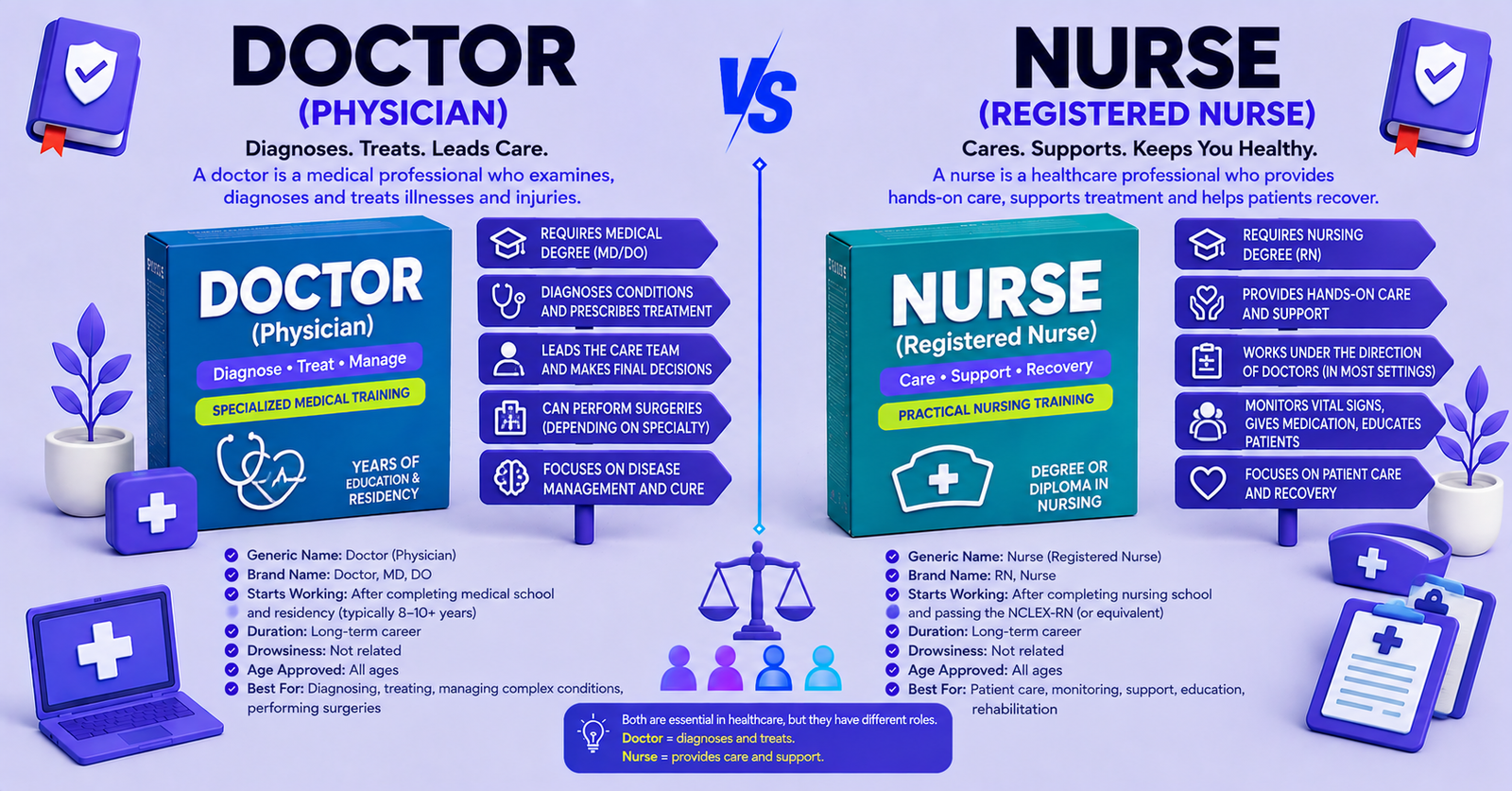

Doctors and nurses are both essential healthcare professionals, but they are trained for different professional roles. A doctor, in the medical sense, is a physician who evaluates health problems, diagnoses conditions, and develops medical treatment plans. A nurse focuses heavily on patient assessment, nursing care, monitoring, treatment administration, education, and ongoing support.
The exact responsibilities can overlap, especially with advanced nursing roles, and scope of practice varies by country and professional license. The simplest distinction is that medicine and nursing are separate professions that work together to care for patients.
Quick Answer
A doctor is a medical professional trained primarily to diagnose diseases and injuries, determine medical treatment, prescribe medications, order or interpret diagnostic tests, and manage medical conditions.
A nurse is a healthcare professional trained to assess patients, provide nursing care, administer medications and treatments, monitor changes in condition, educate patients, and coordinate care.
The main difference is not that one simply “helps” the other. Doctors and nurses have different education, professional responsibilities, and scopes of practice, while working together as part of the healthcare team.
Doctor vs Nurse at a Glance
| Aspect | Doctor | Nurse |
|---|---|---|
| Profession | Medicine | Nursing |
| Main focus | Diagnosis and medical treatment | Nursing care and patient support |
| Education | Medical education followed by clinical training | Nursing education followed by professional clinical training |
| Patient assessment | Yes | Yes |
| Diagnosis | Medical diagnosis within scope of practice | Assessment and, for some advanced nursing roles, diagnosis within authorized scope |
| Medication | Can prescribe within professional scope | Can administer medications; prescribing authority depends on role and jurisdiction |
| Treatment planning | Develops medical treatment plans | Develops or contributes to nursing care plans |
| Patient monitoring | Yes | A major part of nursing practice |
| Patient education | Yes | A major part of nursing practice |
| Surgery | Some doctors specialize in surgery | Nurses may assist with and support surgical care; they do not become surgeons simply by being nurses |
| Collaboration | Works with nurses and other professionals | Works with doctors and other healthcare professionals |
The table describes broad professional patterns rather than rules that apply identically in every country.
What Does a Doctor Do?
In this article, doctor means a medical doctor or physician.
Doctors examine patients, take medical histories, evaluate symptoms, diagnose medical conditions, order or interpret diagnostic tests, prescribe medications, and develop treatment plans. Some doctors also perform procedures or surgery depending on their specialty.
For example, a doctor may:
- Diagnose pneumonia after examining a patient and reviewing test results.
- Prescribe medication for an infection.
- Order blood tests or imaging.
- Develop a treatment plan for diabetes.
- Refer a patient to another specialist.
- Perform surgery if trained and licensed as a surgeon.
- Monitor the patient’s medical progress.
Doctors can specialize in many areas, including pediatrics, cardiology, psychiatry, oncology, dermatology, radiology, emergency medicine, and surgery.
The word doctor can also refer to someone with a doctoral degree in a nonmedical field. In the context of this article, however, it means a physician.
What Does a Nurse Do?
Nurses provide professional nursing care to patients in hospitals, clinics, community settings, homes, and other healthcare environments.
A registered nurse may assess a patient’s condition, record symptoms and observations, administer medications and treatments, monitor medical equipment, contribute to care plans, educate patients and families, and communicate with doctors and other healthcare professionals.
For example, a nurse may:
- Check a patient’s vital signs.
- Monitor changes in the patient’s condition.
- Administer prescribed medication.
- Provide wound care.
- Help prepare a patient for a procedure.
- Explain treatment instructions to a patient.
- Teach a patient how to manage a condition at home.
- Communicate important changes in the patient’s condition to the healthcare team.
- Provide emotional and practical support.
Nursing is broader than simply carrying out instructions. The World Health Organization describes nursing as including autonomous and collaborative care, health promotion, prevention of illness, treatment, rehabilitation, and care for people who are sick, disabled, or dying.
What Is the Difference Between a Doctor and a Nurse?
The central difference is professional role and training.
Doctors are trained in medicine, with a major emphasis on understanding disease, diagnosing medical conditions, determining treatment, and managing medical problems.
Nurses are trained in nursing, with a major emphasis on patient assessment, nursing care, monitoring, treatment administration, education, prevention, rehabilitation, and coordination of patient care.
However, the boundary is not simply:
Doctor = thinks
Nurse = cares
That would be misleading.
Both professions assess patients, communicate with patients, make clinical judgments within their scopes of practice, and contribute to treatment and recovery.
The difference is primarily in professional education, scope of practice, clinical responsibilities, and the type of care each profession is specifically trained and licensed to provide.
Education and Training
Doctors and nurses follow different educational paths.
Doctor
A physician normally completes medical education followed by supervised clinical training. In the United States, for example, physicians typically complete medical school and residency, with additional training possible for specialization.
The length and exact structure vary considerably between countries.
Nurse
Nurses complete nursing education and clinical training appropriate to their professional level and jurisdiction. Registered nurses may qualify through different educational pathways depending on the country.
Nursing also has advanced roles. A nurse practitioner, for example, receives additional education and training and may have authority to diagnose and prescribe depending on the jurisdiction.
Therefore, saying simply that “doctors study more than nurses” is too broad to be a useful explanation. The more important difference is what each professional is trained and licensed to do.
Responsibilities and Scope of Practice
One of the clearest ways to understand the difference is to look at responsibilities.
Doctors commonly focus on:
- Medical diagnosis
- Medical treatment
- Prescription of medication
- Diagnostic investigations
- Medical decision-making
- Procedures and surgery within specialty
- Management of complex medical conditions
- Specialist consultation
Nurses commonly focus on:
- Patient assessment
- Nursing care
- Monitoring
- Medication administration
- Treatment administration
- Patient education
- Care coordination
- Prevention
- Rehabilitation
- Patient and family support
There is overlap.
For example, both a doctor and a nurse may assess a patient. However, the purpose, professional framework, and scope of that assessment can differ.
A registered nurse may recognize a concerning change in a patient’s condition, document it, intervene within nursing scope, and communicate the change to the medical team.
An advanced practice nurse may have additional authority to diagnose and prescribe.
That is why the exact answer depends partly on which type of nurse and which country or jurisdiction you are discussing.
Patient Interaction
Nurses often have frequent and continuous contact with patients.
In a hospital, a nurse may repeatedly monitor a patient throughout a shift, administer medication, assist with daily care, explain procedures, and report changes in the patient’s condition.
A doctor may see the same patient for examinations, diagnosis, treatment decisions, procedures, consultations, and follow-up.
This does not mean doctors have little patient interaction or nurses only provide bedside care. Both professions interact directly with patients, but their responsibilities and patterns of interaction can differ.
How Doctors and Nurses Work Together
Doctors and nurses are usually part of a larger healthcare team.
Consider a patient admitted to a hospital with severe abdominal pain.
A doctor may:
- Examine the patient.
- Review the medical history.
- Order diagnostic tests.
- Determine the diagnosis.
- Develop a medical treatment plan.
A nurse may:
- Assess and monitor the patient’s condition.
- Record vital signs and symptoms.
- Administer prescribed medications.
- Provide nursing care.
- Observe how the patient responds.
- Educate the patient.
- Report important changes to the healthcare team.
The actual workflow can vary by hospital, specialty, country, and professional role.
The important point is that the doctor and nurse contribute different forms of expertise to the same patient’s care.
Can Nurses Diagnose Patients?
The answer depends on which nursing role and where the nurse practices.
A registered nurse’s responsibilities are different from those of a nurse practitioner or another advanced practice nurse.
In some jurisdictions, advanced practice nurses can diagnose certain conditions and prescribe medications. Other nursing roles have narrower scopes.
Therefore, the statement:
“Nurses cannot diagnose.”
is too absolute.
Likewise, it would be inaccurate to assume that every nurse has the same diagnostic authority as a physician.
The safest rule is to consider the specific nursing role and local regulations.
Can Doctors and Nurses Do the Same Things?
Sometimes their responsibilities overlap, but they are not interchangeable professions.
Both may:
- Assess patients
- Educate patients
- Monitor health
- Participate in treatment
- Work in hospitals and clinics
- Specialize
- Conduct or contribute to research
- Collaborate with other healthcare professionals
But the training, professional role, and legal scope of practice remain different.
Advanced nursing roles can create even more overlap with physician practice, which is one reason the simple “doctor diagnoses, nurse follows orders” explanation is incomplete.
Common Misconceptions About Doctors and Nurses
Misconception 1: Nurses are just assistants to doctors
Why it is misleading: Nursing is an independent healthcare profession with its own body of knowledge, professional responsibilities, standards, and scope of practice.
Misconception 2: Nurses only give medications
Medication administration is one nursing responsibility, but nurses also assess patients, monitor conditions, provide care, educate patients, coordinate care, and contribute to treatment.
Misconception 3: Every nurse has the same scope of practice
Different nursing roles have different responsibilities and levels of education. A registered nurse and a nurse practitioner should not automatically be treated as the same professional role.
Misconception 4: Every doctor performs surgery
Most doctors are not surgeons. Doctors can specialize in many areas that do not involve surgery.
Misconception 5: Doctors and nurses compete for the same job
They are separate professions designed to contribute different expertise to healthcare.
Doctor and Nurse in Real Sentences
Example 1
The doctor diagnosed the patient with pneumonia.
Here, doctor is appropriate because the sentence focuses on medical diagnosis.
Example 2
The nurse monitored the patient’s breathing throughout the night.
Here, nurse is appropriate because the sentence focuses on ongoing patient monitoring.
Example 3
The doctor prescribed an antibiotic.
This describes a medical prescribing responsibility.
Example 4
The nurse administered the prescribed medication.
This describes medication administration as part of nursing care.
Example 5
The doctor and nurse discussed the patient’s condition.
This illustrates collaboration between the two professions.
Are Doctor and Nurse Interchangeable?
No.
A doctor and a nurse are not simply two names for the same healthcare professional.
Their responsibilities can overlap, but they have different professional education, training, roles, and scopes of practice.
The comparison also becomes more complicated when advanced practice nurses are included. A nurse practitioner, for example, may have authority to diagnose and prescribe in a particular jurisdiction.
So, when someone says “doctor vs nurse,” it is useful to ask:
Which type of nurse, and in which country?
That question can change the exact answer.
How to Remember the Difference
Use this simple rule:
Doctor → medicine, diagnosis, and medical treatment.
Nurse → nursing care, assessment, monitoring, treatment support, and patient education.
Remember that these are broad patterns, not absolute boundaries.
Both professions contribute to diagnosis, treatment, prevention, education, and patient care in different ways depending on their professional roles.
Which One Should I Use?
If you are trying to describe a medical diagnosis or medical treatment decision, doctor is generally the appropriate term when referring to a physician.
If you are describing nursing care, patient monitoring, medication administration, bedside care, or patient education, nurse is generally appropriate.
For example:
- Diagnosis of a medical condition → doctor
- Developing a medical treatment plan → doctor
- Monitoring a patient’s condition → nurse
- Administering prescribed medication → nurse
- Educating a patient about ongoing care → nurse
- Collaborative patient management → doctor and nurse
For real healthcare decisions, however, the exact responsibility depends on the professional’s role, license, and jurisdiction.
X or Y? Practice Examples
Choose doctor, nurse, or both.
- Who may diagnose a medical condition in the traditional physician role?
- Who commonly monitors a patient’s condition throughout a hospital shift?
- Who may administer prescribed medication?
- Who may develop a medical treatment plan?
- Who can educate patients about managing their health?
- Who can specialize in a particular area of healthcare?
- Who may work directly with patients in a hospital?
- Who can collaborate with other healthcare professionals?
Answers
- Doctor
- Nurse
- Nurse — although medication-related responsibilities vary by professional role.
- Doctor — for medical treatment planning.
- Both
- Both
- Both
- Both
The answers describe common professional patterns, not universal legal rules.
Frequently Asked Questions
What is the main difference between a doctor and a nurse?
A doctor is a physician trained primarily in medicine, diagnosis, and medical treatment. A nurse is a nursing professional trained in patient assessment, nursing care, monitoring, treatment administration, education, and care coordination.
Is a doctor higher than a nurse?
Doctor and nurse are different professions rather than simply higher and lower versions of the same profession. Each has distinct education, responsibilities, and professional scope.
Can a nurse diagnose a patient?
Some advanced nursing professionals can diagnose patients within their authorized scope of practice. The answer for a particular nurse depends on the nursing role and jurisdiction.
Can a nurse prescribe medicine?
Some nurses, particularly nurse practitioners and other advanced practice nurses, may have prescribing authority depending on local regulations. A registered nurse does not automatically have the same prescribing authority.
Do doctors and nurses work together?
Yes. Doctors and nurses commonly collaborate with one another and with other healthcare professionals to assess, treat, monitor, educate, and support patients.
Do doctors and nurses have the same education?
No. They follow different educational and professional training pathways. The exact length and requirements vary by country and professional role.
Can a doctor be a nurse?
Being a doctor and being a nurse are separate professional qualifications. A person can potentially train and qualify in both professions, but one qualification does not automatically make someone qualified in the other.
Is a nurse practitioner a doctor?
A nurse practitioner is a nursing professional with advanced education and training. A nurse practitioner is not automatically a medical doctor, even though some nurse practitioners have doctoral-level nursing degrees and may have substantial diagnostic and prescribing authority.
Conclusion
The difference between a doctor and a nurse is primarily a difference in professional education, role, responsibilities, and scope of practice. Doctors are physicians whose work commonly centers on medical diagnosis, treatment planning, and management of disease. Nurses provide professional nursing care that includes assessment, monitoring, treatment administration, education, prevention, and patient support.
The two professions are not interchangeable, but they frequently overlap and collaborate. The exact responsibilities of a nurse—especially an advanced practice nurse—can vary by role and jurisdiction.

Sajid Ali is an English language educator and content specialist with 7+ years of teaching experience. He holds master’s degrees in Information Technology and Education from the Virtual University of Pakistan and writes SEO-optimized, learner-friendly vocabulary content for diffari.com.