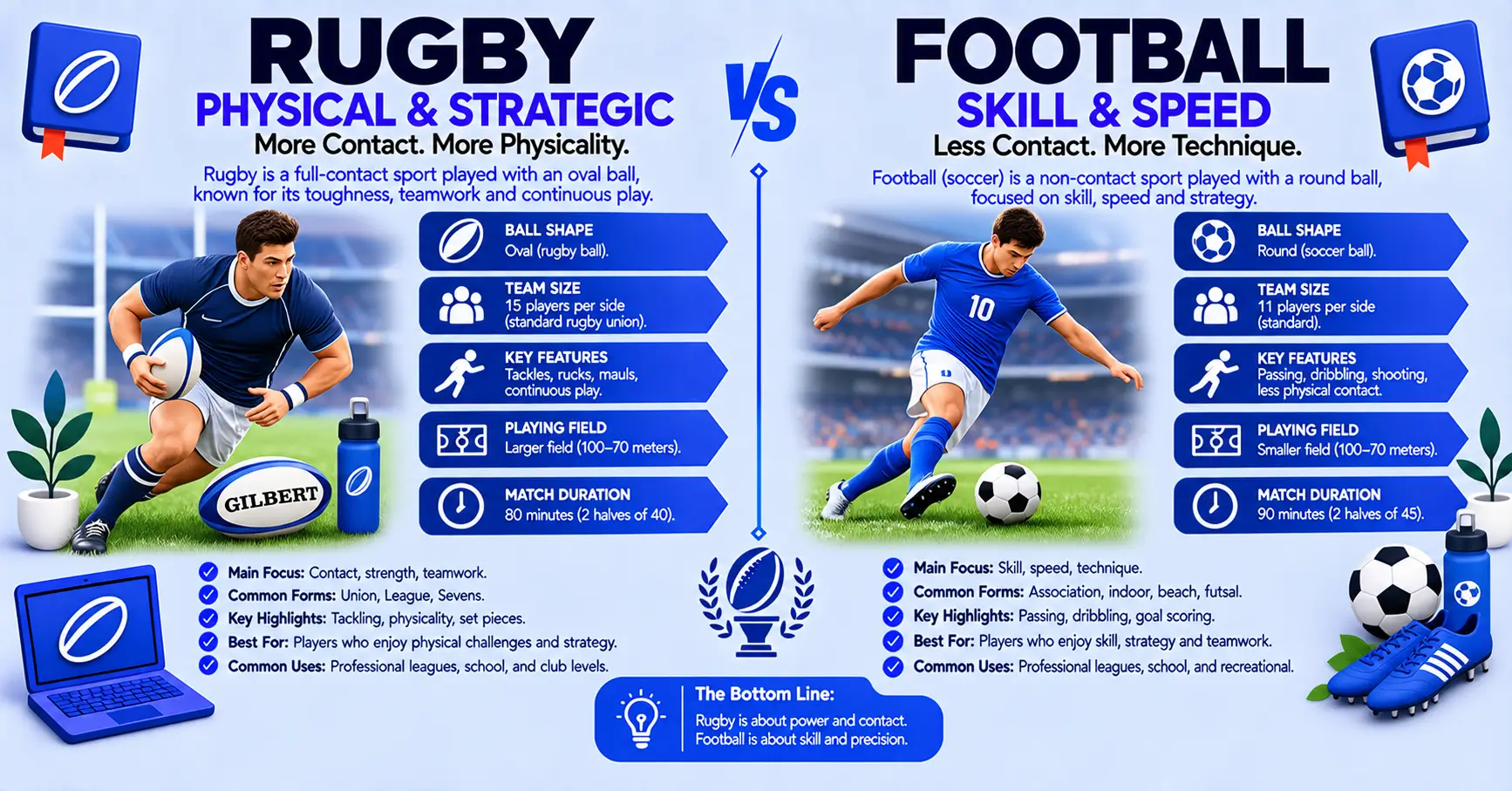
Rugby and football can look similar at first because both involve two teams, an oval-shaped ball, running, kicking, tackling, and scoring in an opponent’s territory. However, they are different sports with very different rules and styles of play.
One important terminology issue comes first: “football” can mean American football or association football (soccer), depending on where you live. In this comparison, football means American football, because that is the version most commonly contrasted directly with rugby in this context. A short explanation of rugby vs soccer appears later in the article.
The biggest difference is how the ball is advanced. In rugby, players can run with the ball and pass it backward or sideways, but a forward pass is not permitted. In American football, forward passing is a central part of the game, and teams use downs to advance the ball toward the opponent’s end zone.
Quick Answer
Rugby and American football are different contact sports with different rules, player roles, and game structures. Rugby normally has 15 players per team on the field and is played in two halves of up to 40 minutes. American football has 11 players from each team on the field at a time and has four 15-minute quarters in an NFL game.
The most important gameplay difference is passing: rugby does not allow a forward pass, while American football uses the forward pass as a major offensive weapon. Rugby also tends to have more continuous play, whereas American football is organized into individual plays separated by frequent stoppages.
Rugby vs Football at a Glance
| Feature | Rugby | American Football |
| Players on field | 15 in standard rugby union | 11 |
| Basic game structure | Two halves | Four quarters |
| Standard game time | Up to 80 minutes | 60 minutes of regulation |
| Forward pass | Not allowed | Allowed |
| Ball movement | Running, kicking, backward/lateral passing | Running, kicking, forward passing and laterals |
| Main scoring play | Try | Touchdown |
| Contact | Tackling and physical contests are integral | Tackling and blocking are integral |
| Protective equipment | Relatively limited | Extensive protective equipment |
| Possession structure | More continuous | Organized into downs |
| Major set pieces | Scrum, lineout, ruck, maul | Snap, scrimmage plays and special teams |
The rugby figures above refer to standard rugby union. World Rugby’s current laws specify no more than 15 players in the playing area and a match lasting no longer than 80 minutes. NFL rules and terminology describe 11-player formations, four downs to gain 10 yards, and 60 minutes divided into four 15-minute quarters.
What Is Rugby?
Rugby is a family of team sports that includes rugby union and rugby league. This article mainly refers to rugby union, the 15-a-side version governed internationally by World Rugby.
The basic objective is to score more points than the opposing team by carrying, passing, kicking, and grounding the ball. World Rugby describes the standard game as one involving two teams of 15 players, although modified forms such as rugby sevens and rugby tens use fewer players.
A distinctive feature of rugby is that play can continue after a tackle. The tackled player generally has to release the ball, allowing teammates and opponents to contest possession.
Rugby therefore combines running, passing, kicking, tackling, and contests for possession in a relatively continuous game.
What Is American Football?
American football is a field sport built around a sequence of offensive and defensive plays.
An offensive team attempts to advance the ball toward the opponent’s end zone. It has a series of downs to gain the required yardage. In the NFL, an offense normally has four downs to gain 10 yards for a new first down.
A quarterback commonly directs the offense and may hand the ball to a runner, run with it, or throw a forward pass to an eligible receiver.
Unlike rugby, American football has highly specialized offensive, defensive, and special-teams roles. Players can leave the field between plays, allowing teams to use different personnel for different situations.
What Is the Main Difference Between Rugby and Football?
The fundamental difference is how the two games organize possession and advance the ball.
In rugby, the game is built around continuous phases of play. Players can carry the ball, kick it, or pass it backward or sideways. A player cannot simply throw the ball forward to a teammate. World Rugby defines a forward throw or pass as a throw in which the passing player’s arms move forward.
American football is built around separate plays. A team can run the ball or use a legal forward pass. The NFL defines a forward pass as a pass thrown from behind the line of scrimmage toward an eligible receiver with the intention of advancing toward the opponent’s goal line.
That single difference produces very different tactics.
Passing
Rugby: passes must travel backward or laterally.
American football: a legal forward pass can move the ball directly downfield.
This is why the quarterback-to-receiver passing game is fundamental to American football, while rugby distributes ball-handling and passing responsibilities across many players.
Tackling
Both sports involve tackling, but what happens immediately afterward is very different.
In rugby, a tackle does not normally end the contest for possession. The tackled player must release the ball, and play can continue through phases such as a ruck.
In American football, the play normally ends when the ball carrier is ruled down. The teams then reset for the next down.
Blocking
Blocking is another major distinction.
American football uses blocking as a fundamental offensive and defensive technique. Players can create space for runners or protect the quarterback.
Rugby does not use blocking in the same organized way. Players cannot simply block an opponent to create a running lane for a teammate.
When to Use the Term “Rugby”
Use rugby when referring to the rugby family of sports, and specify rugby union or rugby league when the particular code matters.
For example:
- “I play rugby.”
- “The Rugby World Cup uses rugby union.”
- “Rugby league has different rules from rugby union.”
If you are discussing the 15-player version governed by World Rugby, rugby union is the most precise term.
When to Use the Term “Football”
Use American football when you want to distinguish the U.S. sport from other forms of football.
For example:
- “I watch American football.”
- “The quarterback threw a forward pass.”
- “The team needs one more first down.”
Simply saying football can be ambiguous for an international audience because in many countries, “football” means soccer.
That distinction is especially important for SEO content because a reader searching for “rugby vs football” may have either sport in mind.
Rugby and Football in Real-World Examples
Example 1: Forward Pass
Rugby:
A player cannot throw the ball forward to a teammate.
American football:
A quarterback can make a legal forward pass from behind the line of scrimmage.
The NFL specifically defines the forward pass as a downfield pass toward an eligible receiver.
Example 2: After a Tackle
Rugby:
Play can continue after the tackle, with the ball becoming available for the next phase.
American football:
The play ends when the ball carrier is down according to the rules, and the next down begins.
Example 3: Possession
Rugby:
Possession can move through several continuous phases.
American football:
Possession is structured around a sequence of downs.
Players and Positions
Rugby union normally has 15 players per team on the field. World Rugby divides the traditional lineup into forwards and backs, with players performing multiple responsibilities during open play.
American football has 11 players from a team on the field at a time, but teams commonly use specialized units and positions.
Typical American-football positions include:
- quarterback
- running back
- wide receiver
- tight end
- offensive lineman
- defensive lineman
- linebacker
- defensive back
- kicker
- punter
The quarterback, for example, receives the snap and may hand the ball to a runner, run, or attempt a forward pass.
This specialization is one reason American football can appear more structured than rugby.
Game Duration and Flow
A standard rugby union match lasts no longer than 80 minutes, divided into two halves of up to 40 minutes each.
An NFL game has 60 minutes of regulation time, divided into four 15-minute quarters.
However, the difference is not simply 80 minutes versus 60 minutes.
Rugby generally has a continuous flow of play, although there are stoppages for penalties, injuries, set pieces, and other situations.
American football is much more segmented. Each play begins with a snap and ends when the play is over, after which teams reset before the next play.
Scoring: Rugby vs Football
The scoring systems are different.
In rugby union, the main scoring play is a try. Teams can also score through conversions, penalty goals, and drop goals.
In American football, the main scoring play is a touchdown. The NFL lists a touchdown as worth six points. Teams can also score through field goals, safeties, and extra-point or two-point attempts.
A rugby try and an American-football touchdown are similar in the broad sense that both involve successfully reaching the opponent’s scoring area, but they are not governed by the same rules.
Equipment Differences
One of the easiest visual ways to distinguish the sports is equipment.
American football players normally wear substantial protective equipment, including helmets and pads. The NFL requires approved shoulder, thigh, and knee pads for players, with specific exceptions for certain positions.
Rugby players generally wear considerably less protective equipment. World Rugby classifies rugby as a physical-contact sport and places significant emphasis on playing within its safety laws.
This does not mean rugby is non-contact or American football is simply “more dangerous.” The sports distribute physical demands differently, so broad claims about which sport is tougher should be treated cautiously.
Ball and Field Differences
Both sports use an oval or prolate ball, but their balls are designed differently.
An NFL football has a pointed prolate-spheroid shape and is designed for throwing and catching. The NFL specifies a length of approximately 11 to 11¼ inches for its football.
A rugby ball is also oval but generally has rounder ends. Its design supports carrying, passing, kicking, and handling during continuous play.
The fields also look different. American football has prominent yard lines and end zones, reflecting its distance-and-down system. Rugby has different markings associated with its own scoring areas, halfway line, touchlines, and set pieces.
Common Mistakes About Rugby and Football
Mistake 1: “Rugby and American football are basically the same.”
Correct: They share historical and gameplay similarities, but they are different sports with different rules.
American football developed into its own distinct game, including the forward pass, downs, line of scrimmage, specialized positions, and extensive protective equipment.
Mistake 2: “Rugby players can pass the ball forward.”
Correct: A rugby player cannot make a forward throw or pass in normal open play. World Rugby specifically defines a throw forward as a forward movement of the passer’s arms when passing the ball.
Mistake 3: “A rugby match stops after every tackle.”
Correct: Rugby generally continues after tackles, creating successive phases of play.
Mistake 4: “Football always means American football.”
Correct: The meaning depends on regional usage.
In the United States and Canada, football commonly refers to American football. In many other countries, football means association football, which Americans usually call soccer.
Are Rugby and Football the Same Sport?
No. Rugby and American football are not the same sport.
They share historical connections and several basic characteristics, including running with an oval ball, tackling, kicking, and scoring in an opponent’s territory. However, their rules have developed in substantially different directions.
The most obvious differences are forward passing, downs, player specialization, tackling phases, equipment, scoring, and game structure.
World Rugby’s current laws and the NFL’s current rulebook demonstrate how differently the two sports regulate players, time, possession, passing, and scoring.
What If You Mean Soccer by “Football”?
This is an important distinction.
If by football you mean association football (soccer), then rugby is much more different.
Association football normally has a maximum of 11 players per team, including a goalkeeper.
The biggest difference is ball handling: outfield soccer players generally cannot deliberately handle the ball with their hands, whereas rugby is built around carrying and handling the ball.
Soccer also uses a round ball and focuses on scoring goals, while rugby uses an oval ball and permits carrying, passing, kicking, and grounding the ball.
Therefore:
- Rugby vs American football: both are contact sports with an oval ball and tackling.
- Rugby vs soccer: the sports have much less in common in their modern gameplay.
This terminology distinction is essential when interpreting the search query “difference between rugby and football.”
Can Rugby and Football Be Used Interchangeably?
No.
Rugby, American football, and association football are separate sports.
The word football itself can be used differently across countries, but that does not make rugby another name for either sport.
For precise writing, use:
- rugby union when discussing the 15-a-side rugby code
- rugby league when discussing the league code
- American football when referring to the U.S. gridiron sport
- association football or soccer when referring to the globally standardized football code
How to Remember the Difference
A simple memory rule is:
Rugby = continuous phases + backward/lateral passing.
American football = downs + forward passing.
If you remember only one gameplay distinction, remember the direction of the pass.
In rugby, the ball cannot normally be thrown forward to a teammate. In American football, the forward pass is one of the sport’s defining offensive tools.
Which One Should I Use?
Trying to identify the sport? Look for these key features:
15 players, continuous phases, rucks, scrums, and backward passes → rugby union.
A quarterback, 11 players, downs, a line of scrimmage, and forward passes → American football.
11 players, a round ball, goals, and mostly foot-based ball control → association football/soccer.
This is the quickest practical way to distinguish the three sports.
Rugby or Football? Practice Examples
Choose the sport that best matches each description.
- The quarterback throws a long pass to a receiver.
- A player is tackled and teammates immediately contest the ball.
- The team has four downs to gain 10 yards.
- A scrum is formed after a particular infringement or restart situation.
- The game is divided into four 15-minute quarters in the NFL.
- A player cannot make a forward pass to a teammate.
- A touchdown is scored in the opponent’s end zone.
- A standard rugby union team has 15 players on the field.
Answers
- American football
- Rugby
- American football
- Rugby
- American football
- Rugby
- American football
- Rugby union
Frequently Asked Questions
What is the main difference between rugby and football?
The main difference is the way the games advance the ball. Rugby does not allow a normal forward pass and uses continuous phases of play, while American football permits forward passing and organizes possession into downs.
Is rugby harder than American football?
There is no objective single answer. Rugby places heavy demands on continuous running, repeated involvement, tackling, and endurance, while American football emphasizes explosive plays, collisions, acceleration, specialized roles, and tactical execution. Calling one universally “harder” oversimplifies the differences.
How many players are in rugby compared with football?
Standard rugby union has up to 15 players per team on the field, while American football has 11 players per team on the field.
Can rugby players pass forward?
No. A normal rugby pass cannot be thrown forward. World Rugby’s laws specifically prohibit a throw forward.
Does American football allow forward passes?
Yes. A legal forward pass is a fundamental part of American football and is normally thrown by the quarterback from behind the line of scrimmage.
How long is a rugby game?
A standard rugby union match lasts no longer than 80 minutes, split into two halves of up to 40 minutes.
How long is an American football game?
An NFL game has 60 minutes of regulation playing time, divided into four 15-minute quarters, although the actual elapsed time is considerably longer because of stoppages.
Is rugby the same as soccer?
No. Rugby and association football (soccer) are separate sports with very different rules, balls, scoring systems, and methods of moving the ball.
Why is American football called football?
The term “football” has a long history and has been used for multiple football codes. American football developed from earlier forms of football, including rugby and association football traditions, and eventually developed its own distinctive rules.
Which sport has more protective equipment?
American football generally uses substantially more protective equipment than rugby. NFL players wear required protective pads and helmets, whereas rugby generally uses much less equipment.
Conclusion
The difference between rugby and football is much more than the shape of the ball. Rugby union is a 15-player, continuous-contact sport in which players carry, kick, and pass the ball backward or sideways. American football uses 11 players, a down-based structure, specialized positions, and legal forward passing.
The easiest rule to remember is simple: rugby relies on continuous phases and no forward passes, while American football is built around individual plays, downs, and forward passing.