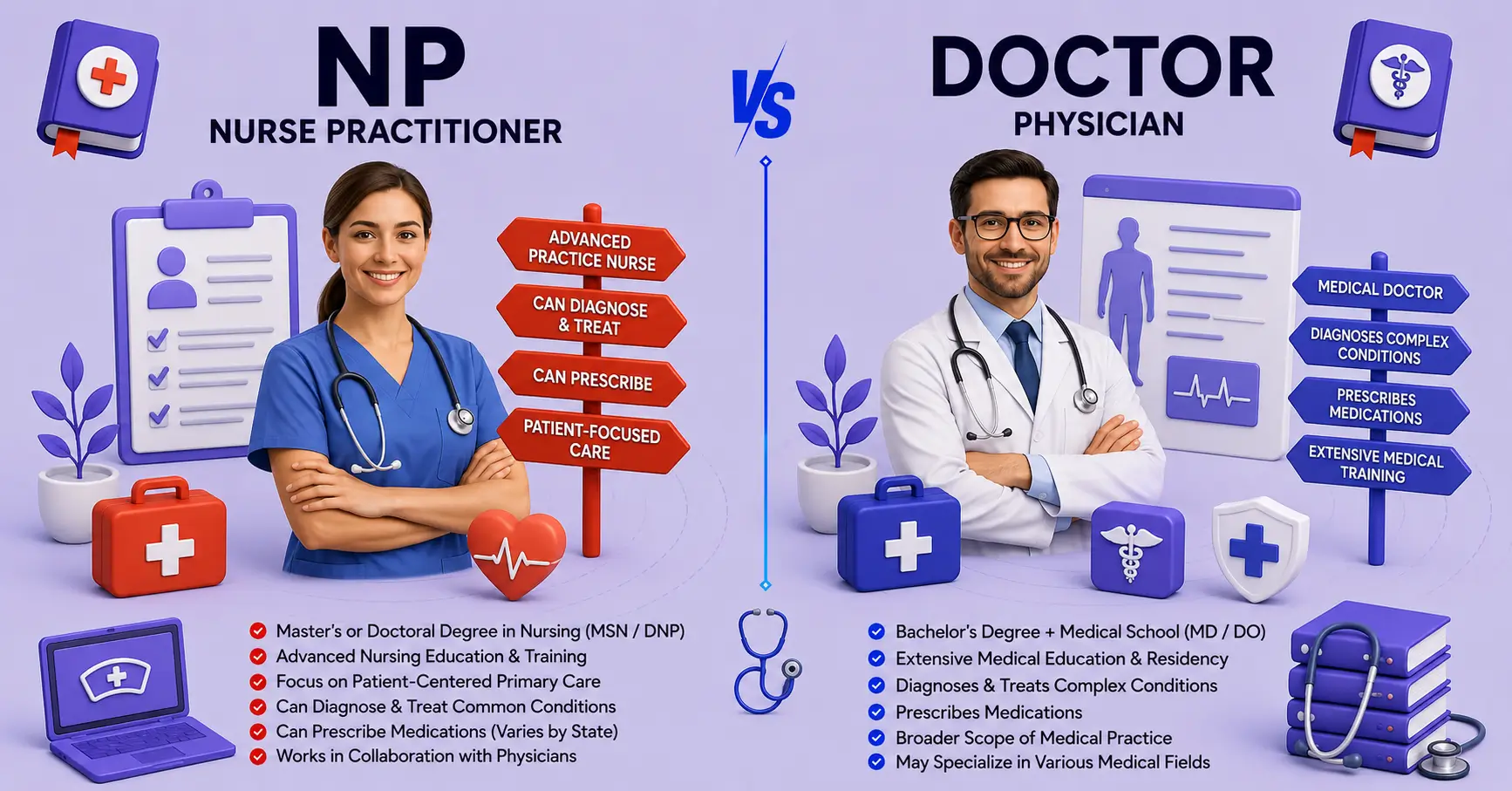

A nurse practitioner (NP) and a doctor can both evaluate patients, diagnose health conditions, recommend treatments, and, depending on the circumstances, prescribe medication. That overlap can make the two roles seem interchangeable. However, an NP and a physician are different healthcare professions with different educational pathways, training models, and legal scopes of practice.
The biggest difference is that an NP is an advanced practice registered nurse, while a physician is a medical doctor who completes medical school and residency training. NPs can provide a broad range of primary and specialty care, but their exact authority varies by state. Physicians have independent medical practice authority and can pursue the full range of medical specialties.
Quick Answer
An NP (nurse practitioner) is an advanced practice registered nurse who has graduate-level nursing education and specialized clinical training. A doctor, when the term means a physician, is an MD or DO who completes medical school followed by residency training.
Both can diagnose and treat patients, and NPs can prescribe medication within the authority permitted by applicable law. The major differences are their education, professional training, scope of practice, and clinical roles.
In simple terms:
NP = advanced nursing profession
Physician/doctor = medical profession
NP vs Doctor at a Glance
| Feature | Nurse Practitioner (NP) | Doctor (Physician) |
|---|---|---|
| Professional role | Advanced practice registered nurse | Physician |
| Common degrees | MSN or DNP | MD or DO |
| Educational model | Nursing + advanced practice education | Medical education + residency |
| Can diagnose? | Yes, within scope of practice | Yes |
| Can prescribe? | Yes, subject to state law and scope | Yes |
| Primary care | Common | Common |
| Specialty care | Yes, depending on specialty | Yes |
| Practice authority | Varies by state | Physicians practice independently |
| Residency | Not equivalent to physician residency | Required for physician specialty practice |
| Surgery | Limited to procedures within training/scope | Physicians can pursue surgical specialties |
What Is an NP?
NP stands for nurse practitioner.
A nurse practitioner is an advanced practice registered nurse who has completed graduate-level education and specialized clinical preparation. NPs can assess patients, diagnose conditions, develop treatment plans, provide preventive care, manage chronic conditions, and prescribe medications within the authority granted by state law and their professional scope.
The American Association of Nurse Practitioners describes full practice authority as allowing NPs to evaluate patients, diagnose conditions, order and interpret diagnostic tests, manage treatment, and prescribe medications under the authority of the state nursing board.
NPs can work in areas such as:
- Family practice
- Adult and gerontology care
- Pediatrics
- Women’s health
- Psychiatry and mental health
- Acute care
- Oncology
- Other specialized fields
The exact role depends on the NP’s education, certification, specialty, employer, and state regulations.
What Is a Doctor?
In this comparison, doctor means a physician, usually an MD (Doctor of Medicine) or DO (Doctor of Osteopathic Medicine).
Physicians complete medical school and then receive postgraduate clinical training through residency. A traditional U.S. medical school curriculum is four years, with students receiving both foundational scientific education and clinical experience.
MD and DO physicians can practice across a very wide range of specialties. Depending on their training, they may work in:
- Family medicine
- Internal medicine
- Pediatrics
- Emergency medicine
- Psychiatry
- Cardiology
- Neurology
- Dermatology
- Obstetrics and gynecology
- Orthopedics
- Surgery
- Many other specialties
MD and DO degrees both lead to physician practice in the United States, although osteopathic medical education includes additional emphasis on osteopathic principles and manipulative treatment.
What Is the Main Difference Between an NP and a Doctor?
The fundamental difference is how they are educated and trained and how their professional practice is structured.
An NP enters advanced practice through the nursing profession. The training builds on nursing education and advanced clinical practice.
A physician follows a medical education pathway that includes medical school and residency.
The two professions can therefore overlap in the care they provide, especially in primary care, without being the same profession.
1. Education
NPs generally complete graduate-level education in nursing. The Bureau of Labor Statistics lists a master’s degree as the typical entry-level education for nurse practitioners.
Physicians attend medical school for an MD or DO degree and then complete residency training. Medical school itself typically includes a combination of scientific instruction and clinical rotations.
2. Training
NP training emphasizes advanced nursing practice, patient care, assessment, diagnosis, treatment, prevention, and management within a chosen population or specialty.
Physician training provides extensive medical education followed by residency training in a specialty.
Therefore, saying that an NP and doctor have simply received “different amounts of the same training” would be misleading. Their professional education is structured differently from the beginning.
3. Scope of Practice
This is one of the most important differences.
NP practice authority varies according to state law. Some states give NPs broad independent practice authority, while other states require varying degrees of collaboration, supervision, or restrictions.
The AANP specifically notes that state laws differ in how NP practice is authorized.
Physicians have independent medical practice authority after meeting the requirements for physician licensure.
Can an NP Diagnose Patients?
Yes.
Nurse practitioners can diagnose medical conditions within their education, certification, and legal scope of practice.
They may:
- Evaluate symptoms
- Take medical histories
- Perform physical examinations
- Order diagnostic tests
- Interpret test results
- Diagnose conditions
- Develop treatment plans
- Manage chronic conditions
The exact authority depends on state law and the NP’s specialty and scope.
Can an NP Prescribe Medication?
Yes, but the legal authority varies by state.
Some states grant NPs full prescriptive authority, while other states impose restrictions or require collaboration or supervision for certain aspects of practice.
For this reason, it is inaccurate to say that every NP has exactly the same prescribing authority in every state. State law must be considered.
Physicians have prescribing authority as part of their licensed medical practice.
NP vs Doctor for Primary Care
This is where the roles can overlap considerably.
Both NPs and physicians may provide:
- Routine checkups
- Preventive care
- Health screenings
- Diagnosis of common conditions
- Treatment of illnesses
- Chronic disease management
- Medication management
- Patient education
Because of this overlap, a patient may receive very similar types of primary care from an NP and a physician.
However, the provider’s education and professional scope remain different.
The Bureau of Labor Statistics notes that advanced practice registered nurses perform many of the same services as physicians and are increasingly used in preventive, primary, and acute care.
When Should You See an NP?
An NP can be an appropriate choice for many routine and ongoing healthcare needs, particularly when the NP’s specialty matches the patient’s needs.
For example, an NP may be a good choice for:
- Routine primary care
- Preventive healthcare
- Common illnesses
- Medication management
- Follow-up appointments
- Chronic disease management
- Health education
- Some urgent-care needs
The important question is not simply whether the provider is an NP. It is whether the NP’s specialty and scope match the patient’s healthcare needs.
When Should You See a Doctor?
A physician may be especially appropriate when a patient has:
- A complex or unusual medical problem
- A condition requiring highly specialized medical expertise
- A need for a physician-only service in a particular setting
- A condition requiring complex surgery or a specialized procedure
- A problem that falls outside the NP’s scope or specialty
This does not mean an NP cannot recognize a complex problem. An NP can evaluate a patient and determine when referral or physician involvement is appropriate.
Healthcare is often collaborative rather than a simple choice between two competing professions.
Are NPs and Doctors the Same?
No.
They are different professions.
However, they can perform some of the same tasks, particularly in primary care.
An NP is an advanced practice nurse, while a physician is a medical doctor. Their educational pathways, professional models, and legal scopes are different.
So it is more accurate to say:
NPs and physicians can provide overlapping healthcare services, but they are not the same profession.
Is an NP a Doctor?
Usually, when people say “doctor” in a medical setting, they mean a physician.
An NP may hold a doctoral nursing degree such as a Doctor of Nursing Practice (DNP). In an academic sense, that person has earned a doctoral degree. However, a DNP holder is not automatically a physician.
This distinction matters because the word doctor can refer to someone with a doctoral degree in different fields. A physician specifically has medical training and physician licensure.
For patient communication, identifying the professional role clearly—such as “nurse practitioner” or “physician”—helps avoid confusion.
NP and Doctor in Real-World Examples
Example 1: Routine Checkup
A patient needs an annual physical and preventive screening.
An NP or primary care physician may be appropriate.
The best choice can depend on availability, insurance, specialty, and the patient’s specific needs.
Example 2: Managing a Common Chronic Condition
A patient needs ongoing management for a condition such as hypertension.
An NP or physician may manage the condition, depending on the provider’s scope and the complexity of the case.
Example 3: Complex Surgical Condition
A patient needs evaluation for a condition requiring major surgery.
A physician with the appropriate surgical specialty would generally be the relevant provider.
Example 4: Mental Health Care
A patient needs treatment for a psychiatric condition.
A psychiatric mental health NP or psychiatrist may be appropriate, depending on the patient’s needs and the professional’s scope.
Common Mistakes About NP vs Doctor
Mistake 1: “An NP is just a nurse.”
Why it is incorrect:
An NP is an advanced practice registered nurse with graduate-level preparation and a specialized clinical role.
Mistake 2: “Every NP must work under a doctor.”
Why it is incorrect:
NP practice authority varies by state. Some states allow full practice authority, while others have restrictions.
Mistake 3: “NPs cannot diagnose.”
Why it is incorrect:
Diagnosis is part of NP practice within the applicable scope of practice.
Mistake 4: “An NP is the same as an MD.”
Why it is incorrect:
NPs and physicians have different professional education and training pathways.
Mistake 5: “Doctor always means physician.”
Why it can be misleading:
A person with a doctoral degree may use the title doctor in an academic or professional context without being a physician.
Common Questions About NP vs Doctor
What is the difference between an NP and a doctor?
An NP is an advanced practice registered nurse with graduate-level nursing education, while a physician is an MD or DO who completes medical school and residency. Both can diagnose and treat patients, but their training and scope of practice differ.
Is an NP as qualified as a doctor?
The question is better framed as whether the provider is qualified for the patient’s particular healthcare need. NPs are highly trained clinicians who can provide many types of primary and specialty care. Physicians undergo a different and generally longer medical training pathway.
Can an NP prescribe medication?
Yes. NPs can prescribe medication within the authority allowed by state law and their professional scope.
Can an NP be a primary care provider?
Yes. NPs can serve as primary care providers, subject to applicable state law, certification, and scope of practice.
Do doctors have more training than NPs?
Physicians generally complete a longer medical education and postgraduate training pathway. NPs follow an advanced nursing pathway that includes graduate-level education and clinical preparation.
Are NPs and doctors interchangeable?
Not completely.
There is substantial overlap in some areas of patient care, especially primary care, but their professional training and scopes are different.
Is an NP better than a doctor?
There is no universal answer.
The appropriate provider depends on the patient’s condition, the provider’s specialty, the complexity of the problem, and applicable scope-of-practice rules.
How to Remember the Difference
Use this simple rule:
NP = advanced nursing practice
Doctor/physician = medical practice
Both can care for patients, but they arrive at that role through different professional pathways.
Which One Should I Use?
Use an NP when you need care that falls within the NP’s specialty and scope, particularly routine, preventive, primary, or chronic-care services.
Choose or seek a physician when your condition requires specialized medical expertise, complex evaluation, surgery, or care beyond the NP’s scope.
If an NP encounters a condition requiring additional expertise, the NP can refer the patient to an appropriate physician or specialist.
The goal is not to decide which profession is universally better. The goal is to match the provider’s training and scope to the patient’s needs.
NP or Doctor? Practice Examples
Choose NP or Doctor in each situation:
- You need a routine primary-care appointment.
- You need management of a chronic condition.
- You need evaluation for a highly complex condition.
- You need major surgery.
- You need preventive healthcare.
- You need medication management.
- You need specialized psychiatric care.
- You need a routine follow-up appointment.
Answers
- NP or Doctor
- NP or Doctor, depending on complexity and scope
- Doctor/appropriate specialist, depending on the condition
- Doctor/surgeon
- NP or Doctor
- NP or Doctor, depending on scope and situation
- NP or Doctor, depending on the professional’s specialty
- NP or Doctor, depending on the reason for follow-up
The important point is that the answer often depends on the specific healthcare need, not simply the provider’s title.
Conclusion
The difference between an NP and a doctor is mainly their professional pathway, education, training, and scope of practice. A nurse practitioner is an advanced practice registered nurse who can provide diagnosis, treatment, prevention, and other clinical services within their specialty and legal authority. A physician is an MD or DO who completes medical school and residency training.

Sajid Ali is an English language educator and content specialist with 7+ years of teaching experience. He holds master’s degrees in Information Technology and Education from the Virtual University of Pakistan and writes SEO-optimized, learner-friendly vocabulary content for diffari.com.