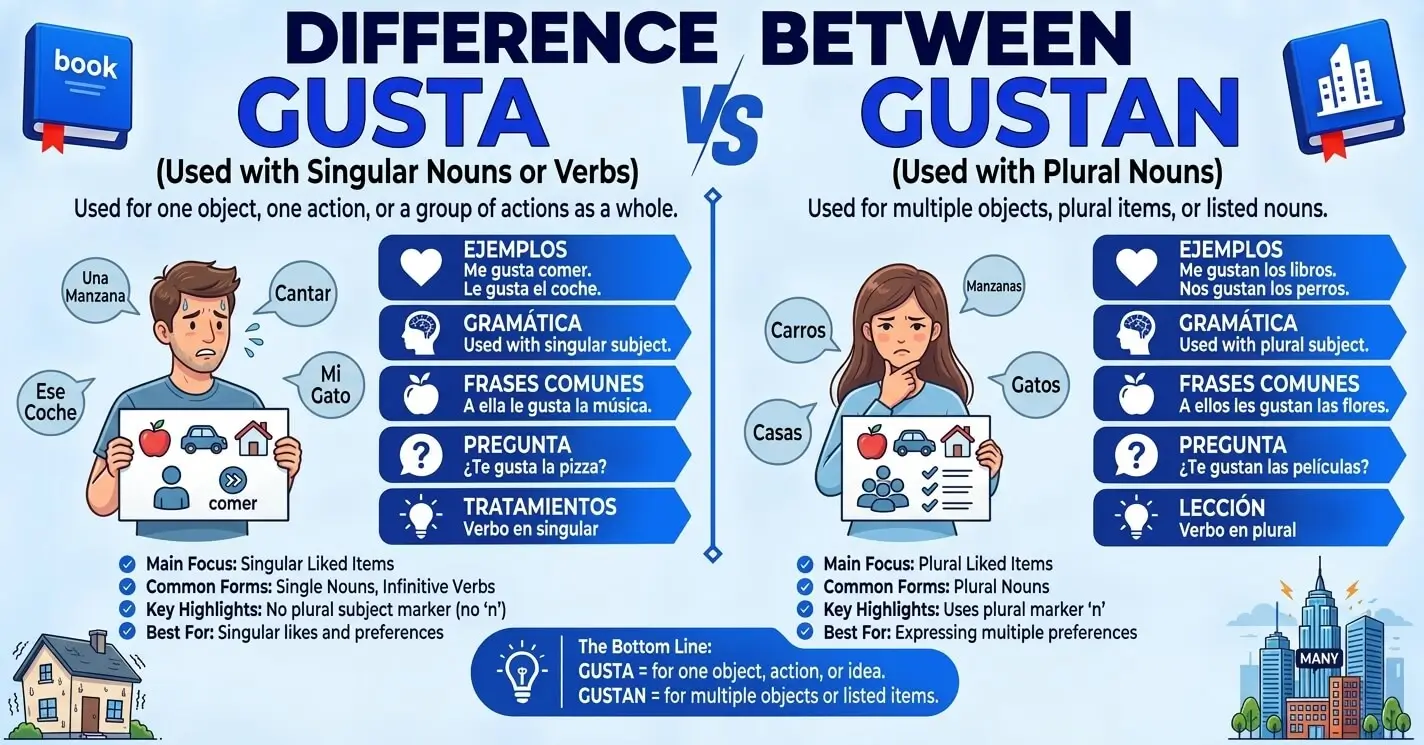
If you are learning Spanish, gusta and gustan can be confusing because they do not work exactly like the English verb “like.” Both forms come from gustar, but you choose between them based mainly on the number of things being liked.
The basic rule is simple: use gusta with a singular noun or an infinitive verb, and use gustan with a plural noun. The important part is understanding why the verb changes.
Quick Answer
Gusta is used when the thing being liked is singular or when the sentence is followed by an infinitive verb.
- Me gusta el café. — I like coffee.
- Me gusta bailar. — I like dancing.
Gustan is used when the thing being liked is plural.
- Me gustan los libros. — I like books.
- Me gustan las películas. — I like movies.
The key rule is:
Gustar agrees with what is liked, not with the person who likes it.
Gusta vs. Gustan at a Glance
| Feature | Gusta | Gustan |
|---|---|---|
| Basic use | Singular thing or activity | Plural things |
| Noun | Singular | Plural |
| Infinitive | Yes | No |
| Example | Me gusta el libro. | Me gustan los libros. |
| Meaning | I like the book. | I like the books. |
What Does Gusta Mean?
Gusta is the singular form commonly used with gustar when the grammatical subject is singular.
For example:
Me gusta el chocolate.
Here, el chocolate is singular, so the verb is gusta.
You can also use gusta before an infinitive:
Me gusta leer.
Me gusta cocinar.
Me gusta viajar.
An infinitive such as leer, cocinar, or viajar functions as the activity being liked, so the singular form gusta is used.
More Examples With Gusta
- Me gusta la música.
- Me gusta el fútbol.
- Me gusta esta canción.
- Me gusta mi ciudad.
- Me gusta estudiar español.
- Me gusta caminar por la mañana.
In each example, the thing or activity being liked is treated as singular.
What Does Gustan Mean?
Gustan is the plural form of gustar used when the grammatical subject is plural.
For example:
Me gustan los libros.
The subject los libros is plural, so gustan is required.
Other examples include:
- Me gustan los perros.
- Me gustan las películas.
- Me gustan las flores.
- Me gustan estos zapatos.
- Me gustan las canciones españolas.
- Me gustan los deportes.
The important point is that me does not determine whether you use gusta or gustan. The number of the thing being liked does.
Why Does Gustar Work This Way?
This is the part that causes the most confusion for English speakers.
In English, we normally say:
I like coffee.
The subject is I, and the verb is like.
Spanish structures the gustar construction differently:
Me gusta el café.
A useful literal way to understand this is:
“Coffee is pleasing to me.”
In this structure, el café is the grammatical subject, while me identifies the person experiencing the preference.
That explains why the verb changes:
- Me gusta el café.
- Me gustan los libros.
The person remains me, but the thing being liked changes from singular to plural.
When to Use Gusta
Use gusta when the thing being liked is singular.
1. Singular nouns
Me gusta el chocolate.
Me gusta la playa.
Me gusta este restaurante.
Me gusta tu idea.
2. Infinitive verbs
Use gusta when you are talking about liking an activity expressed with an infinitive.
Me gusta correr.
Me gusta leer.
Me gusta cocinar.
Me gusta aprender español.
Even if an activity involves many actions, the infinitive construction takes gusta.
3. A single idea or activity
You can also use gusta when the sentence presents an activity or concept as one idea.
Me gusta viajar.
Me gusta trabajar desde casa.
Me gusta aprender idiomas.
The practical question is:
Is the thing being liked singular, or is it an infinitive activity?
If yes, gusta is normally the form you need.
When to Use Gustan
Use gustan when the thing being liked is plural.
Me gustan los libros.
Me gustan las películas.
Me gustan las montañas.
Me gustan mis amigos.
Me gustan las canciones de este album.
Here, the subjects—libros, películas, montañas, amigos, and canciones—are plural.
Two or More Nouns
When two or more nouns are joined together, the subject is plural:
Me gustan el café y el té.
Me gustan las manzanas y las naranjas.
Me gustan el verano y la primavera.
The presence of multiple nouns makes gustan appropriate.
Gusta and Gustan in Sentences
Compare these pairs:
Singular vs. Plural
Me gusta el perro.
I like the dog.
Me gustan los perros.
I like dogs.
Me gusta la canción.
I like the song.
Me gustan las canciones.
I like the songs.
Me gusta la película.
I like the movie.
Me gustan las películas.
I like the movies.
Me gusta este libro.
I like this book.
Me gustan estos libros.
I like these books.
The change in the noun from singular to plural causes the change from gusta to gustan.
Other Pronouns With Gusta and Gustan
The same agreement principle works with other indirect object pronouns.
| Person | Singular | Plural |
|---|---|---|
| I | me gusta | me gustan |
| You | te gusta | te gustan |
| He/She/You formal | le gusta | le gustan |
| We | nos gusta | nos gustan |
| You plural / They | les gusta | les gustan |
Examples:
Te gusta el café.
You like coffee.
Te gustan los libros.
You like books.
Le gusta la música.
He/She likes music.
Le gustan las películas.
He/She likes movies.
Nos gusta viajar.
We like traveling.
Nos gustan los deportes.
We like sports.
Changing me to te, le, nos, or les does not change the basic rule. The thing being liked still determines gusta or gustan.
Common Mistakes With Gusta and Gustan
Mistake 1: Using Gusta With a Plural Noun
Incorrect:
Me gusta los libros.
Correct:
Me gustan los libros.
Why:
Los libros is plural, so the verb must be gustan.
Mistake 2: Using Gustan With an Infinitive
Incorrect:
Me gustan viajar.
Correct:
Me gusta viajar.
Why:
It is an infinitive activity, so the normal construction is me gusta viajar.
Mistake 3: Saying Yo Gusto to Mean “I Like”
Incorrect for this meaning:
Yo gusto el café.
Correct:
Me gusta el café.
Why:
The gustar construction identifies the person who experiences the liking with an indirect object pronoun such as me, while the thing liked functions as the subject.
Mistake 4: Thinking “Me” Determines the Verb
Some learners see me and automatically memorize me gusta as one fixed phrase.
But me only tells you who experiences the preference.
Compare:
Me gusta la canción.
Me gustan las canciones.
The pronoun stays me, while the verb changes because the subject changes from singular to plural.
Can Gusta and Gustan Be Used Interchangeably?
No. They are not normally interchangeable when they are being used in the standard gustar construction.
Use:
gusta → singular noun or infinitive
gustan → plural noun
For example:
Me gusta el libro.
but:
Me gustan los libros.
Using the wrong form creates a subject-verb agreement error.
A Useful Clarifying Structure: A Mí Me…
Spanish can add a phrase such as a mí for emphasis or clarification:
A mí me gusta el café.
A mí me gustan los libros.
The phrase a mí identifies or emphasizes the person, while me remains the indirect object pronoun.
You can also see similar structures with other people:
A Juan le gusta la música.
A María le gustan las flores.
The same singular/plural agreement remains.
How to Remember the Difference
Don’t memorize:
me gusta = I like
and
me gustan = I like
as completely separate expressions.
Instead, remember this:
Look at the thing being liked.
If it is one thing:
gusta
If it is more than one thing:
gustan
If it is an infinitive activity:
gusta
A quick mental check is:
What is pleasing to me?
- One thing → gusta
- Multiple things → gustan
- One activity expressed by an infinitive → gusta
Which One Should I Use?
Use this simple decision guide:
For one singular thing, use GUSTA.
Me gusta el libro.
When you are talking about several things, use GUSTAN.
Me gustan los libros.
For an activity expressed with an infinitive, use GUSTA.
Me gusta leer.
When two or more nouns are the subject, use GUSTAN.
Me gustan el café y el té.more nouns → GUSTAN
Gusta or Gustan? Practice Examples
Choose gusta or gustan.
- Me ___ la música.
- Me ___ los perros.
- Me ___ viajar.
- Me ___ las películas.
- Me ___ este restaurante.
- Me ___ mis amigos.
- Me ___ cocinar.
- Me ___ estas canciones.
- Me ___ el chocolate.
- Me ___ los deportes.
Answers
- gusta — la música is singular.
- gustan — los perros is plural.
- gusta — viajar is an infinitive.
- gustan — las películas is plural.
- gusta — este restaurante is singular.
- gustan — mis amigos is plural.
- gusta — cocinar is an infinitive.
- gustan — estas canciones is plural.
- gusta — el chocolate is singular.
- gustan — los deportes is plural.
Frequently Asked Questions
What is the difference between gusta and gustan?
Gusta is used with a singular thing or an infinitive activity, while gustan is used with plural things.
Is it “me gusta” or “me gustan”?
Both are correct, depending on what follows. Say me gusta el libro but me gustan los libros.
Why don’t I say “yo gusto” for “I like”?
The gustar construction works differently from the ordinary English “I like” structure. The person experiencing the preference is represented by an indirect object pronoun such as me, while the thing liked determines the form of gustar.
Do I use gusta with verbs?
Yes. When gustar is followed by an infinitive such as leer, bailar, viajar, or cocinar, use gusta.
Me gusta leer.
Can I say “me gustan viajar”?
No. The standard construction is:
Me gusta viajar.
Does gustan always mean that I like many things?
It means the grammatical subject associated with gustar is plural. For example, me gustan los libros means that books are pleasing to me.
Is “a mí me gusta” different from “me gusta”?
The a mí phrase can add emphasis or clarify who the preference belongs to. The essential indirect object pronoun is still me.
Conclusion
The difference between gusta and gustan becomes much easier once you stop thinking of them as direct equivalents of the English verb “like.” In the common Spanish gustar construction, the thing being liked determines the verb form.
Use gusta with a singular noun or an infinitive activity:
Me gusta el libro.
Me gusta leer.
Use gustan with plural nouns:
Me gustan los libros.
The easiest rule to remember is: look at what is being liked, not who is doing the liking.