
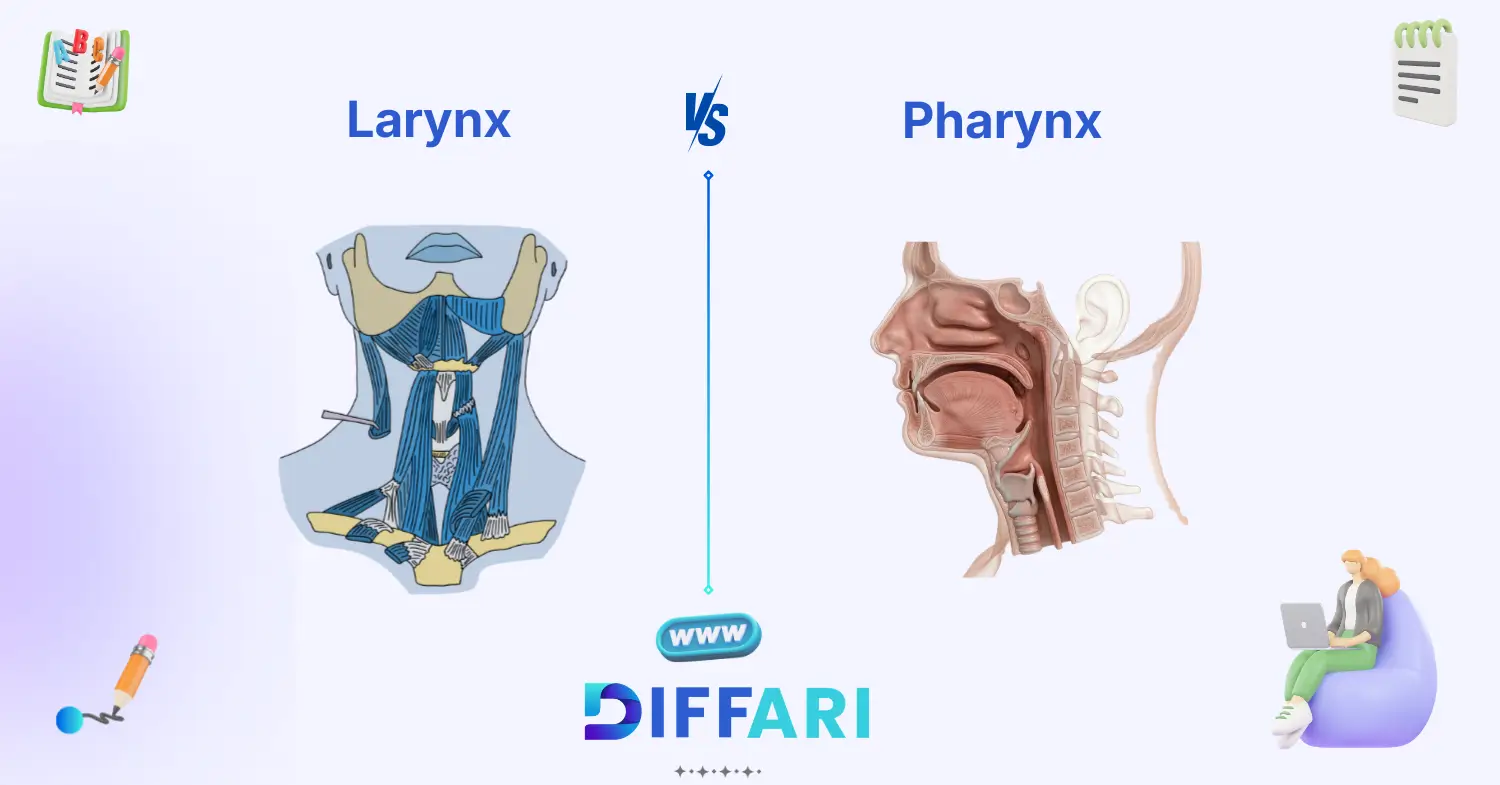

Difference between larynx and pharynx often confuses students in biology class. You may remember sitting in a lesson, trying to label a throat diagram, and wondering: “Which one helps me speak? Which one helps me swallow?”
The difference between larynx and pharynx becomes clear once you understand their roles in the body. Both are located in the throat area. Both are part of the respiratory system. Yet they serve different purposes.
The pharynx is a muscular tube behind the nose and mouth. It connects the nasal cavity to the esophagus and larynx. The larynx, often called the voice box, sits just below the pharynx and produces sound.
Understanding the difference between larynx and pharynx helps learners avoid exam mistakes and speak more confidently about anatomy. Let’s explore their key differences step by step.
Key Difference Between the Two
The main difference is function.
The pharynx acts as a shared passageway for air and food. It plays a role in both breathing and swallowing.
The larynx, on the other hand, focuses mainly on sound production and protecting the airway. It ensures that food does not enter the lungs.
In simple terms:
- The pharynx is a passage.
- The larynx is a voice-producing and protective structure.
Why Is Their Difference Necessary to Know
Students need to know this difference for exams, medical studies, and clear understanding of the human body. Mixing them up can lead to incorrect answers and confusion.
For professionals like doctors, nurses, and speech therapists, this knowledge is essential. A problem in the larynx affects speech. A problem in the pharynx affects swallowing or breathing.
In society, correct understanding improves health awareness. People can better describe symptoms to doctors. Now, let’s look at how to pronounce these words correctly.
🔊 Pronunciation
Larynx
US: /ˈler.ɪŋks/
UK: /ˈlær.ɪŋks/
Pharynx
US: /ˈfer.ɪŋks/
UK: /ˈfær.ɪŋks/
Notice how both words end in “-rynx.” This similarity often causes confusion. Now, let’s define each clearly.
📚 Core Definitions
Larynx
The larynx is a short structure made of cartilage, muscles, and vocal cords. It sits between the pharynx and the trachea. The Larynx produces sound when air passes through the vocal cords.
It also protects the airway during swallowing.
Example:
Speaking in Class – When you answer a question aloud, your larynx produces the sound.
Pharynx
The pharynx is a muscular tube located behind the nose and mouth. It connects to both the larynx and the esophagus. The pharynx allows air to pass to the lungs and food to pass to the stomach.
It does not produce sound directly.
Example:
Swallowing Water – When you drink water, it passes through the pharynx before entering the esophagus.
📚 10 Clear Differences Between Larynx and Pharynx
1. Primary Function
The larynx produces sound and protects the airway.
The pharynx acts as a passage for air and food.
Example for Larynx:
Singing a Song – The larynx creates vocal sounds.
Example for Pharynx:
Eating a Sandwich – Food moves through the pharynx.
2. Role in Speech
The larynx contains vocal cords.
The pharynx does not contain vocal cords.
Example for Larynx:
Public Speaking – The larynx controls pitch and volume.
Example for Pharynx:
Silent Breathing – Air passes without sound creation.
3. Structure
The larynx is made mainly of cartilage.
The pharynx is mostly muscular tissue.
Example for Larynx:
Voice Crack – Cartilage and cords adjust tension.
Example for Pharynx:
Swallowing Action – Muscles contract smoothly.
4. Location
The larynx sits below the pharynx.
The pharynx sits above the larynx.
Example for Larynx:
Neck Vibration – You can feel it when speaking.
Example for Pharynx:
Back of Throat Sensation – You feel it when swallowing.
5. Role in Breathing
The larynx directs air to the trachea.
The pharynx channels air from the nose/mouth downward.
Example for Larynx:
Deep Breath Before Speaking – Air moves into lungs.
Example for Pharynx:
Inhaling Through Nose – Air passes first through pharynx.
6. Protective Function
The larynx prevents food from entering the lungs.
The pharynx guides food safely to the esophagus.
Example for Larynx:
Cough Reflex – Protects lungs from choking.
Example for Pharynx:
Smooth Swallow – Directs food properly.
7. Medical Specialization
Voice specialists focus on the larynx.
ENT doctors treat pharyngeal infections.
Example for Larynx:
Hoarseness Treatment – Related to vocal cords.
Example for Pharynx:
Sore Throat – Often involves the pharynx.
8. Sound Production
The larynx creates sound vibrations.
The pharynx shapes resonance but does not create sound.
Example for Larynx:
Whispering – Controlled airflow through cords.
Example for Pharynx:
Echo Effect – Helps modify tone slightly.
9. Number of Parts
The larynx is one structure.
The pharynx has three parts: nasopharynx, oropharynx, laryngopharynx.
Example for Larynx:
Voice Box – Single organ.
Example for Pharynx:
Upper Throat Areas – Divided sections.
10. Educational Context
Students learn the larynx in speech units.
Students learn the pharynx in digestion units.
Example for Larynx:
Drama Class Lesson – Focus on vocal control.
Example for Pharynx:
Biology Lab Diagram – Focus on swallowing path.
🎯 Why Knowing the Difference Matters
Students must know the difference to avoid exam errors. Clear knowledge builds confidence in science subjects.
Professionals must know it for accurate diagnosis. A speech problem is not the same as a swallowing problem.
Clear communication prevents misunderstanding in medical settings.
Real‑World Consequences of Confusion
If someone says they have a “larynx infection” but actually mean throat infection, doctors may ask further questions. Accurate terms save time and improve treatment.
🧠 Why People Get Confused
Similar Spelling and Pronunciation
Both words end with “-rynx.” Their sounds are close. This similarity leads to confusion.
Semantic Overlap
Both belong to the throat region. Both are part of the respiratory system.
Context-Based Usage
Teachers often explain them in the same chapter.
Influence of Informal Speech
People say “throat” for both. This general term hides their differences.
🎭 Connotation & Emotional Tone
Connotation = the emotional meaning associated with a word.
Larynx
Positive:
Associated with singing and communication.
Example: “Her larynx allowed her to sing beautifully.”
Negative:
Linked to voice disorders.
Example: “The doctor examined his damaged larynx.”
Neutral:
Scientific discussion.
Example: “The larynx connects to the trachea.”
Pharynx
Positive:
Health and smooth swallowing.
Example: “The pharynx worked normally during the test.”
Negative:
Sore throat or infection.
Example: “The infection spread in the pharynx.”
Neutral:
Academic explanation.
Example: “The pharynx is part of the digestive system.”
🗣 Usage in Metaphors, Similes & Idioms
These terms rarely appear in idioms. However, they may appear in scientific metaphors.
Example Sentence:
“The singer’s larynx worked like a finely tuned instrument.”
“The cold air irritated his pharynx, like sandpaper against skin.”
Writers mostly use these words in medical or academic contexts.
📊 Comparison Table
| Feature | Larynx | Pharynx |
|---|---|---|
| Meaning | Voice box | Throat passage |
| Tone | Speech-related | Neutral anatomical |
| Usage | Sound production | Air & food pathway |
| Context | Speaking, breathing | Swallowing, breathing |
| Formality | Medical/academic | Medical/academic |
⚖️ Which Is Better in What Situation?
When to Use Larynx
Use “larynx” when discussing speech, voice, or vocal cords. For example, in singing lessons or speech therapy sessions.
When to Use Pharynx
Use “pharynx” when talking about swallowing, sore throat, or upper digestive system functions.
Situational Clarity
Choose the word based on function. If it involves sound, use larynx.
Contextual Correctness
In anatomy discussions, precise terms show expertise and accuracy.
📖 Literary or Cultural References
These terms appear mostly in medical or scientific works.
- Book: Gray’s Anatomy (Medical Textbook, Henry Gray, 1858) – Discusses both structures in detail.
- Movie: The Doctor (USA, 1991) – Explores medical experiences and throat conditions indirectly through patient care themes.
Writers rarely use these words in fiction unless discussing health or biology.
❓ FAQs
1. Is the larynx the same as the throat?
No. The throat is a general term. The larynx is a specific structure inside the throat that produces sound.
2. Can you live without a larynx?
Yes, but speaking becomes difficult. Doctors may perform surgery to remove it in serious illness cases. Patients then use alternative speaking methods.
3. Does the pharynx help in breathing?
Yes. Air passes through the pharynx before reaching the larynx and lungs. It plays a key role in respiration.
4. Why does my voice change during illness?
Illness often affects the larynx and vocal cords. Swelling changes sound production.
5. What causes sore throat pain?
Most sore throats involve inflammation in the pharynx. Infections or irritation usually cause it.
🏁 Conclusion
The difference between larynx and pharynx lies mainly in function. The larynx produces sound and protects the airway. The pharynx acts as a shared passage for air and food. Although they sit close together, they serve distinct roles in the body.
Understanding this difference improves academic performance and health awareness. It also strengthens communication skills in scientific discussions.
When you think about speaking, remember the larynx. When you think about swallowing, remember the pharynx.
Clear language creates clear thinking. Keep learning, keep asking questions, and your knowledge will grow stronger every day. 📘✨

Sajid Ali is an English language educator and content specialist with 7+ years of teaching experience. He holds master’s degrees in Information Technology and Education from the Virtual University of Pakistan and writes SEO-optimized, learner-friendly vocabulary content for diffari.com.