
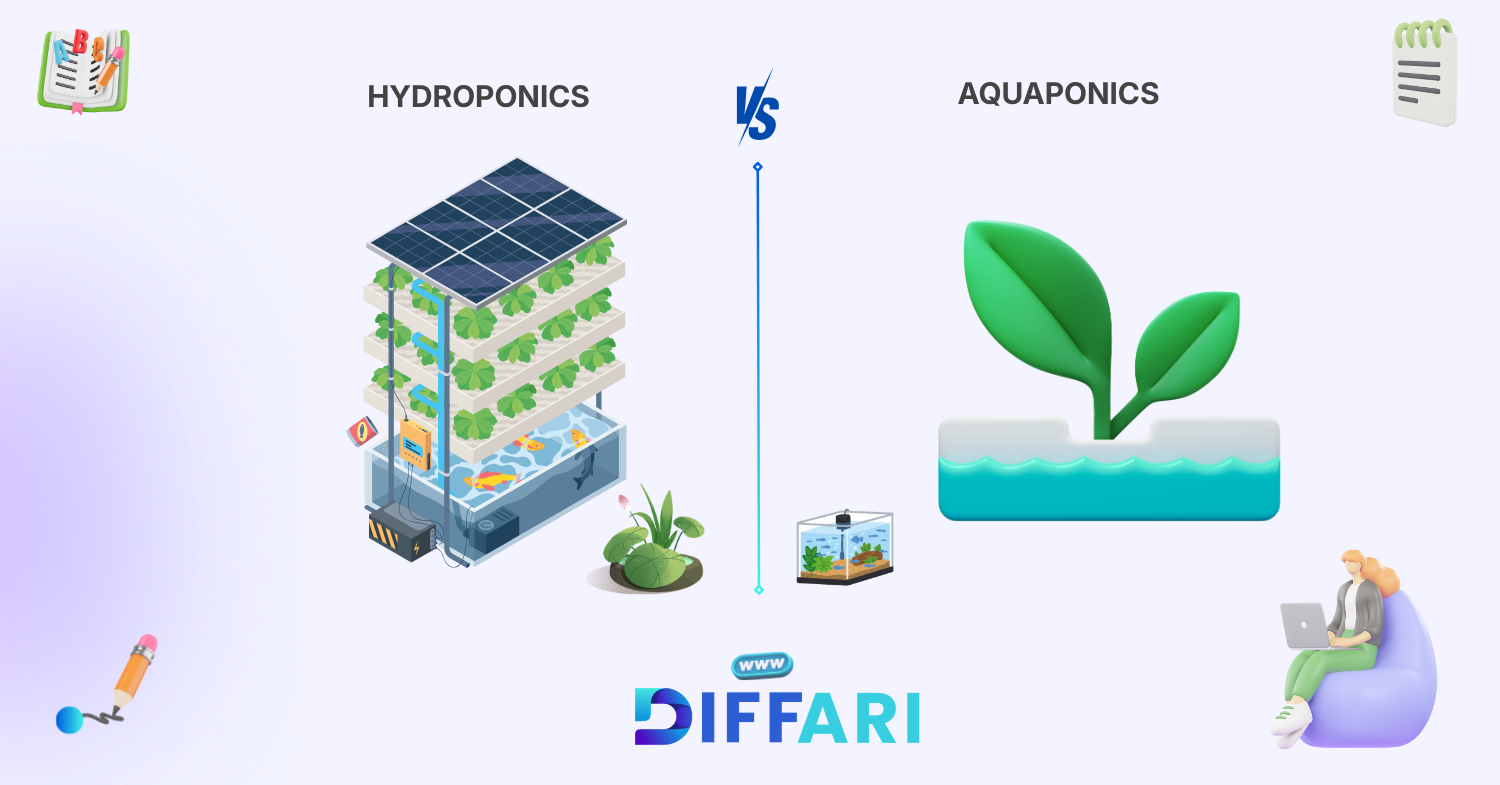

Difference between hydroponics and aquaponics often comes up when people explore modern farming or home gardening systems. Many beginners feel confused when they see these two terms in agriculture articles or videos.
A small home gardener may want to grow lettuce indoors and wonders whether hydroponics or aquaponics works better. Both systems grow plants without soil, but they operate in different ways.
Understanding the difference between hydroponics and aquaponics helps students, farmers, and researchers choose the right growing method. It also improves knowledge of sustainable and smart farming.
In this guide, you will clearly understand the difference between hydroponics and aquaponics, their meaning, and how they work in real-life farming systems before diving into detailed comparisons.
🌱 Key Difference Between the Two
The main difference between hydroponics and aquaponics lies in how nutrients reach the plants.
Hydroponics uses nutrient-rich water with added minerals to feed plants directly. Aquaponics uses fish waste to provide natural nutrients to plants through a biological cycle.
In simple terms, hydroponics depends on artificial nutrients, while aquaponics depends on a natural ecosystem involving fish and plants.
This core difference shapes their cost, maintenance, sustainability, and farming outcomes.
🎯 Why Is Their Difference Necessary to Know
Knowing the difference between hydroponics and aquaponics helps learners understand modern agricultural systems and sustainable food production. It builds awareness about water-saving and soil-free farming.
For professionals like farmers, agricultural engineers, and researchers, this knowledge improves decision-making and system design. Choosing the wrong system may increase costs and reduce productivity.
In society, sustainable farming is becoming essential due to climate change and food demand. Understanding these systems supports smarter farming choices and environmental protection 🌍
Now, let’s explore how these two terms are pronounced before moving to their definitions.
🔊 Pronunciation
Hydroponics
US: /ˌhaɪ.drəˈpɑː.nɪks/
UK: /ˌhaɪ.drəˈpɒn.ɪks/
Aquaponics
US: /ˌɑː.kwəˈpɑː.nɪks/
UK: /ˌæk.wəˈpɒn.ɪks/
Both words come from scientific and agricultural terminology. Clear pronunciation helps learners speak confidently in academic and professional discussions.
Now, let’s define hydroponics and aquaponics clearly before comparing them in detail.
📚 Core Definitions
Hydroponics
Hydroponics is a method of growing plants without soil by using water mixed with nutrients. Plants grow in a controlled environment where water delivers essential minerals directly to roots.
The tone of this term is scientific and modern because it represents advanced farming technology.
Example:
Example: The school built a hydroponics system to grow vegetables indoors.
Aquaponics
Aquaponics is a farming system that combines fish farming and plant growing in one ecosystem. Fish waste provides nutrients for plants, and plants clean the water for fish.
The tone of this term feels eco-friendly and sustainable because it creates a natural cycle.
Example:
Example: The farmer uses aquaponics to grow vegetables and raise fish together.
📚 10 Clear Differences Between Hydroponics and Aquaponics
1. Nutrient Source
Hydroponics uses chemical or mineral nutrient solutions to feed plants directly through water. Aquaponics uses fish waste as a natural nutrient source for plant growth.
Example for Hydroponics:
Example: The farmer added liquid nutrients to the hydroponics system.
Example for Aquaponics:
Example: The aquaponics system used fish waste to nourish the plants.
2. System Structure
Hydroponics focuses only on plant growth systems and water circulation. Aquaponics combines fish tanks, bacteria, and plant beds in one integrated system.
Example for Hydroponics:
Example: The hydroponics setup had pipes and nutrient tanks.
Example for Aquaponics:
Example: The aquaponics system included fish tanks and plant beds.
3. Maintenance Level
Hydroponics requires regular monitoring of nutrient levels and water quality. Aquaponics requires care for both fish and plants, which makes it more complex.
Example for Hydroponics:
Example: He checks nutrient levels daily in hydroponics.
Example for Aquaponics:
Example: She feeds fish and checks water balance in aquaponics.
4. Sustainability
Hydroponics uses artificial nutrients, so sustainability depends on resource management. Aquaponics is more eco-friendly because it uses a natural biological cycle.
Example for Hydroponics:
Example: Hydroponics saves water but uses chemical nutrients.
Example for Aquaponics:
Example: Aquaponics creates a natural and sustainable farming system.
5. Cost
Hydroponics usually costs less at the beginning because it needs fewer components. Aquaponics requires fish tanks, pumps, and filters, which increases initial cost.
Example for Hydroponics:
Example: A small hydroponics system is affordable for beginners.
Example for Aquaponics:
Example: Aquaponics needs more investment at the start.
6. Water Usage
Hydroponics saves water compared to soil farming but may require periodic replacement. Aquaponics reuses water continuously through fish and plant cycles.
Example for Hydroponics:
Example: The hydroponics system replaced water weekly.
Example for Aquaponics:
Example: Aquaponics recycled water naturally.
7. Learning Difficulty
Hydroponics is easier for beginners because it focuses only on plants. Aquaponics needs knowledge of fish care and biological systems.
Example for Hydroponics:
Example: Students started with hydroponics in school.
Example for Aquaponics:
Example: Experts handled aquaponics systems carefully.
8. Food Production
Hydroponics produces vegetables and herbs only. Aquaponics produces both vegetables and fish.
Example for Hydroponics:
Example: Hydroponics grows lettuce and tomatoes.
Example for Aquaponics:
Example: Aquaponics produces fish and vegetables together.
9. Environmental Impact
Hydroponics reduces soil use and land pressure. Aquaponics supports biodiversity and natural nutrient cycles.
Example for Hydroponics:
Example: Hydroponics works well in urban farming.
Example for Aquaponics:
Example: Aquaponics supports eco-friendly farming.
10. System Balance
Hydroponics depends on human control of nutrients and water. Aquaponics depends on natural balance between fish, plants, and bacteria.
Example for Hydroponics:
Example: Farmers control nutrients in hydroponics manually.
Example for Aquaponics:
Example: Aquaponics needs natural ecosystem balance.
🎯 Why Knowing the Difference Matters
Students benefit from understanding the difference between hydroponics and aquaponics because it improves their knowledge of modern agriculture and environmental science. It also supports academic learning and research.
Professionals such as farmers, researchers, and agricultural engineers need this knowledge to choose the right system for food production and sustainability goals. Proper understanding reduces mistakes and improves efficiency.
In society, smart farming helps solve food shortages and water problems. Knowing the difference helps communities adopt sustainable agricultural methods for future generations 🌱
Real‑world consequences of confusion
If a farmer chooses hydroponics instead of aquaponics without understanding the difference, they may lose the opportunity to produce fish and natural nutrients.
Similarly, choosing aquaponics without proper knowledge may increase system complexity and maintenance problems. Clear understanding prevents costly errors.
🧠 Why People Get Confused
Similar Scientific Names
Hydroponics and aquaponics sound similar because both end with “ponics.” This similarity makes them confusing for beginners.
Semantic Overlap
Both systems grow plants without soil. This shared feature creates misunderstanding between the two methods.
Context-Based Usage
Many agriculture articles mention both systems together. Readers often assume they work in the same way.
Influence of Informal Speech
People sometimes use hydroponics as a general term for all soil-free farming. This informal usage increases confusion.
🎭 Connotation & Emotional Tone
Connotation = emotional meaning attached to a word.
Hydroponics
Positive:
It suggests modern technology and efficient farming.
Example: Hydroponics offers a smart way to grow food.
Negative:
It may suggest artificial or chemical-based farming.
Example: Some people worry hydroponics uses chemicals.
Neutral:
It simply describes a soil-free plant-growing system.
Example: Hydroponics is common in urban farming.
Aquaponics
Positive:
It suggests eco-friendly and natural farming.
Example: Aquaponics supports sustainable agriculture.
Negative:
It may suggest complexity and high maintenance.
Example: Aquaponics requires careful monitoring.
Neutral:
It describes a system combining fish and plants.
Example: Aquaponics uses fish waste for nutrients.
Connotation (bold) = the emotional meaning associated with a word.
🗣 Usage in Metaphors, Similes & Idioms (If Applicable)
Scientific terms like hydroponics and aquaponics are not traditional idioms, but writers and educators sometimes use them in metaphors to explain sustainability and balance.
Hydroponics in Figurative Use
Hydroponics often symbolizes controlled growth and modern efficiency.
Example:
Example: His business strategy works like hydroponics, controlled and carefully managed.
Example:
Example: The school runs its learning system like hydroponics, structured and well‑planned.
This shows how hydroponics represents precision and human control.
Aquaponics in Figurative Use
Aquaponics usually represents balance, cooperation, and natural harmony.
Example:
Example: Their teamwork feels like aquaponics, where everyone supports each other.
Example:
Example: The community runs like aquaponics, balanced and sustainable.
This highlights cooperation and ecosystem thinking.
📊 Comparison Table
| Feature | Hydroponics | Aquaponics |
|---|---|---|
| Meaning | Soil-free plant growing using nutrients in water | Soil-free system combining fish and plants |
| Tone | Scientific and technological | Eco-friendly and natural |
| Usage | Indoor farming and controlled agriculture | Sustainable and integrated farming |
| Context | Urban farms, greenhouses, labs | Eco farms, sustainable agriculture |
| Formality | Technical and academic | Technical but environmentally focused |
This table gives a quick and clear overview of the difference between hydroponics and aquaponics.
⚖️ Which Is Better in What Situation?
When to Use Hydroponics
Hydroponics works best when you want fast plant growth and easy system control. It suits indoor farming, urban agriculture, and research labs. Small growers often choose hydroponics for simplicity.
When to Use Aquaponics
Aquaponics works best when you want sustainable farming and dual food production. It suits eco-farms and long-term agricultural systems. Farmers choose aquaponics for natural balance.
Situational Clarity
Hydroponics fits controlled environments and small spaces. Aquaponics fits larger and eco-friendly farming setups. The choice depends on goals and resources.
Contextual Correctness
In academic and farming discussions, using the correct term shows expertise. Clear usage prevents misunderstanding and improves communication.
📖 Literary or Cultural References
Book Reference
Aquaponic Gardening (Non-fiction, Sylvia Bernstein, 2011)
This book explains how aquaponics works in home and commercial farming systems.
Book Reference
Hydroponic Food Production (Non-fiction, Howard M. Resh, 2012)
This book discusses hydroponics technology and controlled environment agriculture.
Media Reference
Sustainable (USA, 2016 Documentary)
This documentary highlights modern farming systems including hydroponics and aquaponics.
These references show the importance of both systems in modern agriculture.
❓ FAQs
1. Is aquaponics better than hydroponics?
Aquaponics is not always better than hydroponics. It depends on the goal of farming. Aquaponics is more sustainable, but hydroponics is easier to manage. Beginners often start with hydroponics first.
2. Which system is cheaper?
Hydroponics is usually cheaper to start because it needs fewer components. Aquaponics requires fish tanks and biological systems, which increase cost. However, aquaponics may save money in the long term.
3. Can hydroponics work without electricity?
Most hydroponics systems need electricity for water pumps and lights. Some passive systems can work with minimal power. However, modern hydroponics usually depends on electricity.
4. Do aquaponics systems need fish all the time?
Yes, fish are essential in aquaponics because they provide nutrients for plants. Without fish, the system cannot maintain its natural cycle. Fish and plants depend on each other.
5. Which system is better for beginners?
Hydroponics is better for beginners because it is simple and easier to manage. Aquaponics requires knowledge of fish care and ecosystem balance. Beginners usually learn hydroponics first.
🏁 Conclusion
The difference between hydroponics and aquaponics mainly lies in how plants receive nutrients and how the system operates. Hydroponics uses nutrient-rich water, while aquaponics uses a natural fish-based ecosystem.
Understanding this difference helps learners, farmers, and researchers choose the right farming method for their needs. It also supports sustainable agriculture and smart food production.
Both systems offer valuable solutions for modern farming, especially in urban and water-scarce areas. Choosing the right method depends on resources, knowledge, and long-term goals.
Keep exploring agricultural innovations, learn practical applications, and build deeper understanding of sustainable farming to make smarter and eco-friendly decisions in the future 🌱

Sajid Ali is an English language educator and content specialist with 7+ years of teaching experience. He holds master’s degrees in Information Technology and Education from the Virtual University of Pakistan and writes SEO-optimized, learner-friendly vocabulary content for diffari.com.